How to Identify Old Stamps: Paper, Print, Perforation and Watermark
Classic and 19th-century stamps can be dated by hand, without an app: the paper they are printed on, the printing method, the perforation gauge and the watermark each narrow the field before you ever open a catalogue. This guide runs that sequence in order for classic material, then shows how to convert the result into an exact issue and subtype.
Photo-First Speed
Try this in the app now.
Run a quick photo scan to narrow candidates, then use this old-stamp method for technical confirmation.
AI-powered suggestions, fast scan, free to install.
Classic Issues
Start with era clues, then narrow into technical identifiers.
This visual block sets the guide flow: date first, authenticate second, and only then match detailed catalog subtypes.
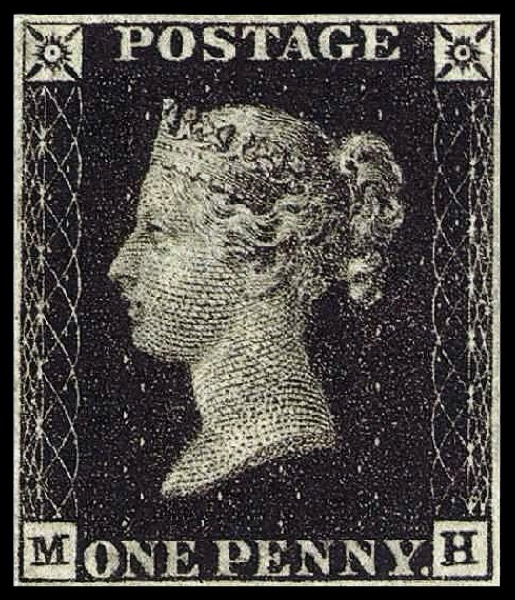
Image: Penny Black, General Post Office of the United Kingdom. Public domain, via Wikimedia Commons.
1) Date the stamp by era before searching catalogs
Estimate a stamp's age first from visual clues such as portrait style, typography, currency format, and cancellation type, then place it in a roughly 20-30 year window before opening any catalog. Trying to match exact catalog numbers too early creates noise, so use the table below to narrow the historical period.
| Era clue | What to inspect | Practical meaning |
|---|---|---|
| Portrait style | Monarch profile, engraving style, frame ornamentation | Narrows country and period quickly |
| Typography | Letter shape, spacing, serif style | Helps separate reissues and reprints |
| Currency format | Old monetary symbols and denominations | Connects to specific historical periods |
| Cancellation style | Town marks, bars, numerals, date stamp type | Verifies timeframe and usage |
Free · iOS & Android
Skip the catalogue: photograph the stamp
StampID reads country, era, catalogue listing and a value range from one photo of the front. Scan first, then use this guide to verify the details.
2) Confirm technical identifiers
The four technical identifiers that separate near-identical classic stamps are perforation gauge, watermark, paper type, and printing method. Many classic-era variants look identical at first glance, so these measured checks are often the decisive evidence.
- Perforation: measure both directions if possible. Record as x/y when uneven.
- Watermark: inspect with safe fluid or backlight method.
- Paper: note thickness, mesh, and tone.
- Printing method: engraving vs lithography changes line texture.
- Country text and language
- Observed era estimate
- Denomination/currency
- Perforation readings
- Watermark result
- Condition faults (thins, tears, repairs)
3) Authentication risk points
The most common authentication risks on old stamps are forgeries, reperforated edges, added fake postmarks, and chemically cleaned or repaired examples. Classic stamps attract these alterations because age raises perceived value, so authentication starts with skepticism toward anything that looks too good for its age.
High-risk warning signs
- Suspiciously bright paper tone on supposed 19th-century material.
- Cut or reperforated edges to mimic better centering.
- Postmarks that look added to improve desirability.
- Color inconsistencies that may indicate chemical cleaning.
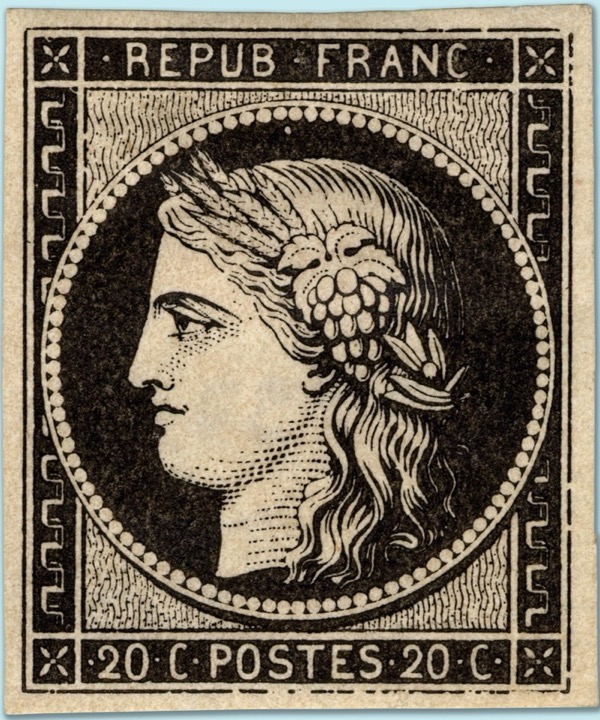
France Ceres 20c noir, 1849. Design by Jacques-Jean Barre. Public domain, via Wikimedia Commons.
4) Match catalogs efficiently
Match catalogs from broad to narrow: start with the country and era section, then the design family and denomination, and only last confirm the technical subtype. When you have enough markers, work through this order:
- Country main section and era.
- Base design family and denomination.
- Technical subtype (watermark/perforation/paper).
- Condition-adjusted value notes.
If one technical marker conflicts, do not force a match. Mark the ID as provisional and continue evidence gathering.
5) What to do after identification
After you identify an old stamp, continue with valuation and rarity screening:
- Stamp Value Checker Guide for range-based pricing.
- Rare Stamps Worth Money for scarcity validation.
- Identify by Photo workflow to improve documentation quality.
- How Much Is My Stamp Worth? for beginner-friendly valuation steps.
Try this in the app now.
Scan your next classic stamp in StampID and apply the era and technical checks from this guide.
Free install for faster historical identification.
Editorial note: Potentially high-value classic stamps should be reviewed by qualified experts before sale or insurance declarations.
Frequently Asked Questions
How can I tell how old a stamp is?
Estimate a stamp's age from its visual and technical clues rather than a printed date, since most stamps carry no year. Portrait style, denomination and currency format, typography, and the cancellation type usually place a stamp within a 20-30 year window, and technical markers such as perforation gauge, watermark, and printing method then narrow it to a specific issue. Imperforate stamps, for example, generally predate the 1850s-1860s for most countries.
How do I identify an old stamp without the country name?
Identify a stamp with no country name using its design, currency, and script, because many early issues omitted the country by convention. The clearest example is the United Kingdom, which still never prints its name on stamps and instead uses the monarch's silhouette. Match the portrait, the monetary unit (such as pence, centimes, or kreuzer), the alphabet, and any cancellation town marks against catalog illustrations to determine the issuing country.
Are stamps without perforations older?
Imperforate (unperforated) stamps are usually older, since the earliest stamps from 1840 onward were issued without perforations and had to be cut apart with scissors. Perforation machines came into widespread use in the 1850s and 1860s, so a genuinely imperforate stamp often dates to that early era. However, modern reprints, proofs, and deliberately imperforate special issues also exist, so use perforation as one dating clue rather than proof of age.
Does an old stamp being rare mean it is valuable?
Age alone does not make a stamp valuable, because value depends on scarcity, condition, and collector demand together. Many 19th-century stamps were printed in millions and remain inexpensive, while condition faults such as thins, tears, or heavy cancels sharply reduce price. A common old stamp in poor condition can be worth less than a scarce modern one, so confirm rarity and grade before assuming worth.
How do I know if an old stamp is genuine or a forgery?
Check an old stamp for forgery by comparing its paper tone, perforation edges, color, and postmark against authenticated catalog references. Suspiciously bright paper on supposed 19th-century material, reperforated or trimmed edges, postmarks that look added, and colors altered by chemical cleaning are common red flags. For potentially high-value classic stamps, obtain a certificate from a recognized expertizing body before buying, selling, or insuring.