How to Identify US Stamps: Complete Guide by Era
The United States has issued postage stamps since 1847, producing thousands of distinct varieties that range from common definitives worth a few cents to rarities valued at over a million dollars. Identifying a US stamp accurately requires examining its design, perforation gauge, paper type, watermark, and printing method. This guide walks you through every major era of US philately and the specific markers that distinguish each period.
Identify US Stamps Instantly
Snap a photo of any stamp and let StampID's AI tell you the country, era, Scott number, and estimated value in seconds.
Download Free on Google PlayUS Stamp History at a Glance
US stamp production divides into four main eras: Early Classics (1847–1869), the Bank Note Era (1870–1893), Bureau Issues (1894–1938), and the Modern Era (1938–present), each with distinctive printing techniques and design conventions. Identifying which era your stamp belongs to is the first and most important step in identification.
- 1847–1869 — Early Classics (imperforate, then first perforated issues, grills)
- 1870–1893 — Bank Note Era (multiple private printers, secret marks)
- 1894–1938 — Bureau Issues (government-printed, watermarked paper, flat and rotary press)
- 1938–present — Modern Era (Presidential series, commemoratives, self-adhesives)
Free · iOS & Android
Skip the catalogue: photograph the stamp
StampID reads country, era, catalogue listing and a value range from one photo of the front. Scan first, then use this guide to verify the details.
Early Classics (1847–1869)
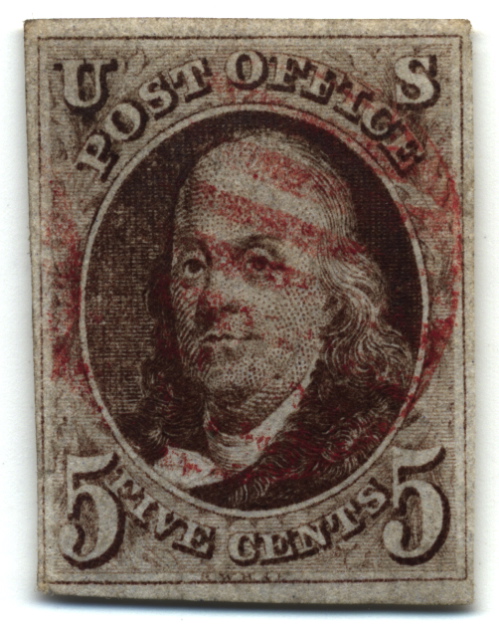
The first US stamps were issued on July 1, 1847: a 5-cent Benjamin Franklin (Scott #1) and a 10-cent George Washington (Scott #2). These stamps were imperforate—printed in sheets and cut apart with scissors or a knife—so their margins are irregular.
Key identification features
- No perforations (1847–1856): All stamps before 1857 are imperforate. If your stamp has clean-cut straight edges on all four sides and features Franklin or Washington, it may be from the 1847 issue.
- First perforated issues (1857–1861): Perforation 15 was introduced. The same designs as the imperforate issues were reissued with perforations, creating entirely different Scott numbers (e.g., Scott #18 vs. Scott #1).
- 1861–1869 designs: New designs during the Civil War era feature Franklin (1c), Jackson (2c), Washington (3c), Lincoln (15c), and others. Look for the distinctive "grill" pattern embossed into stamps from 1867–1869—small waffle-like impressions pressed into the paper to prevent stamp reuse by making the paper absorb cancellation ink more thoroughly.
- Paper: Thin to medium, usually bluish or grayish tint. Some 1847 issues appear on slightly brownish paper.
Understanding grills
Grills are small embossed patterns pressed into the paper to help ink absorb and prevent stamp reuse. They were used primarily on the 1867–1869 issues. Grills appear as a rectangular area of tiny raised or indented bumps. An essential identification detail is the orientation of the grill points: earlier grills have points up (pushed into the paper from the back, so points face upward on the front), while later grills have points down (pressed from the front, points visible on the back). This orientation helps distinguish grill types and detect forgeries. Grill varieties include:
- A Grill: Covering the entire stamp. Extremely rare.
- B Grill: 18×15mm. Scarce.
- C Grill: 13×16mm.
- D Grill: 12×14mm.
- E Grill: 11×13mm. Most common early grill.
- F Grill: 9×13mm. Most common overall.
- Z Grill: 11×14mm. Extremely rare—the 1-cent Z Grill (Scott #85A) is one of the most valuable US stamps.
1869 Pictorial Issue
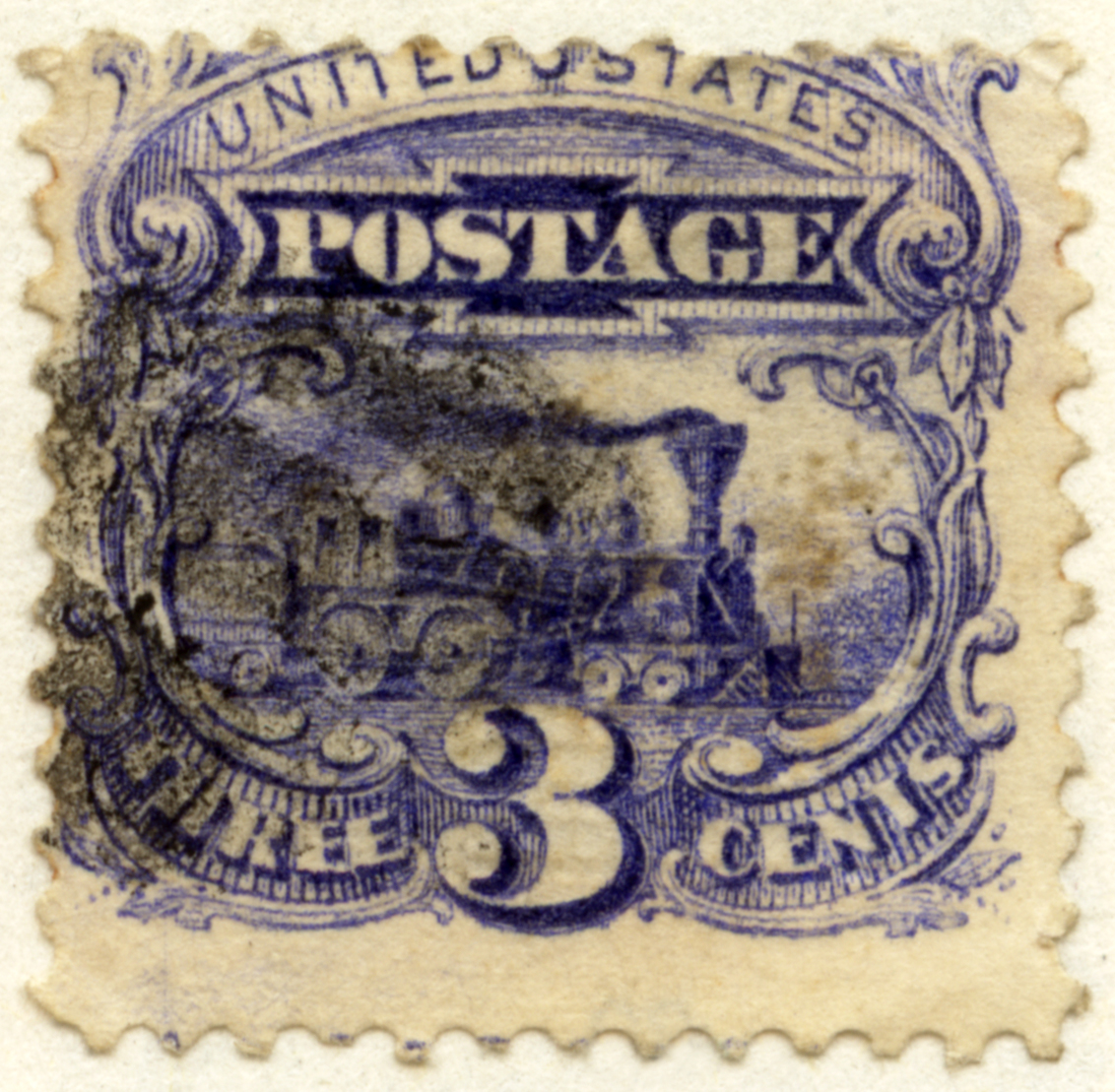
The 1869 Pictorial Issue (Scott #112–#122) marked a dramatic departure from US stamp design. For the first time, stamps featured subjects beyond presidential portraits: a locomotive (#114), a shield and eagle (#116), the SS Adriatic steamship (#117), the landing of Columbus (#118–#119), the signing of the Declaration of Independence (#120), and a shield with flags (#121). These bi-color stamps were printed in two passes, which occasionally resulted in the center vignette being printed upside down. The resulting inverts—Scott #119b (15c), #120b (24c), and #121b (30c)—are among the most prized US stamp errors, with values ranging from tens of thousands to over a million dollars.
What 1847 five-cent stamps sell for at auction
The 1847 5-cent Franklin (Scott #1) is scarce but not unobtainable — roughly 3,700 covers and many thousands of used singles survive. At auction, a sound used copy with red cancel and clear margins typically brings $300–$700; four-margin examples with sharp cancels reach $1,000–$2,000+, while copies with faults (thins, close-cut margins, heavy cancels) often sell for $100–$250. Unused examples are genuinely rare and start in the mid four figures. The 10-cent Washington (Scott #2) is several times scarcer: used singles usually realise $700–$1,500+, and covers command strong premiums. Values swing sharply on margins, cancellation colour, and certification — for stamps at this level a certificate from the Philatelic Foundation or APS adds real money at sale. See our 1847 Franklin deep-dive for identification points and forgery warnings, and the stamp valuation guide for how to grade condition before estimating.
Bank Note Era (1870–1893)
Three private companies printed US stamps between 1870 and 1893—National Bank Note Company (1870–1873), Continental Bank Note Company (1873–1879), and American Bank Note Company (1879–1893)—and the key to telling them apart is the "secret marks" Continental added to many designs in 1873. The designs are otherwise nearly identical across all three printers, making identification a genuine challenge.
Distinguishing the three printers
- National Bank Note (1870–1873): Printed on hard white paper. No secret marks. The earliest 1870 printings carried over the grill from the preceding era (Scott #134–#144 with grills; #145–#155 without grills).
- Continental Bank Note (1873–1879): Introduced "secret marks"—small design additions to help distinguish their printings. For example, the 1-cent Franklin received a small curved line in the ball of the numeral "1"; the 2-cent Jackson shows a small dash under the tip of the left ribbon.
- American Bank Note (1879–1893): Printed on softer, more porous paper that absorbs ink differently. Colors tend to appear slightly duller. Same secret marks as Continental, but the paper is the key differentiator.
1893 Columbian Exposition Issue
The 1893 Columbian Exposition stamps (Scott #230–#245) were the first US commemorative stamps, issued to mark the World’s Columbian Exposition in Chicago. The series featured 16 values from 1 cent to $5, each depicting a scene from the life of Columbus. The high-value stamps—especially the $4 Isabella (Scott #244) and the $5 Columbus (Scott #245)—were expensive even at face value and remain highly sought after. A mint $5 Columbian can catalog for several thousand dollars.
Bureau Issues (1894–1938)
In 1894 the Bureau of Engraving and Printing (BEP) took over US stamp production. This era introduced watermarked paper and eventually rotary press printing, both of which are critical identification markers.
Watermark identification
Bureau Issues used two main watermark types, visible when a stamp is placed face-down in watermark fluid:
- USPS single-line watermark (1895–1910): Letters "USPS" in a single line, spaced across the sheet. Each stamp shows only a portion of a letter or sometimes no visible watermark at all.
- USPS double-line watermark (1910–1916): "USPS" in double-line block letters. Easier to detect than single-line.
- Unwatermarked (1916 onward): After 1916, watermarked paper was discontinued. If your Bureau Issue stamp shows no watermark, it dates to 1916 or later.
Flat press vs. rotary press
Starting in 1919, the BEP began using rotary presses alongside flat-bed presses. Rotary press stamps are slightly taller or wider than flat press stamps because the curved printing plate stretches the design:
- Flat press stamps: Measure approximately 19–19.5mm × 22–22.5mm for standard-size definitives.
- Rotary press stamps: Measure approximately 19.5–20mm × 22.5–23mm. The difference of roughly 0.5mm is detectable with a good ruler or perforation gauge.
Washington-Franklin Issues (1908–1922)
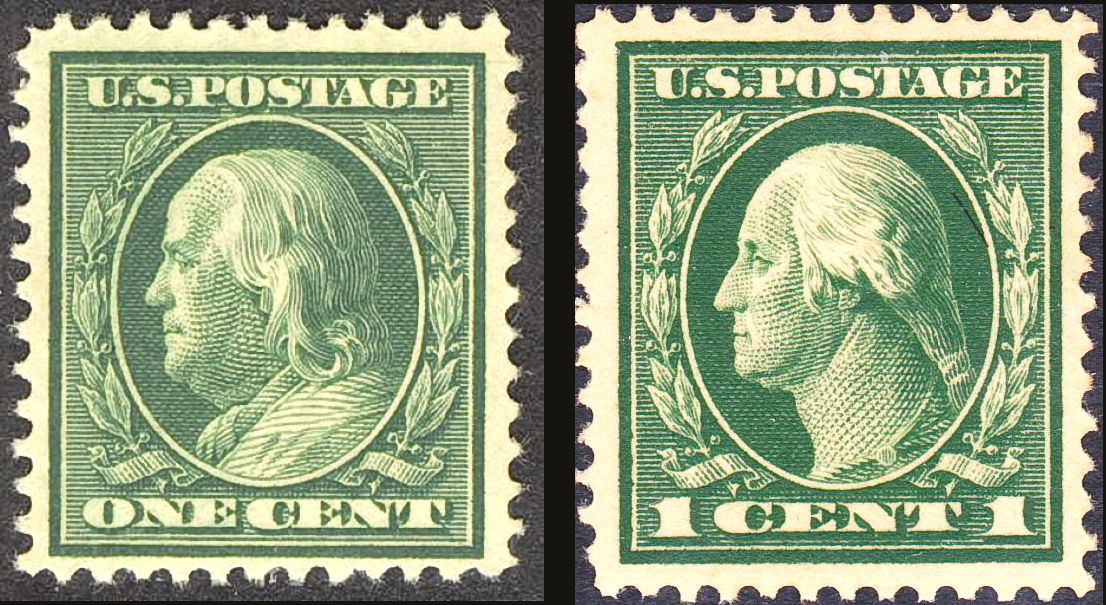
The Washington-Franklin series is one of the most complex areas of US philately. Although the stamps share only two basic portrait designs—George Washington and Benjamin Franklin—the series comprises hundreds of distinct varieties. Collectors must examine multiple identification markers simultaneously: single-line vs. double-line watermark (or no watermark), flat press vs. rotary press printing, perforation gauge (perf 12, 11, 10, or 8½), and subtle design types (Types I through VII for some denominations). A seemingly ordinary 2-cent Washington can range from a few cents to thousands of dollars depending on these characteristics. The Scott US Specialized catalog devotes many pages to this series alone.
Coil stamps
The US began issuing coil stamps in 1908 for use in vending machines and affixing machines. Coil stamps are perforated on two sides only—either top and bottom (for horizontal coils) or left and right (for vertical coils)—with straight edges on the other two sides. Identifying genuine coils is a particular challenge because trimmed sheet stamps can mimic the straight-edge appearance. Key markers include: paste-up pairs (where one coil strip was spliced to the next), line pairs (showing a colored guide line between two stamps from the flat-plate printing process), and slight size differences on rotary press coils. Expertization is strongly recommended for valuable early coil issues.
Modern US Stamps (1938–Present)
Modern US stamps run from the 1938 Presidential Series through today's self-adhesive Forever stamps, and most are common—valued at or near face value—with the era defined by definitive sets (Presidential, Liberty, Prominent Americans) and an expanding annual program of commemoratives.
Presidential Series (1938)
The 1938 Presidential Series (Scott #803–#834) featured every US president from Washington through Coolidge, with denominations from ½c to $5. These are common but form an attractive set for beginners. See every value pictured in our complete guide to the 1938 Presidential Series, including how to tell the scarcer coil and booklet stamps from ordinary sheet stamps.
Liberty Series (1954) and Prominent Americans (1965)
The Liberty Series introduced larger-format definitives, while the Prominent Americans series shifted to notable figures beyond presidents. Both are readily available in used condition.
Commemoratives and special issues
Since the 1940s, the USPS has issued dozens of commemorative stamps each year. Key identification points include:
- Size: Commemoratives are typically larger than definitives.
- Denomination placement: Modern commemoratives show the denomination prominently, often with "USA" and "FOREVER" (from 2007 onward).
- Self-adhesive vs. lick-and-stick: After 1992, most US stamps transitioned to self-adhesive backing. Water-activated stamps became uncommon after 2000.
Perforation Gauges for US Stamps
Perforation gauge—the number of perforation holes in a 2cm span—is one of the most important tools for US stamp identification. Common US gauges include:
- Perf 15: First US perforated issues (1857–1861).
- Perf 12: Standard for most Bank Note and early Bureau issues.
- Perf 11: Common on Bureau Issues from 1908 onward.
- Perf 10: Used on some rotary press coils and sheet stamps (1920s).
- Perf 11×10.5 or 10.5×11: Compound perforations found on certain Bureau Issues. Measuring both horizontal and vertical gauges separately can reveal scarce varieties.
Scott Catalog Numbering Basics
The Scott catalog is the standard reference for US stamps. Numbers are assigned chronologically, with letter prefixes for special categories:
- No prefix: Regular postage stamps (Scott #1 through the thousands).
- C: Airmail stamps (C1–C150).
- E: Special delivery.
- J: Postage due.
- O: Official stamps.
- Q: Parcel post.
When buying or selling, always reference the Scott number to avoid ambiguity. A "1-cent Franklin" could be dozens of different stamps; "Scott #300" is exactly one.
US Stamp Errors & Varieties Worth Money
Printing errors and scarce varieties can make otherwise common stamps extraordinarily valuable. The most famous US errors and varieties include:
| Stamp | Scott # | Year | Estimated Value |
|---|---|---|---|
| 1-cent Z Grill (rare grill variety) | 85A | 1868 | $3,000,000+ |
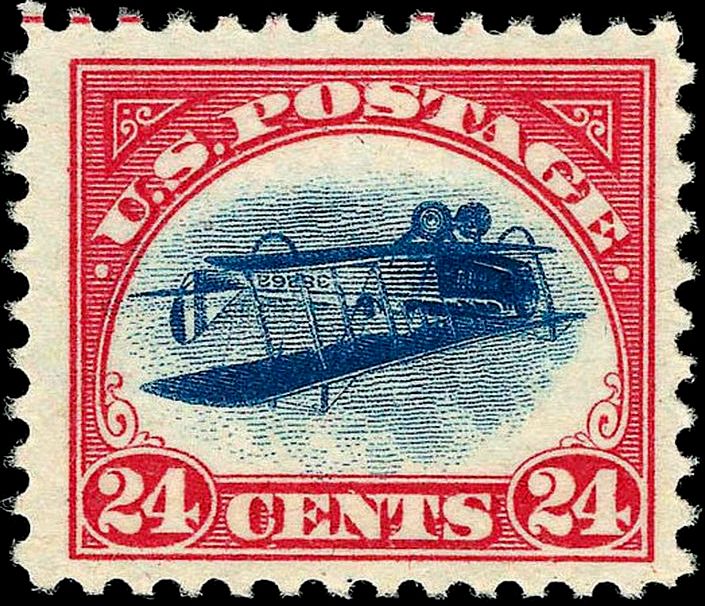
| Inverted Jenny (24c airmail, inverted center) | C3a | 1918 | $150,000–$1,600,000+ |
| 1869 Pictorial 15c invert (Columbus landing) | 119b | 1869 | $100,000–$500,000+ |
| 1869 Pictorial 24c invert (Declaration of Independence) | 120b | 1869 | $200,000–$1,000,000+ |
| 1869 Pictorial 30c invert (shield with flags) | 121b | 1869 | $200,000–$1,000,000+ |
| CIA Invert (Americana Series) | 1610d | 1979 | $15,000–$25,000 |
| Dag Hammarskjold invert | 1204 | 1962 | $5–$15 (intentionally reprinted) |
| Legends of the West recalled sheet (Bill Pickett) | 2870 | 1994 | $200–$500 per sheet |
Quick-Reference: US Stamps by Era
| Era | Key Features | Typical Scott # | Value Range |
|---|---|---|---|
| 1847 Issue | Imperforate, Franklin & Washington designs | 1–2 | $500–$200,000+ |
| 1851–1856 | Imperforate, expanded denominations | 5–17 | $25–$50,000+ |
| 1857–1861 | First perforations (perf 15) | 18–39 | $15–$30,000+ |
| 1861–1869 (Civil War) | New designs, grills introduced | 63–101 | $5–$50,000+ |
| 1870–1893 (Bank Note) | Secret marks, three printers | 134–229 | $1–$5,000+ |
| 1894–1938 (Bureau) | Watermarks, flat/rotary press | 246–834 | $0.25–$35,000+ |
| 1938–1970s | Presidential/Liberty/Prominent Americans | 803–1400s | $0.10–$50 |
| 1980s–present | Commemoratives, self-adhesives, Forever stamps | 1400s–present | Face value–$10 |
Tips for Beginners Examining US Stamps
- Always handle stamps with stamp tongs (tweezers)—skin oils damage paper and ink over time.
- Use a perforation gauge on every stamp. Two stamps that look identical may have different perforations and vastly different values.
- Check for watermarks using watermark fluid and a dark tray. Never skip this step with pre-1917 Bureau Issues.
- Examine color carefully under natural daylight. Artificial light can distort shades, and color varieties can be worth significant premiums.
- Measure stamp dimensions with a millimeter ruler to distinguish flat press from rotary press printings.
- Look at the back of the stamp: original gum condition (OG, NH, HR, NG) strongly affects value.
- Compare your stamp to catalog illustrations side-by-side. Subtle design differences separate common stamps from rarities.
- Start with a Scott US Specialized catalog—it provides the detail needed to identify varieties that a standard catalog may group together.
Frequently Asked Questions
How do I identify a US stamp?
Start by determining the era from the design, then narrow it down using perforation gauge, paper type, watermark, and printing method (flat press vs. rotary press). The portrait or scene tells you the rough period—Franklin and Washington dominate 19th-century issues—while the perforation gauge (measured in holes per 2cm), the presence of a USPS watermark (1895–1916), and the stamp's exact dimensions separate look-alike varieties. Match these details to a Scott US Specialized catalog, or photograph the stamp with the StampID app to get the country, era, Scott number, and estimated value instantly.
Are old US stamps valuable?
Most old US stamps are worth only a few cents to a few dollars, because they were printed in the millions, but scarce varieties, errors, and high-condition examples can be worth thousands. Value depends far more on the specific Scott number, perforation, watermark, and gum condition than on age alone—a 2-cent Washington can range from a few cents to thousands of dollars depending on those details. Common 20th-century commemoratives and definitives rarely exceed face value used.
What is the rarest and most valuable US stamp?
The 1868 1-cent Z Grill (Scott #85A) is the rarest US stamp, with only two known examples and a value exceeding $3 million. Other top US rarities include the 1918 Inverted Jenny (Scott #C3a), a 24-cent airmail with an upside-down biplane that has sold for over $1.5 million, and the 1869 Pictorial inverts (Scott #119b, #120b, #121b), each worth six to seven figures.
How do I know what year a US stamp is from?
Identify the issue era first from the design, then refine the date using physical clues: imperforate stamps date to 1847–1856, perf 15 to 1857–1861, grills to 1867–1869, USPS single-line watermarks to 1895–1910, double-line watermarks to 1910–1916, and unwatermarked Bureau paper to 1916 or later. "USA" and "FOREVER" inscriptions indicate 2007 or newer, and self-adhesive backing points to 1992 or later. Cross-referencing the design with a Scott catalog pins the exact issue year.
What's the difference between flat press and rotary press US stamps?
Rotary press stamps are roughly 0.5mm taller or wider than flat press stamps because the curved printing plate stretches the design as it rolls. Flat press definitives measure about 19–19.5mm × 22–22.5mm, while rotary press versions measure about 19.5–20mm × 22.5–23mm. The distinction can be worth thousands of dollars—the 1923 1-cent green Franklin is Scott #594 (rotary, over $35,000) versus Scott #581 (flat press, a few dollars). Measure the printed design with a millimeter ruler to tell them apart.
Browse real US stamps in the photo catalogue
Every entry is a real stamp photographed by a collector, matched to a catalogue record and reviewed before publication.
By year of issue
- 1850s 1851
- 1860s 1861, 1869
- 1870s 1870, 1873, 1875, 1879
- 1890s 1890, 1891, 1893, 1894, 1895, 1898
- 1900s 1901, 1903, 1908, 1909
- 1910s 1913, 1914, 1917, 1918
- 1920s 1922, 1923, 1925, 1926, 1928, 1929
- 1930s 1930, 1931, 1932, 1933, 1934, 1936, 1937, 1938, 1939
- 1940s 1940, 1943, 1945, 1947, 1948, 1949
- 1950s 1952, 1953, 1954, 1955, 1956, 1957, 1958, 1959
- 1960s 1960, 1961, 1962, 1963, 1964, 1965, 1966, 1967, 1968, 1969
- 1970s 1970, 1971, 1972, 1973, 1974, 1975, 1976, 1977, 1978
- 1980s 1982, 1983, 1987, 1989
- 1990s 1990, 1993
By series
- State Flags 36 stamps
- Washington-Franklin Issues 30 stamps
- Famous Americans 23 stamps
- Presidential 23 stamps
- Liberty 22 stamps
- Prominent Americans 22 stamps
- Fourth Bureau Issue 19 stamps
- Statehood Anniversaries 18 stamps
- Columbian Exposition Issue 16 stamps
- 1948 Commemoratives 14 stamps
- Series of 1902 14 stamps
- Black Heritage 13 stamps
Sources
- Smithsonian National Postal Museum — the 1847 5-cent Franklin stamp
- USPS Postal Facts — 1847: first U.S. postage stamps issued
- Robert A. Siegel Auction Galleries — auction realizations and censuses for classic U.S. issues
- American Philatelic Society — collector resources and expertizing