How to Identify German Stamps: States to Reunification
German philately is uniquely complex because "Germany" as a unified country has only existed since 1871, was divided from 1945 to 1990, and was preceded by dozens of independent states each issuing their own stamps. This guide covers every major era, explains the Michel catalog system, and provides practical advice on identifying watermarks, plate flaws, and the many overprinted varieties that characterize German stamp collecting.
Pre-Unification: German States (1849-1871)
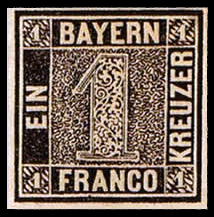
German States stamps were issued from 1849 to 1871 by individual kingdoms, duchies, and free cities, each using its own designs and currency, and they rank among the most valuable German philatelic items. Bavaria led with the first issue in 1849, followed by Saxony, Prussia, Hanover, the Hanseatic cities, and the Thurn und Taxis postal system. Major issuing states include:
- Bavaria (Bayern): First German state to issue stamps (1849). The One Kreuzer Black (Michel Bayern 1) is the most famous German stamp. Genuine examples show a distinctive silk thread embedded in the paper as a security feature.
- Saxony (Sachsen): The 1850 3-pfennig red, known as the "Sachsen Dreier" (Michel Sachsen 1), is extremely rare and valuable. It was printed on thin, fragile paper.
- Prussia (Preussen): Issued stamps from 1850 featuring Frederick William IV and later William I. Look for the watermark of a crowned eagle on the 1857-1861 issues.
- Hamburg, Bremen, Lubeck: Free Hanseatic cities that issued their own stamps. Hamburg's 1859 imperforate issues are particularly popular with collectors.
- Hanover: Issued stamps 1850-1864, including the iconic rose design of 1851. The blind embossed stamps (no color, just embossing) are distinctive and easily identified.
- Thurn and Taxis: The postal system run by the aristocratic Thurn und Taxis family issued stamps for its Northern and Southern districts, using different currencies (Silbergroschen in the north, Kreuzer in the south).
Free · iOS & Android
Skip the catalogue: photograph the stamp
StampID reads country, era, catalogue listing and a value range from one photo of the front. Scan first, then use this guide to verify the details.
German Empire / Deutsches Reich (1872-1945)
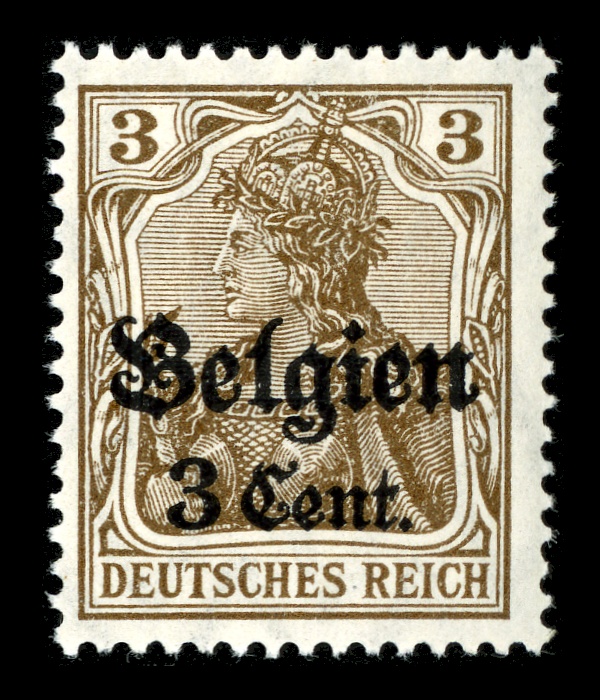
German Empire stamps span 1872 to 1945 and are identified by four main design eras: the 1872 eagle breast shields, the 1875-1900 numeral and Reichsadler issues, the 1900-1922 Germania definitives, and the inscription change from "REICHSPOST" to "DEUTSCHES REICH" after 1902. All are cataloged in the main Michel sequence beginning at Mi 1.
Eagle Breast Shields (1872)
The first stamps of the unified German Empire feature an eagle on a heraldic breast shield. Two distinct types exist:
- Small shield (Kleiner Brustschild, Mi 1-11): The eagle is smaller and positioned higher. These were issued first and are generally scarcer.
- Large shield (Grosser Brustschild, Mi 14-28): The eagle fills more of the stamp. Both types exist in Groschen (northern) and Kreuzer (southern) currency, which is crucial for correct identification.
Numeral and Eagle Issues (1875-1900)
The "Pfennige" and "Pfennig" issues (Mi 31-52) are distinguished by their inscription: early stamps spell out "PFENNIGE" (with a final E), while later issues use "PFENNIG." The Reichsadler (Imperial Eagle) stamps continued with gradually refined designs.
Germania Definitives (1900-1922)
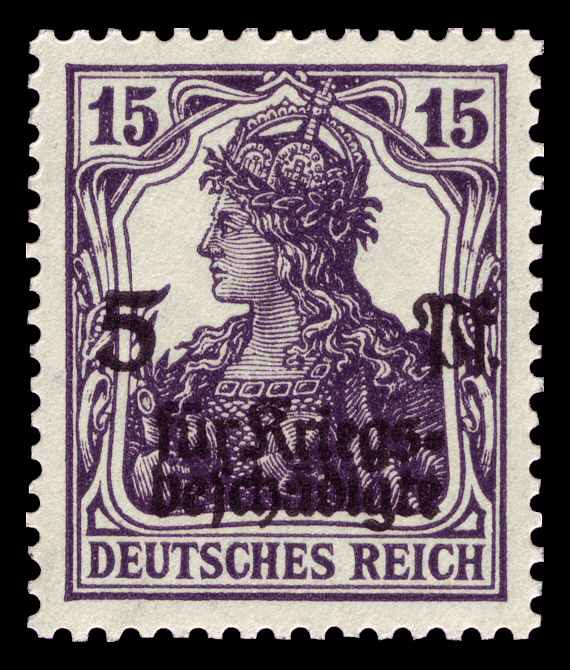
Germania definitives (1900-1922) are dated by watermark and inscription: the earliest 1900 stamps are unwatermarked and read "REICHSPOST," stamps from 1902 read "DEUTSCHES REICH," and from 1905 they carry a diamond/lozenge watermark. The design depicts an allegorical female warrior and is one of the most recognized German stamp types. Key identification points:
- Unwatermarked (Mi 53-67): The earliest Germanias from 1900 have no watermark.
- Lozenges watermark (Mi 83-104): From 1905, stamps show a diamond/lozenge watermark pattern when held up to light.
- "Deutsches Reich" inscription: After 1902, the inscription changed from "REICHSPOST" to "DEUTSCHES REICH" (Mi 68-104).
- War printings: During WWI, paper quality and perforation gauge declined noticeably. War-era printings on poor-quality paper are identifiable by their rough texture.
Inflation Era (1921-1923)
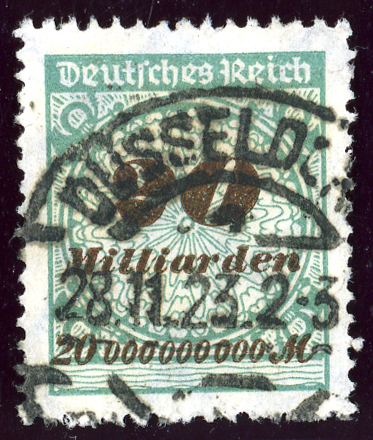
German inflation stamps (1921-1923, Mi 183-337) are identified by their rapidly escalating face values, which rose from single marks to billions of marks within two years, and by the surcharges and overprints used to revalue existing stock. The German hyperinflation produced some of the most extraordinary stamps in philatelic history. Identification challenges include:
- Overprints and surcharges: Existing stamps were overprinted with new values as inflation outpaced printing capacity. Genuine overprints were applied by official printers; check that the typeface, ink color, and alignment match known authentic examples.
- Michel numbers Mi 183-337: The inflation era spans over 150 catalog numbers. The highest face value, the 50-billion-mark stamp (Mi 337), is paradoxically quite common because enormous quantities were printed.
- Local overprints: Some post offices created their own provisional overprints. Many of these are rare, but many more are forgeries created to exploit collectors.
- Paper varieties: As paper supplies ran short, stamps were printed on varying paper stocks. Watermarked vs. unwatermarked, and different paper thicknesses, create significant catalog varieties.
Weimar Republic: Stable Period (1924-1933)
After the currency reform of late 1923, Germany entered a period of relative economic stability. Stamps from this era are cataloged roughly as Mi 338-478 and include several important series:
- Reichspräsident definitives: Portrait stamps of President Friedrich Ebert (from 1928) and later Paul von Hindenburg (from 1932) served as the standard definitive issues. The Hindenburg definitives bridge the Weimar and Third Reich periods.
- Nothilfe (Emergency Relief) semi-postals: Charity stamps issued annually to fund social welfare programs. These semi-postal issues feature coats of arms, famous buildings, and cultural themes, and are popular with thematic collectors.
- Zeppelin stamps (Mi 423-424, 438-439, 456-458): Among the most valuable and sought-after German stamps. Issued to frank mail carried on Graf Zeppelin and Hindenburg flights, these airmail stamps command premium prices especially on flown covers. The 1928-1931 issues in particular are key pieces for any serious German collection.
Third Reich Period (1933-1945)
Third Reich stamps (1933-1945) are identified by their definitive series and propaganda commemoratives, anchored by the Hindenburg Medallion (Mi 512-528) and the Hitler Head definitives (Mi 781-802). Major definitive series include:
- Hindenburg Medallion (Mi 512-528): Issued 1933-1936, these portrait stamps of President Hindenburg come in two watermark varieties: the upright waffle pattern and the horizontal mesh pattern. The watermark type significantly affects value.
- Hitler Head definitives (Mi 781-802): Issued from 1941 as the standard definitive series. High values exist in both perf 14 and perf 12.5 varieties.
- Commemoratives: The regime issued many propaganda-themed commemoratives for events, party congresses, and annexations. Stamps for the 1936 Berlin Olympics (Mi 609-616) and the "Anschluss" with Austria (Mi 662-663) are among the most collected.
- Occupation stamps: As Germany occupied territories during WWII, overprinted stamps were issued for Bohemia-Moravia, the General Government (Poland), Ostland (Baltic states), and Ukraine.
Post-WWII Occupation Zones (1945-1949)
After Germany's defeat, the four Allied occupation zones each issued separate stamps before the creation of the two German states:
| Zone | Period | Michel Range | Key Features |
|---|---|---|---|
| American Zone | 1945-1946 | Mi 1-15 (AM Post) | Printed in Washington, DC; distinctive US-quality paper and printing |
| British Zone | 1945-1946 | Mi 16-35 (AM Post) | British-printed versions of same designs; different paper and perforations |
| American/British Bizone | 1946-1949 | Mi 36-68 (AM Post) | Combined zone issues; the "Posthorn" overprints (Netzaufdruck) are key varieties |
| French Zone | 1945-1949 | Separate catalog | Regional issues for Baden, Rhineland-Palatinate, and Wurttemberg with local designs |
| Soviet Zone (SBZ) | 1945-1949 | Separate catalog | Local provisional overprints on Hitler-head stamps (head obliterated); province-specific issues |
West Germany / BRD (1949-1990)
The Federal Republic of Germany (Bundesrepublik Deutschland) issued stamps from September 1949. Key series for identification:
- Posthorn definitives (Mi 123-138): The first definitive series of the BRD, featuring a stylized posthorn. The 2-mark deep blue (Mi 134) is the key value. These were printed on watermarked paper showing a pattern of interlocking posthorns.
- Heuss definitives (Mi 177-196, 253-265): Portrait of President Theodor Heuss, issued in two series. The first series (1954) is on watermarked paper; the second (1959) is unwatermarked.
- "Bund" (Federal) charity stamps: Semi-postal issues for welfare, youth, sports, and Christmas are a cornerstone of German collecting. They carry a surcharge (e.g., "80+40" means 80 pfennig postage plus 40 pfennig donation).
- Fluorescent paper: From the mid-1960s, West German stamps were printed on luminescent paper for automatic sorting. This creates catalog varieties between fluorescing and non-fluorescing paper types.
Berlin Stamps (1948-1990)
West Berlin issued its own stamps, distinct from both BRD and DDR. Identifying features include:
- "BERLIN" overprints (Mi Berlin 1-20): The first Berlin stamps were BRD stamps overprinted "BERLIN" in black or red. The relative value of red vs. black overprints varies by denomination — for some values the red overprint is scarcer, while for others (particularly the 2-mark) the black overprint commands significantly higher prices. Forgeries of these overprints are extremely common.
- Separate definitive series: Berlin issued its own versions of the Heuss, Brandenburger Tor, and other definitive series, always inscribed "DEUTSCHE BUNDESPOST BERLIN" rather than simply "DEUTSCHE BUNDESPOST."
- Michel Berlin numbers: Berlin stamps have their own section in the Michel catalog, numbered separately from BRD issues.
East Germany / DDR (1949-1990)
The German Democratic Republic issued a large volume of stamps over its 41-year existence. Identification points:
- Inscription: Early stamps (1949-1950) are inscribed "DEUTSCHE POST." From 1950, stamps began using the full inscription "DEUTSCHE DEMOKRATISCHE REPUBLIK." The abbreviated form "DDR" alone did not appear on stamps until approximately 1953-1954.
- Printing quality: DDR stamps were generally printed using offset or photogravure, resulting in a flatter appearance than the recess-printed BRD issues.
- Watermarks: DDR stamps from 1949-1955 show a distinctive "DDR" watermark or "posthorn" watermark. After 1955, unwatermarked paper was used.
- Karl Marx definitives (Mi DDR 327-341): The first DDR definitive set, depicting Marx and other historical figures, is important for its watermark and perforation varieties.
- CTO stamps: The DDR mass-produced cancelled-to-order stamps for the packet trade. These have full, clean, often identical cancels and full original gum. They are worth significantly less than genuinely postally used examples.
Reunified Germany (1990-Present)
After reunification on 3 October 1990, Germany issued stamps inscribed "DEUTSCHLAND" replacing both "DEUTSCHE BUNDESPOST" and "DDR." Key points:
- Euro transition: Stamps changed from Deutsche Mark to Euro values in 2002. Dual-denominated stamps exist from the transition period.
- Self-adhesive vs. gummed: Modern German stamps come in both formats, with self-adhesives dominating since the 2010s. The self-adhesive versions have die-cut simulated perforations.
- Charity stamps continue: The tradition of semi-postal welfare and youth stamps continues, now denominated in euros with surcharges.
The Michel Catalog System
Michel is the definitive reference catalog for German stamps, equivalent to Yvert for France or Scott for the US. Understanding its structure:
- Main numbering: German Empire stamps begin at Mi 1 (the small shield eagle). BRD stamps restart from Mi 111 (continuing from the Bizone issues). DDR and Berlin have separate numbering sequences.
- Suffixes: A letter suffix indicates a variety (e.g., Mi 134I vs. Mi 134II for different plate states). Lowercase letters denote shade or paper varieties.
- Special catalogs: Michel publishes separate volumes for German States, German Colonies, occupied territories, and local issues. The "Deutschland-Spezial" two-volume catalog is the most detailed reference for serious collectors.
- Online catalog: The Michel online database allows searching by catalog number, year, or theme and includes current market values in euros.
Identifying German Stamp Watermarks
Watermarks are critical for correctly identifying and cataloging German stamps. The most important watermarks:
Watermark Identification Checklist
- Lozenge/Diamond pattern (Rauten): Used on Germania and early Weimar Republic issues. Hold stamp face-down on a dark surface or use watermark fluid. The pattern consists of interlocking diamond shapes.
- Waffle pattern (Waffelmuster): Found on 1933-1934 Hindenburg definitives. Appears as a grid of small squares.
- Swastikas (Hakenkreuze): Used briefly in 1934 on certain Hindenburg issues. A network of small swastika shapes visible under magnification with fluid.
- Posthorn watermark: Used on BRD Posthorn definitives (1951-1952). A repeating posthorn pattern across the sheet.
- DDR watermark: The letters "DDR" repeated diagonally across early East German stamps.
- No watermark: Many German stamps, especially from the late 1950s onward, are unwatermarked. This absence itself can be a key identification point.
Plate Flaws and Varieties
German stamp collecting has a strong tradition of plate-flaw study. Some significant varieties:
- Germania "Friedensdruck" vs. "Kriegsdruck": Peace-time printings (before 1914) use higher-quality inks and paper than wartime printings. The difference is visible in color intensity and paper texture.
- Posthorn "Posthorner" varieties: The BRD Posthorn definitives have numerous documented plate flaws, including broken lines in the posthorn, missing dots, and retouched areas. Michel lists these with Roman numeral suffixes.
- Heuss fluorescence varieties: The second Heuss series exists on both fluorescent and non-fluorescent paper, creating valuable varieties that can only be distinguished under UV light.
- DDR imperforate proofs: Imperforate examples of DDR stamps exist from proof sheets. Genuine proofs are rare; most offered examples are trimmed perforated stamps.
Quick Identification Table
| Period | Issuing Entity | Michel Numbers | Key Identification Features |
|---|---|---|---|
| 1849-1871 | German States | Separate per state | State name or coat of arms; Kreuzer or Groschen currency |
| 1872 | German Empire | Mi 1-28 | Eagle breast shields; small vs. large; two currency systems |
| 1875-1900 | German Empire | Mi 31-67 | "PFENNIGE" vs. "PFENNIG" spelling; Reichsadler design |
| 1900-1922 | German Empire | Mi 53-114 | Germania design; "REICHSPOST" vs. "DEUTSCHES REICH"; watermark types |
| 1921-1923 | Weimar Republic | Mi 183-337 | Inflation-era high values; overprints; rapidly escalating denominations |
| 1924-1933 | Weimar Republic (stable) | Mi 338-478 | Ebert/Hindenburg portraits; Nothilfe semi-postals; Zeppelin airmails |
| 1933-1945 | Third Reich | Mi ~482-910 | Hindenburg medallion; Hitler head definitives; propaganda themes (Mi 479-481 are late Weimar issues) |
| 1945-1949 | Occupation Zones | Various | AM Post issues; zone-specific designs; Soviet Zone local overprints |
| 1949-1990 | BRD (West Germany) | Mi 111+ | "DEUTSCHE BUNDESPOST"; Posthorn, Heuss, Brandenburger Tor definitives |
| 1948-1990 | Berlin (West) | Mi Berlin 1+ | "DEUTSCHE BUNDESPOST BERLIN"; own definitive series |
| 1949-1990 | DDR (East Germany) | Mi DDR 1+ | "DDR" inscription; offset/photogravure printing; CTO copies common |
| 1990-present | Reunified Germany | Continues BRD numbering | "DEUTSCHLAND" inscription; Euro values from 2002 |
Identify Any German Stamp Instantly
Snap a photo of any German stamp and let StampID's AI identify the period, Michel catalog number, and current market value in seconds, from Bavarian classics to modern Bundespost.
Google Play App StoreFrequently Asked Questions
How do I identify a German stamp?
Start with the inscription and currency: "REICHSPOST" or "DEUTSCHES REICH" indicates the German Empire (1872-1945), "DEUTSCHE BUNDESPOST" is West Germany/BRD (1949-1990), "DEUTSCHE BUNDESPOST BERLIN" is West Berlin, "DDR" or "DEUTSCHE DEMOKRATISCHE REPUBLIK" is East Germany, and "DEUTSCHLAND" is reunified Germany (1990-present). Pre-1871 stamps show an individual state name or coat of arms with Kreuzer or Groschen currency. Then check the design, watermark, and perforation against the Michel catalog to pin down the exact number.
What does "Deutsches Reich" mean on a stamp?
"Deutsches Reich" means "German Empire" (literally "German Realm") and was the official inscription on German national stamps from 1902 until 1945. It replaced the earlier "REICHSPOST" inscription used on the first Germania definitives. The phrase covers the Imperial, Weimar Republic, and Third Reich periods, so the inscription alone spans 1902-1945; you need the design, watermark, and Michel number to date a "Deutsches Reich" stamp more precisely.
Are German inflation stamps valuable?
Most German inflation stamps (1921-1923, Mi 183-337) are inexpensive because they were printed in enormous quantities; even the 50-billion-mark high value (Mi 337) is common. The valuable items are specific overprint varieties such as inverted, doubled, or shifted surcharges, which can be worth thousands of euros. Because these varieties are heavily forged, expensive inflation stamps should carry BPP (Bund Philatelistischer Prüfer) expertization.
What is the difference between BRD and DDR stamps?
BRD (Bundesrepublik Deutschland, West Germany) stamps are inscribed "DEUTSCHE BUNDESPOST," are usually recess-printed for a sharper, raised appearance, and are cataloged in Michel from Mi 111. DDR (Deutsche Demokratische Republik, East Germany) stamps are inscribed "DDR" or "DEUTSCHE DEMOKRATISCHE REPUBLIK," were typically offset or photogravure printed with a flatter look, have their own Michel "DDR" numbering, and frequently appear as cancelled-to-order (CTO) copies. Both were issued from 1949 to 1990, when reunification merged them under "DEUTSCHLAND."
Which catalog should I use for German stamps?
Use the Michel catalog, the definitive reference for German philately, equivalent to Scott in the US or Yvert in France. Michel assigns the standard "Mi" numbers, with separate numbering sequences for German States, the German Empire, BRD, Berlin, and DDR. For detailed varieties, watermarks, and plate flaws, the two-volume "Deutschland-Spezial" is the most thorough edition, and the Michel online database lists current market values in euros.