How to Identify British Stamps: From Penny Black to Modern
Great Britain holds a unique place in philately: it issued the world's first adhesive postage stamp—the Penny Black—on May 6, 1840. To this day, British stamps are the only stamps in the world that do not bear the issuing country's name; instead, they carry the reigning monarch's silhouette as a mark of origin. This convention, combined with nearly two centuries of continuous issuance, makes British stamp identification a rewarding pursuit with its own distinct set of markers and challenges.
Identify British Stamps with AI
Photograph any UK stamp and let StampID determine the monarch, SG number, printing type, and estimated value instantly.
Download Free on Google PlayLine-Engraved Issues (1840–1880)
Britain's first stamps—issued from 1840 to roughly 1880—were line-engraved (recess-printed) and comprise the Penny Black, Twopenny Blue, and the long-running Penny Red, all bearing Queen Victoria's profile and identified by corner letters, watermark, and plate number.
The Penny Black and Twopenny Blue (1840)
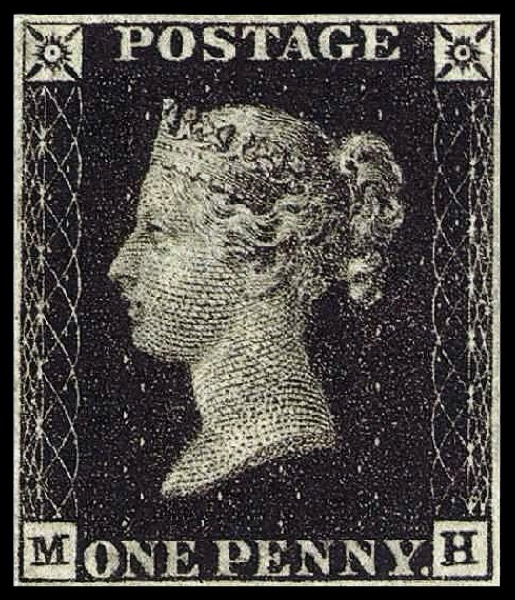
The Penny Black (SG 1) depicts a young Queen Victoria in profile, based on the City Medal by William Wyon. Exactly 68,158,080 copies were printed across 11 plates (Plate 11 being extremely rare). The Twopenny Blue (SG 5) used the same portrait in blue ink. Both are imperforate and printed by line engraving.
- Corner letters: Each stamp has letters in the lower corners indicating its position on the sheet (e.g., "A-A" for row 1, column 1). The Penny Black has letters only in the bottom corners; later Penny Reds added letters to all four corners.
- Cancellation: Penny Blacks were cancelled with a red Maltese Cross. The red ink was easy to wash off and reuse, which prompted the switch to black cancellations and then to the Penny Red.
- Plate numbers: Different plates produce subtly different impressions. Plate 11 Penny Blacks are worth vastly more than common plates—surviving examples are valued at tens of thousands of pounds. (Note: SG 2 is the Penny Black from Plate 1b, a relatively common variety; Plate 11 has its own distinct catalog status and high value.)
Penny Red (1841–1879)
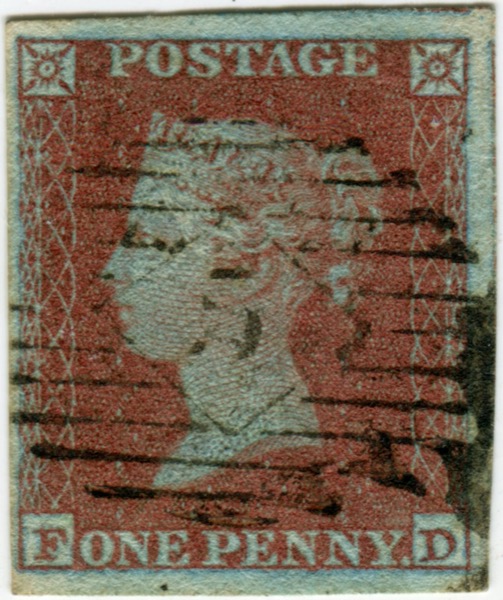
The Penny Red replaced the Penny Black and was issued in enormous quantities across many plates. The imperforate version (1841–1854, SG 8–12) gives way to the perforated version (1854 onward, SG 17+). Key identification markers:
- Stars vs. letters in corners: Early imperforate Penny Reds have stars in the upper corners. From 1858, all four corners carry letters ("plate alphabet" stamps, SG 43).
- Plate numbers: Perforated Penny Reds display a tiny plate number in the design (look in the side ornaments). Plate 77 was prepared but never issued—the few surviving examples are among the world's rarest stamps, valued at over £500,000.
- Paper and perforation: Imperforate on blued paper (1841), then on white paper. Perforated versions use perf 16 (1854–1856) and perf 14 (1856 onward).
Free · iOS & Android
Skip the catalogue: photograph the stamp
StampID reads country, era, catalogue listing and a value range from one photo of the front. Scan first, then use this guide to verify the details.
Surface-Printed Issues (1855–1900)
Higher-denomination stamps (from 4d upward) were produced using surface printing (typography) rather than line engraving. These Queen Victoria stamps feature more elaborate designs with ornamental frames.
Identifying features
- Corner letters: Surface-printed stamps display letters in all four corners from the start. The upper-left and lower-right letters indicate the stamp's sheet position; the upper-right and lower-left are reversed.
- Plate numbers: Many surface-printed stamps include a plate number within the design. Certain plate numbers are considerably scarcer.
- Watermarks: These stamps carry various Crown watermarks (Small Crown, Large Crown, Emblems, Spray of Rose, Large Garter, Anchor, Orbs, Imperial Crown). Watermark type is the primary method for dating surface-printed issues.
- Colors: Shades are important—the 1867 5s rose (SG 126) vs. 5s pale rose (SG 127) represents a significant value difference.
Watermark Guide for British Stamps
Watermarks are essential for identifying and dating British stamps. Place the stamp face-down in watermark fluid on a dark tray to reveal the mark. Major types include:
| Watermark | Period | Description |
|---|---|---|
| Small Crown | 1840–1854 | Small crown device, used on Penny Blacks and early Penny Reds |
| Large Crown | 1854–1862 | Larger crown, used on perforated line-engraved issues |
| Emblems | 1860–1864 | Heraldic emblems of the UK nations (rose, thistle, and shamrock) |
| Spray of Rose | 1867–1873 | Used on surface-printed high values |
| Large Garter | 1873–1880 | Found on surface-printed middle values |
| Imperial Crown | 1880–1911 | Most common Victorian/Edwardian watermark |
| Simple Cypher (GvR) | 1911–1934 | Royal cypher of George V |
| Block Cypher (GvR) | 1924–1936 | Block-style royal cypher |
| GviR | 1937–1952 | George VI cypher |
| E2R / Tudor Crown | 1952–1967 | Elizabeth II cypher with Tudor or St Edwards Crown |
| No watermark | 1967 onward | Watermarks discontinued for most definitive and commemorative issues |
King Edward VII (1901–1910)
Edward VII stamps feature his right-facing profile and range from ½d to £1. They use the Imperial Crown watermark and are perforated 14. Key points:
- The 6d value exists in both purple and slate-purple shades—the scarcer shade commands a premium.
- The £1 green (SG 266) is the high value of the set and is worth several hundred pounds in fine condition.
- De La Rue printed the lower-value Edward VII stamps by surface printing (typography), while the higher values (2s6d, 5s, 10s, £1) were printed by recess printing (intaglio/line engraving).
King George V (1911–1936)
George V stamps (1911–1936, SG 321–456) span photographic Downey Heads, profile-head Royal and Block Cypher definitives, and the recess-printed Seahorse high values, with the watermark and printing method being the primary identification markers. They divide into several distinct printing types:
- Downey Heads (1911–1912): Low values with a photographic portrait. Named after the photographer W. & D. Downey. SG 321–350.
- Royal Cypher issues (1912–1922): Profile head with Simple Cypher watermark. Multiple shades and die varieties exist, especially in the 1d red.
- Block Cypher issues (1924–1936): Changed watermark to Block Cypher. Look for the sideways watermark on some coil stamps.
- Seahorse high values (1913–1934): The iconic 2s6d, 5s, and 10s stamps featuring Britannia astride a seahorse (the £1 value used a different design). Three printings exist: Waterlow, De La Rue, and Bradbury Wilkinson—each identified by subtle differences in shading and line quality. Waterlow printings (SG 399–403) are often highly sought after, though value depends on denomination and condition; Bradbury Wilkinson and De La Rue printings can also be very valuable for certain values.
- Photogravure (1934–1936): The final George V low values were printed by photogravure, giving a distinctly different appearance with smoother tonal gradation.
King George VI (1937–1952)
George VI definitives feature a left-facing profile. The main series uses the GviR watermark and perf 15×14. Identification points:
- Dark colors (1937–1941): Early printings used rich, dark inks.
- Pale colors (1941–1942): Wartime economy forced thinner paper and paler inks. These "war economy" printings are collected as distinct varieties.
- New colors (1950–1951): A final color change series before Elizabeth II acceded to the throne.
- High values: The 1939–1948 high values (2s6d to £1) come in two distinct sets—arms designs and the later festival high values.
Queen Elizabeth II (1952–2022)
Elizabeth II's 70-year reign produced two main definitive series: the photogravure Wilding portraits (1952–1967), identified by their Tudor or St Edwards Crown watermark, and the watermark-free Machins (1967–2022), identified by phosphor bands, gum, and paper.
Wilding Definitives (1952–1967)
Named after photographer Dorothy Wilding, these show a right-facing portrait of the young Queen. Printed in photogravure. The watermark changes from Tudor Crown to St Edwards Crown in 1955—a critical identification point that significantly affects value for certain denominations.
Machin Definitives (1967–2022)
The Machin series, based on Arnold Machin's sculpted portrait, is the longest-running stamp design in history. With thousands of varieties produced over 55 years, Machin collecting is a specialty unto itself. Key identification factors:
- Printing method: Photogravure (Harrison, Enschedé, De La Rue, Walsall), lithography, or intaglio. The printing method affects the sharpness and texture of the image.
- Gum type: PVA gum (shiny), gum arabic (matte), or self-adhesive. The gum type narrows the date range significantly.
- Phosphor bands: On modern Machins, one band indicates second class and two bands indicate first class, but earlier Machin stamps may have different band configurations (e.g., one centre band, two side bands, or "all over" phosphor) that do not follow this rule. Count the bands under UV light to confirm the correct variety.
- Paper: Original cream-colored paper (OCP) vs. fluorescent-brightened paper (FCP). Under UV light, FCP glows bright white while OCP appears dull.
- Head type: Decimal Machins have gone through multiple head types with slight differences in the queen's silhouette (Type I, Type II, etc.).
- Source codes and date codes: From the late 1990s, Machins include tiny printed codes indicating the year and source of printing.
Stanley Gibbons Catalog System
Stanley Gibbons (SG) numbers are the standard reference for British and Commonwealth stamps, equivalent to Scott numbers for US stamps. Key points:
- Numbers are assigned chronologically: SG 1 is the Penny Black, SG 2 is the Penny Black from Plate 1b.
- The "Specialised" catalog provides far more detail than the "Concise" edition, listing shade varieties, plate numbers, and printing details.
- For Machins, the SG Concise catalog assigns simplified numbers while the Specialised volume breaks them into thousands of sub-varieties.
- SG numbers are used in the UK, Commonwealth countries, and much of Europe. International auction houses typically list both SG and Scott numbers.
Perforation Types and Values
British stamps were imperforate from 1840 to 1854, perforated at gauge 16 from 1854 to 1856, and at gauge 14 from 1856 onward—so perforation gauge both dates a stamp and significantly affects its value, especially for Victorian issues. The main types are:
- Imperforate (1840–1854): All early issues. Margins must be clear of the design for full value.
- Perf 16 (1854–1856): First perforated issues. Clean separations are scarce.
- Perf 14 (1856 onward): Standard gauge for most Victorian and Edwardian stamps.
- Perf 15×14 (George VI): Compound perforation used for definitive issues.
- Perf varieties: Imperforate errors of otherwise perforated stamps can be worth enormous premiums. A missing perforation on one side is called an "imperf margin" and is collected as a variety.
Regional Issues
Since 1958, Great Britain has issued stamps for its constituent regions with distinctive national emblems:
- Scotland: Features the Lion Rampant or St Andrew's Cross. Uses the same Machin portrait with Scottish emblem added.
- Wales: Features the Welsh Dragon (Y Ddraig Goch). Bilingual inscriptions appear on some issues.
- Northern Ireland: Features the Red Hand of Ulster or flax plant emblem.
- England: Introduced in 2001 with the Three Lions and Tudor Rose. Relatively modern addition to the regional lineup.
Regional stamps are valid for postage throughout the UK, not just in their respective regions. They carry the same face values as the corresponding Machin definitives.
Channel Islands and Isle of Man
These Crown Dependencies issue their own stamps independently of Royal Mail:
- Jersey: Independent postal authority since 1969. Issues its own stamps with "Jersey" inscription. Uses its own catalog section in SG.
- Guernsey: Independent since 1969 as well. Includes stamps for Alderney (a Guernsey dependency) and formerly for Herm and Sark (local issues).
- Isle of Man: Independent postal authority since 1973. Stamps inscribed "Isle of Man" or "Ellan Vannin" (Manx Gaelic).
These stamps are not valid for postage in the UK, and UK stamps are not valid in these territories. Collectors treat them as separate issuing entities.
Common UK Stamp Errors and Varieties
| Error / Variety | SG # | Description | Estimated Value |
|---|---|---|---|
| Penny Black Plate 11 | — | Only plate not officially issued; very few survive. (SG 2 is Plate 1b, a separate and more common variety.) | £40,000–£500,000+ |
| VR Official Penny Black | — | Prepared for government use with "VR" in the upper corners but never officially issued. One of the most famous British philatelic rarities. | £20,000–£300,000+ |
| Penny Red Plate 77 | — | Prepared but never issued. One of the world's rarest stamps | £500,000+ |
| 1910 2d Tyrian Plum | — | Edward VII stamp prepared but recalled upon his death | £100,000+ |
| 1961 Post Office Savings 2½d missing orange | SG 625a | Missing color error | £3,000–£5,000 |
| Machin missing phosphor | Various | Stamps printed without phosphor bands | £10–£500 |
| Wilding watermark inverted | Various | Stamps with the watermark printed upside-down | £20–£2,000 |
| Commemorative missing color | Various | One or more colors omitted during printing | £100–£15,000 |
Quick-Reference: British Stamps by Era
| Era | Monarch / Type | Key Features | Typical SG # |
|---|---|---|---|
| 1840–1879 | Victoria (line-engraved) | Imperforate then perf 14/16, corner letters, plate numbers | SG 1–49 |
| 1855–1900 | Victoria (surface-printed) | Higher values, ornate frames, multiple watermarks | SG 62–214 |
| 1901–1910 | Edward VII | Imperial Crown watermark, De La Rue typography | SG 215–318 |
| 1911–1936 | George V | Downey Heads, Seahorses, photogravure low values | SG 321–456 |
| 1936 | Edward VIII | Only four values issued before abdication | SG 457–460 |
| 1937–1952 | George VI | GviR watermark, dark/pale/new color sets | SG 462–514 |
| 1952–1967 | Elizabeth II (Wilding) | Photogravure, Tudor/St Edwards Crown watermark | SG 515–616 |
| 1967–2022 | Elizabeth II (Machin) | No watermark, phosphor bands, self-adhesive from 1990s | SG 723–U series |
| 2022–present | Charles III | New portrait, barcoded stamps | Ongoing |
British Stamp Identification Checklist
- Identify the monarch's portrait—this immediately narrows the date range.
- Check whether the stamp is imperforate or perforated, and measure the gauge if perforated.
- Look for corner letters (Victorian issues) to confirm the era and printing style.
- Check the watermark with watermark fluid—the single most reliable dating tool for pre-1967 stamps.
- For Machins, count the phosphor bands under UV light. On modern issues, one band = second class and two bands = first class, though earlier Machins may have different configurations.
- Note the gum type: gum arabic (pre-1970), PVA (1970s onward), or self-adhesive (1990s onward).
- Look for plate numbers on Victorian line-engraved and surface-printed issues.
- Cross-reference with the SG Concise or Specialised catalog to confirm the exact variety.
Frequently Asked Questions
How do I identify a British stamp that has no country name on it?
If a stamp shows a monarch's head but no country name, it is almost certainly British. Great Britain is the only country that omits its name from its stamps—a privilege it holds for having issued the world's first stamp in 1840. Identify the monarch's portrait to fix the era, then check the watermark, perforation, and (for Machins) the phosphor bands to pin down the exact issue.
Why don't UK stamps show the country name?
UK stamps omit the country name because Great Britain issued the world's first adhesive postage stamp, the Penny Black, on May 6, 1840, before any naming convention existed. The Universal Postal Union later exempted Britain from the rule requiring all other countries to print their name, on the condition that British stamps always display the reigning monarch's head as the mark of origin.
How do I tell which monarch is on a UK stamp?
Match the profile against the six modern monarchs: Queen Victoria (1840–1901) faces left with a young or veiled portrait; Edward VII (1901–1910) faces right; George V (1911–1936) faces left; George VI (1937–1952) faces left; Elizabeth II (1952–2022) faces right; and Charles III (2022–present) faces left on barcoded definitives. The monarch alone narrows the date range to a few decades.
Are Penny Black stamps valuable?
Yes, but less than most people expect. Over 68 million Penny Blacks were printed in 1840, so used examples are common and typically sell for £20–£300 depending on condition and margins. Value rises sharply for fine four-margin copies, unused examples, and rare plates—Plate 11 Penny Blacks and the unissued "VR Official" can reach tens or hundreds of thousands of pounds.
What is a Machin stamp and how do I identify one?
A Machin is a British definitive based on Arnold Machin's 1966 sculpted profile of Elizabeth II, in use from 1967 to 2022 and the longest-running stamp design in history. It shows only the Queen's plaster-cast head and a denomination on a plain colored background, with no watermark. Identify the exact variety by printing method, gum type, phosphor bands under UV light, paper, and head type.