Stamp Value Lookup: Catalogue, Auction and Dealer Price Sources
Stamp prices come from four places: printed catalogues, auction archives, sold listings on marketplaces, and dealer price lists. Each one reports a different kind of number, and mixing them up is how collectors end up with a figure nobody would pay. This guide explains what each source actually measures, how to read a listing, and how to turn several sources into one low-mid-high range. For the full valuation walkthrough, start with how much your stamp is worth.
Price Sources
Four price sources, and what each one actually tells you
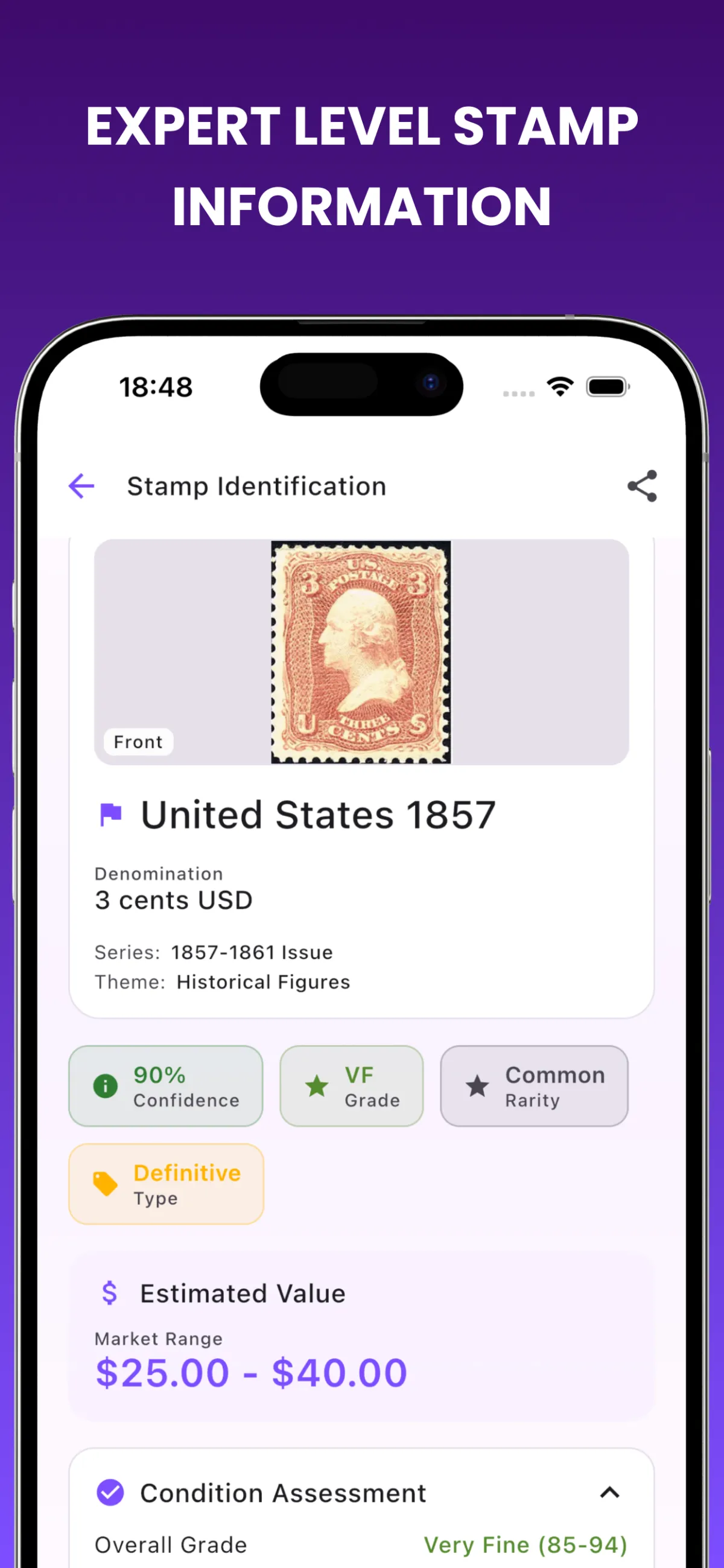
The fastest path: identify the stamp's catalogue listing first (the catalogue tells you a baseline value), then refine with recent auction comps and condition adjustments. StampID does step one from a photo, free.
The Four Places Stamp Prices Come From
No single website gives you a trustworthy price. Use these sources together, and always prefer prices that were actually paid over prices someone is asking:
| Source | What it tells you | Cost |
|---|---|---|
| Catalogues (Scott, Stanley Gibbons, Michel, Yvert) | A retail reference value per catalogue number; a ceiling, not a sale price | Paid; see which catalogue to use |
| eBay sold listings | What common and mid-range stamps really sell for | Free |
| Auction archives (Heritage Auctions, Stamp Auction Network, Delcampe results) | Realised prices for better stamps and certified examples | Free, some need a login |
| Dealer price lists | Retail asking prices; expect to receive well below these when selling | Free |
| StampAuctionsHistory | Aggregated auction results across many houses | Paid |
A reliable stamp value check has three parts: an exact identification (catalogue number), a condition assessment, and recent sold prices for comparable examples. Online "value checker" tools that skip any of these steps produce numbers you can't trust — a catalogue price without condition weighting typically overstates real market value by 5–10×. The workflow below walks through all three, and the free StampID app handles the identification step from a single photo.
Step 0: Identify the Stamp First
You must pin the stamp to one exact catalogue listing before pricing anything, because the same design from two different printings can be worth $1 or $1,000 depending on which variant you actually hold. So before pricing, get the stamp matched to a specific catalogue number (Scott, Stanley Gibbons, Michel, Yvert). With that catalogue match in hand, the rest of the work is comparing against documented sales.
If you don't yet know exactly which stamp you have, StampID identifies the stamp from a photo of the front and returns the country, era, and likely catalogue listing — usually all you need to start the valuation workflow below.
1) Collect the right inputs before pricing
Before pricing, collect four inputs: the confirmed catalogue listing, condition notes, recent sold comparables, and the market venue — skipping any one of them leads to false pricing. Gather these inputs first:
- Confirmed issue and likely catalog number (or short candidate list).
- Condition notes: centering, perforations, gum, faults, cancellation quality.
- Recent sold comparables from similar condition tiers.
- Market venue context (retail dealer vs auction vs private sale).
2) Apply condition weighting
Condition can multiply a stamp's value several-fold — it is usually the single biggest swing, so a common issue in exceptional condition can beat a scarcer issue in poor condition.
| Condition tier | Typical characteristics | Valuation effect |
|---|---|---|
| Premium | Strong centering, full perforations, clean paper, minimal faults | Can exceed median comps significantly |
| Average | Minor wear, acceptable cancellation, no major structural damage | Usually aligns with market median |
| Faulted | Tears, thins, repairs, heavy creases, clipped perfs | Often deep discount to catalog guidance |
3) Build a comp set correctly
Build your comp set from at least 3-5 recent sold prices (last 6-12 months) for the exact same catalogue subtype in similar condition, excluding obvious outliers — asking prices and visual lookalikes are not valid evidence.
Comp hygiene rules
- Prefer sold listings from the last 6-12 months.
- Match issue subtype, not just visual similarity.
- Exclude outliers caused by obvious damage or hype bidding.
- Keep at least 3 comps when possible, ideally 5+.
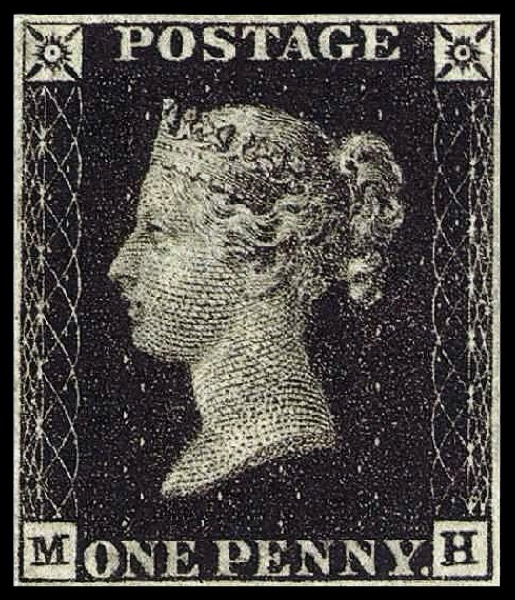
Penny Black, General Post Office of the UK. Public domain, via Wikimedia Commons.
4) Produce a low-mid-high range
Instead of one number, publish a range with confidence notes:
- Low: quick sale / weak demand / minor uncertainty.
- Mid: realistic expected sale with solid presentation.
- High: patient sale, strong buyer match, above-average eye appeal.
"Estimated range: $X-$Y (midpoint $Z). Confidence: medium. Drivers: verified issue, average condition, 4 recent sold comps. Risks: uncertain watermark orientation."
5) Valuation mistakes to avoid
- Using only unsold asking prices as valuation evidence.
- Ignoring minor faults that buyers price aggressively.
- Assuming every old stamp is rare.
- Copying a catalog number without technical marker confirmation.
6) Complementary guides
For stronger estimates, pair this page with:
- How to Identify Stamps by Photo for cleaner identification inputs.
- Rare Stamps Worth Money for scarcity and demand context.
- How to Identify Old Stamps for classic-era dating and authentication.
- How much your stamp is worth: the beginner-friendly overview with typical values.
Try this in the app now.
Generate your next ID with StampID and immediately apply this low-mid-high pricing method.
Free install for faster valuation prep.
Frequently Asked Questions
How do I use these sources to price a stamp?
Four steps: (1) identify the stamp's exact catalogue listing (Scott, Stanley Gibbons, Michel, Yvert); (2) look up the catalogue value as a starting baseline; (3) check recent sold auction prices for the same listing in similar condition (eBay sold, Heritage Auctions, Cherrystone, Spink); (4) adjust down for condition issues (centering, gum, faults, cancellations) or up for rare condition. The result is a realistic low-mid-high range, not a single number.
Is catalogue value the same as market value?
No. Catalogue value (Scott, Stanley Gibbons, etc.) is a reference point, not a market price. Most stamps sell for 30-70% of catalogue. Cheap stamps often sell below 10% of catalogue. Genuinely rare stamps in top condition sometimes sell above catalogue. Use catalogue as a starting baseline, then verify with actual sold-comp evidence.
How much does condition affect a stamp's value?
Massively. A Very Fine (VF) example can be worth 3-10x a "Fine" example of the same stamp. Mint never-hinged (MNH) gum is worth 2-3x mint hinged. A small thin or short perforation can cut value by 50-90%. For high-value candidates, get professional certification (PSAG, APS, BPA) — a certified VF stamp sells for substantially more than the same stamp without certification.
Where can I check actual stamp sales prices?
Best free sources: eBay sold listings (filter "sold" in advanced search), Heritage Auctions archive (free login), Stamp Auction Network realized prices, Delcampe sold results. Paid: StampAuctionsHistory aggregator. Avoid using "for sale" listings as evidence — they include lots of overpricing and unsold inventory.
Is there a free stamp value checker app?
Yes — the free StampID app identifies stamps from a photo and returns the country, era and likely catalogue listing along with an estimated market value range. For high-value candidates, treat the estimate as a starting point and verify with the four-step process above.
Editorial note: This valuation framework is educational. High-value candidates may require professional certification.