How to Identify French Stamps: Ceres to Marianne
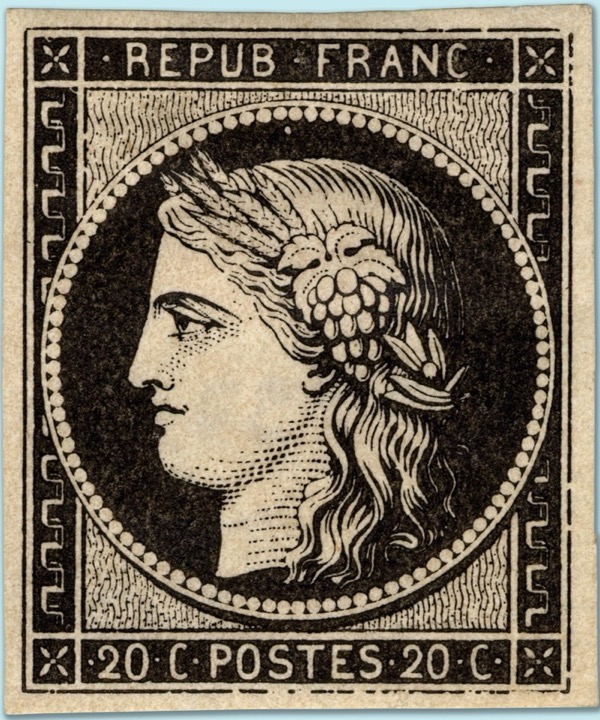
France was one of the first countries in the world to issue postage stamps, beginning on 1 January 1849 with the iconic Ceres design. Over nearly two centuries, French stamps have reflected the nation's turbulent political history, shifting from monarchist to republican imagery and back again. This guide walks you through every major period, explains the Yvert et Tellier catalog system, and shows you how to distinguish valuable classics from common reprints.
The Classic Period: 1849-1876
France's classic period covers four design families: the Ceres goddess (1849-1852), the Napoleon III portraits (1852-1871), and the Ceres re-issues of 1871-1876 — all imperforate at first, then perforated 14 x 13.5 from 1862.
Ceres Issues (1849-1852)
France's first stamps depict Ceres, the Roman goddess of agriculture, engraved by Jacques-Jean Barre. They were printed in taille-douce (recess/intaglio) on hand-made laid paper without watermarks. All values were imperforate and had to be cut with scissors. Key identification points:
- Yvert 1-7: The 20c black (Y1) is the most common, though mint examples still command premium prices. The 1-franc vermilion (Y7) is one of the rarest and most valuable French stamps, with used examples selling for tens of thousands of euros.
- Paper: Genuine classics are on tinted paper (yellowish for the 1849 issue). The 1850 re-issue used whiter paper.
- Grid cancel (grille): The distinctive lozenge-shaped grid cancel was standard; stamps with clear, light cancels are worth more.
- Tete-beche pairs: The 20c and 1-franc exist in tete-beche (inverted) pairs, which are extremely rare and valuable.
Napoleon III Issues (1852-1871)
When Louis-Napoleon became Emperor, stamps were redesigned to feature his portrait. These come in two main categories:
- Imperforate (Y9-18, "Empire non-dentele"): Issued 1852-1862, printed on various paper types. The 1853-1860 series uses a thick, slightly bluish paper.
- Perforated (Y19-33, "Empire dentele"): From 1862 onwards, stamps were perforated 14 x 13.5, a gauge that helps distinguish genuine stamps from forgeries.
- "Laureated" heads (Y25-33): After 1863, Napoleon III was depicted with a laurel wreath. These are sometimes confused with the earlier bareheaded type.
Free · iOS & Android
Skip the catalogue: photograph the stamp
StampID reads country, era, catalogue listing and a value range from one photo of the front. Scan first, then use this guide to verify the details.
Type Sage: Peace and Commerce (1876-1900)
The Type Sage definitives (Yvert 61-106), issued 1876-1900 and designed by Jules-Auguste Sage, depict an allegorical figure of Peace and Commerce and are identified by the position of the "N" in "INV" relative to the inscription above. They are among the most studied French stamps due to numerous varieties:
- Type I vs. Type II: Type I (Y61-76) has the "N" of "INV" falling under the "U" of "REPUBLIQUE." Type II (Y77-106) shows the "N" falling under the "E." This tiny shift is the single most important identification point for Sage stamps.
- Paper: Early printings used a quadrille-lined paper visible under magnification. Later printings switched to ordinary wove paper.
- Colors: Many values exist in multiple shades. The 1-franc olive-green (Y72) is far more valuable than the 1-franc bronze-green (Y82).
- Yvert numbers: Y61-106 cover the entire Sage series. The 5-franc lilac (Y95) is the most sought-after value.
The Sower (Semeuse) Definitives: 1903-1940
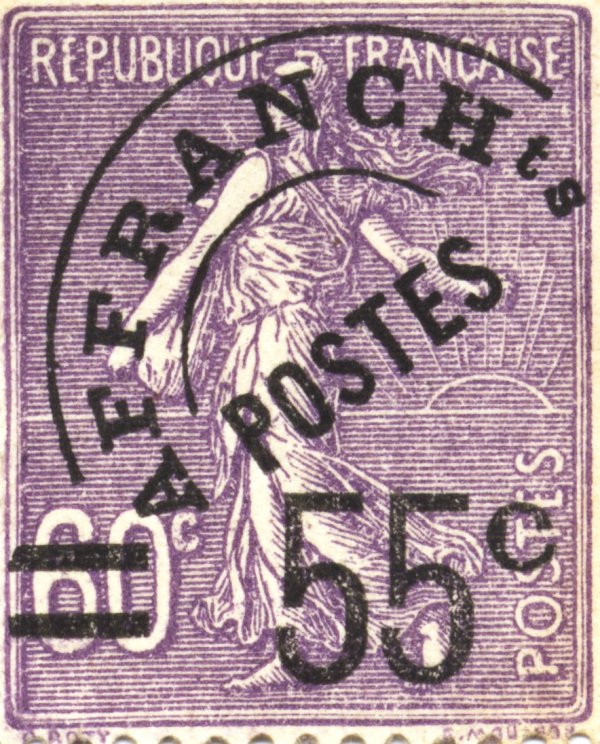
The Semeuse ("Sower") definitives, designed by Louis-Oscar Roty and in use from 1903 to 1940, come in three identifiable types: the lined-background Semeuse lignee (Yvert 129-133), the solid-background Semeuse camee (Yvert 137-196), and post-1924 rotary printings that are slightly taller than flat-plate ones. The design shows a female figure striding forward, sowing seeds against the wind:
- Lined background (Semeuse lignee, Y129-133): Introduced in 1903, the background consists of fine horizontal lines. Printed in recess.
- Solid background (Semeuse camee, Y137-196): From 1907, the background is solid color. These were printed in flat-plate typography and are far more common.
- Flat-plate vs. rotary printing: Post-1924 printings were done on rotary presses, producing stamps that are slightly taller (21.5mm vs. 21mm). This is a key variety for specialists.
The Semeuse was in continuous use for nearly four decades, making it the longest-running French definitive design. Common values in used condition are worth very little, but rare shade varieties and printing errors can be highly valuable.
Merson and Pre-WWI High Values
For higher denominations, France used the Merson design (Y119-128) from 1900-1927, depicting the allegorical figure of Liberty and Peace. These large-format stamps were printed in two colors using recess printing. The 2-franc values in particular show significant shade varieties. The Type Blanc (Y107-112) covered the lowest values from 1900 onwards, featuring a simple allegorical design.
The Marianne Series: 1944-Present
Since 1944, France's definitive stamps have featured Marianne, the allegorical figure of the French Republic, with a new design typically commissioned under each president — so the artist's name (Gandon, Muller, Decaris, and so on) is the fastest way to date a Marianne stamp. Adopted after the Liberation, the series replaced the Semeuse:
| Marianne Type | Period | Yvert Range | Key Features |
|---|---|---|---|
| Marianne de Gandon | 1945-1955 | Y713-733 | Profile facing left, engraved by Pierre Gandon; recess printed |
| Marianne de Muller | 1955-1959 | Y1009-1011C | Three-quarter view, typographed; common and inexpensive |
| Marianne de Decaris | 1960-1965 | Y1263 | Two-color recess printing; best known for the 0.25F value |
| Marianne de Cheffer | 1967-1971 | Y1535-1536B | Stylized profile; exists in typographed and engraved versions |
| Marianne de Bequet | 1971-1978 | Y1663-1664A | Bold outline style; rotary and flat-plate varieties |
| Marianne (Liberte) | 1982-1990 | Y2178-2190 | Based on Delacroix painting; intaglio printed |
| Marianne de Briat (Bicentenaire) | 1990-1997 | Y2614-2649 | Clean modern profile; first self-adhesive French definitives |
| Marianne de Luquet | 1997-2005 | Y3083-3101 | Juvenile face; offset printed; many shade varieties |
| Marianne de Lamouche | 2005-2008 | Y3731-3757 | Confident expression; ITVF and Phil@poste imprints distinguish printings |
| Marianne de Beaujard | 2008-2013 | Y4226-4265 | Engraved style; exists gummed, self-adhesive, and in booklets |
| Marianne de Ciappa-Kawena | 2013-2018 | Y4763-4791 | First Marianne designed with digital tools; data-matrix code on some |
| Marianne l'Engagee (YZ Kami) | 2018-present | Y5248+ | Current definitive; designed by YZ Kami; self-adhesive and gummed versions |
The Yvert et Tellier Catalog System
Yvert et Tellier is the standard reference catalog for French stamps, equivalent to Scott for US stamps or Stanley Gibbons for British stamps. Understanding Yvert numbering is essential:
- Regular issues: Numbered sequentially from Y1 (the 1849 Ceres 20c black).
- Airmail (Poste Aerienne): Prefixed "PA" (e.g., PA15 is the 50-franc Burelage).
- Postage dues (Taxe): Prefixed "T."
- Precancels (Preobliteres): Prefixed "Preo."
- Official stamps (Service): Prefixed "S" for stamps used by the Council of Europe and UNESCO.
When buying or selling French stamps internationally, always specify whether you are using Yvert, Scott (American), or Michel (German) numbers, as they differ significantly.
French Colonial Stamps
France issued stamps for its extensive colonial empire. Identifying colonial stamps versus metropolitan French stamps requires checking several features:
- Colony name inscription: Most colonial stamps carry the colony name (e.g., "ALGERIE," "INDOCHINE," "AFRIQUE OCCIDENTALE FRANCAISE").
- Currency: Colonies often used different currencies. Indochina used centimes and piastres; West Africa used CFA francs.
- Generic colonial designs: The "Commerce and Navigation" type (Groupe Allegory) was used across many colonies from 1892-1912, with only the colony name differing.
- Overprints: Many colonial stamps are simply French stamps overprinted with the colony name and sometimes a new value. These overprints can be forged, so check alignment and ink color carefully.
Identifying Reprints and Forgeries
Classic French stamps are heavily forged. Here is a checklist for authentication:
Authentication Checklist for Classic French Stamps
- Paper test: Genuine 1849-1862 stamps use hand-made laid paper. Hold the stamp up to light; you should see laid lines and possibly a watermark-like pattern. Machine-made wove paper indicates a forgery or later reprint.
- Perforation gauge: The 1862-1871 perforated Napoleon III issues should gauge 14 x 13.5. Forgeries often have irregular or incorrect perforation measurements.
- Color under UV light: Genuine classic French stamps fluoresce differently from reprints under ultraviolet light. Originals typically show no fluorescence, while reprints on modern paper may glow.
- Cancel authenticity: Forgers often add fake cancels to genuine but damaged stamps. Look for cancels that match known postal markings of the period. The "gros chiffres" numeral cancels should correspond to a real post office number.
- Expert marks: Many authenticated French stamps carry small expert handstamps on the reverse (e.g., Calves, Brun, Roumet). While these can also be forged, a genuine expert mark adds confidence.
- Printing method: Classic stamps were recess-printed (intaglio). You should feel the raised ink with your fingernail. Flat, smooth printing suggests a lithographic or offset forgery.
Printing Methods and Paper Types
French stamps employ several distinct printing techniques that serve as vital identification tools:
- Taille-douce (recess/intaglio): Used for nearly all stamps from 1849-1960s. The ink sits in engraved grooves and transfers to paper under pressure, creating a slightly raised feel. France is one of the last countries still using this method for select commemoratives.
- Typographie (letterpress): Used for the Semeuse camee and Blanc types. The ink sits on raised surfaces; the printed image is slightly impressed into the paper.
- Offset and photogravure: Introduced from the 1960s onward for mass-produced definitives. The print quality is flatter and more uniform.
- GC vs. GC+ paper: Modern French stamps use phosphorescent paper (papier phosphorescent) for mail-sorting machines. Under UV light, bar markings are visible.
Common Stamps That Look Valuable But Aren't
Many collectors come across French stamps they believe to be rare. Here are frequent false alarms:
- Semeuse camee in common values: The 5c, 10c, 25c, and 35c Semeuse definitives were printed by the hundreds of millions. Used examples are worth a few cents at most, despite being over 100 years old.
- Marianne de Gandon used: Very high print runs make most values essentially worthless in used condition.
- 1960s-1970s commemoratives: France issued beautiful engraved commemoratives, but print runs were large and collector demand kept mint supplies high. Most are worth face value or less.
- CFA overprints on common stamps: Reunion Island overprints ("CFA") on ordinary French stamps are generally inexpensive, despite looking unusual.
Quick Identification Table
| Period | Design | Yvert Numbers | Key Identification Features |
|---|---|---|---|
| 1849-1852 | Ceres | Y1-7 | Imperforate, laid paper, grid cancel, no watermark |
| 1852-1862 | Napoleon III (bare head) | Y9-18 | Imperforate, thick bluish paper for later printings |
| 1862-1871 | Napoleon III (perforated) | Y19-33 | Perf 14 x 13.5; laureated versions from 1863 |
| 1871-1875 | Ceres (re-issue) / Bordeaux | Y38-57 | Y39-48 are the Bordeaux emission (coarser engraving); Y50-57 are the subsequent Paris re-issues (cleaner printing) |
| 1876-1900 | Type Sage | Y61-106 | Type I vs Type II (position of "N"); quadrille paper for early prints |
| 1900-1927 | Blanc / Mouchon / Merson | Y107-145 | Three concurrent designs for low, medium, and high values |
| 1903-1940 | Semeuse | Y129-196 | Lined background (lignee) vs. solid background (camee) |
| 1932-1941 | Type Paix | Y280-289 | Olive branch design, typography printed; replaced Semeuse for some values |
| 1944-present | Marianne (various) | Y713+ | Artist name distinguishes type; printing method changed over decades |
Identify Any French Stamp Instantly
Point your camera at any French stamp and let StampID's AI identify the issue, Yvert number, and current market value in seconds.
Google Play App StoreFrequently Asked Questions
How do I identify a French stamp?
Start with the central design and the inscription. France's first stamps (1849-1876) show the goddess Ceres or a portrait of Napoleon III; from 1876 to 1900 the Type Sage depicts Peace and Commerce; the Semeuse ("Sower") ran from 1903 to 1940; and since 1944 the definitive design has been Marianne. Then check perforation (imperforate before 1862, perf 14 x 13.5 after), paper type, and the Yvert et Tellier catalog number to pin down the exact issue and value.
What does "RF" mean on a French stamp?
"RF" stands for République Française (French Republic). It appears on stamps issued under republican governments and is a quick way to confirm a stamp is French. Stamps issued under the Second Empire (1852-1870) instead carry "EMPIRE FRANC." with Napoleon III's portrait, while republican issues use "RF" or the full "REPUBLIQUE FRANCAISE" inscription.
Who is the woman on French stamps?
The woman depends on the era. On modern definitives (1944 to today) she is Marianne, the allegorical figure who personifies the French Republic and the values of liberty and reason. On the 1849-1876 classics she is Ceres, the Roman goddess of agriculture, and on the 1903-1940 definitives she is the Semeuse ("Sower"), a striding female figure scattering seeds, designed by Louis-Oscar Roty.
Are old French stamps worth anything?
It depends on the issue and condition. The 1849-1876 classics can be very valuable — the 1849 1-franc vermilion Ceres (Yvert 7) sells for tens of thousands of euros — and rare shades, errors, and tete-beche pairs command strong prices. However, most common 20th-century stamps such as standard Semeuse camee and used Marianne de Gandon values were printed in the hundreds of millions and are worth only a few cents each.
What catalog number system is used for French stamps?
French stamps are catalogued under the Yvert et Tellier system, the French equivalent of Scott (US) or Stanley Gibbons (UK). Regular issues are numbered sequentially from Yvert 1 (the 1849 Ceres 20c black), while specialised categories use prefixes: "PA" for airmail (Poste Aerienne), "T" for postage dues (Taxe), "Preo." for precancels, and "S" for official service stamps. Yvert, Scott, and Michel numbers differ, so always specify which you are quoting in international transactions.