How to See and Identify Stamp Watermarks: 4 Methods
Watermark Detection Guide
Three methods to detect a stamp watermark — and one shortcut
Watermark detection traditionally means a fluid tray, a backlight, or a high-resolution scan. There's also a faster shortcut: if you can identify the stamp's catalogue listing, the catalogue tells you which watermark to expect — often resolving the question without any fluid.
What is a watermark on a stamp? It is a faint pattern (a crown, letters, a star) pressed into the paper when it was made, so the paper is slightly thinner there. You usually can't see it from the front. To see a stamp's watermark, turn it face-down and hold it against a strong light, place it in a black tray with a few drops of watermark fluid, or scan the back at high resolution and raise the contrast.
Watermarks are one of the most critical features for correctly identifying stamps. Two stamps that look identical in design, colour, and perforation can belong to completely different catalogue listings based on watermark alone, with value differences of 10x or more. This guide covers all three traditional detection methods (fluid, backlight, digital scanning), a faster catalogue-based shortcut, and a complete reference of historical watermark types by country.
The Shortcut: Identify the Stamp First
Most collectors reach for the fluid tray immediately, but it's worth asking a simpler question first: do I actually know what stamp this is? If the answer is yes — if you have a catalogue match (Stanley Gibbons number, Scott number, Michel number, Yvert) — then the watermark is usually already implied. Catalogues list which watermark each variant carries, so identifying the stamp tells you which watermark to expect. Confirmation then becomes a one-second visual check, not a full fluid-tray procedure.
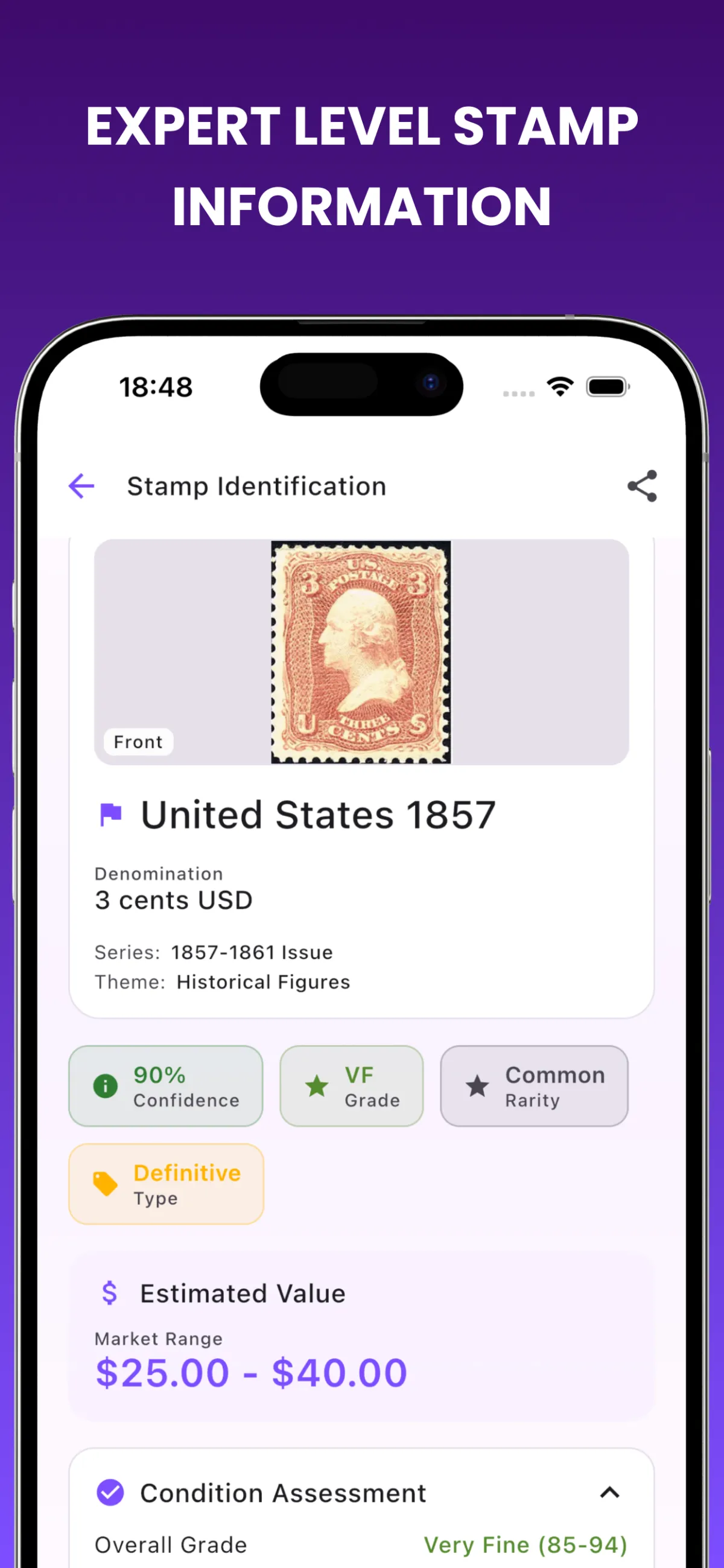
This is where a stamp identifier app like StampID is useful. Photograph the front of the stamp and the app returns the country, era, and likely catalogue listing — along with which watermark that issue carries. You can then use the methods below to confirm.
Free · iOS & Android
Skip the catalogue: photograph the stamp
StampID reads country, era, catalogue listing and a value range from one photo of the front. Scan first, then use this guide to verify the details.
What Are Watermarks?
A watermark is a deliberate thinning of paper in a specific pattern, created during the papermaking process by pressing a wire design (called a "dandy roll" or "watermark bit") into the wet paper pulp. The compressed areas dry thinner than the surrounding paper, creating a translucent pattern visible when held to light or treated with detection fluid.
Postal authorities used watermarked paper as a security measure to prevent counterfeiting, much as banknotes use watermarks today. Because different watermarks were used across different periods and printings, they serve as reliable markers for dating and cataloguing stamps.
History of Watermarks in Stamps
Watermarked stamp paper dates back to the world's first stamps in 1840 and remained in widespread use into the mid-20th century. Great Britain's first stamps of 1840, the Penny Black and Two Pence Blue, were printed on paper watermarked with a small crown. This tradition continued throughout the Victorian era, with the watermark design changing periodically to reflect new reigns and security needs. The Small Crown watermark gave way to the Large Crown in 1855, followed by the Anchor, Orb, and Imperial Crown designs.
The United States introduced watermarked stamp paper in 1895 with the "USPS" double-line watermark, switching to a single-line "USPS" in 1910. US revenue stamps used the "USIR" (United States Internal Revenue) watermark. Many other countries adopted their own distinctive watermarks, including the Multiple Crown CA used across the British Commonwealth.
Common Watermark Types
Watermarks can be broadly divided into single watermarks (one design per stamp) and multiple or all-over watermarks (a repeating pattern across the entire sheet so that each stamp shows part of the design).
| Watermark Type | Country | Period | Description |
|---|---|---|---|
| Small Crown | Great Britain | 1840-1854 | Small crown centered on each stamp; used on Penny Black and early line-engraved issues |
| Large Crown | Great Britain | 1855-1862 | Larger crown design replacing the small crown |
| Anchor | Great Britain | 1867-1880 | Used on high-value stamps (5s and above) |
| Orb | Great Britain | 1867-1880 | Maltese cross atop a globe; used on certain surface-printed issues |
| Imperial Crown | Great Britain | 1880-1902 | Crown with cross pattée; standard late-Victorian watermark |
| Crown CA | British Commonwealth | 1882-1921 | Crown over the letters "CA" (Crown Agents); used across dozens of colonies |
| Multiple Crown CA | British Commonwealth | 1921-1948 | Repeating pattern of Crown and CA across the full sheet |
| Double-line USPS | United States | 1895-1910 | Letters "USPS" in double-line capitals, one watermark per stamp |
| Single-line USPS | United States | 1910-1916 | Letters "USPS" in single-line capitals |
| USIR | United States | 1898-1914 | "USIR" watermark for Internal Revenue stamps |
| Star | India, Italy | Various | Star design; India used a single star and later multiple stars |
| Multiple Rosette | Netherlands | 1924-1940s | Repeating rosette pattern across the sheet |
| Lozenges | Germany | 1872-1920s | Diamond-shaped pattern used on Imperial and Weimar issues |
Watermark Detection Methods
There are four ways to determine a stamp's watermark: a detection-fluid tray (most reliable), backlighting (safest), high-resolution scanning, or reading it off a catalogue match. Each method is explained below, with its strengths and risks.
Watermark Tray with Detection Fluid
The traditional and most reliable method. Place the stamp face-down in a shallow black tray and apply a few drops of watermark detection fluid. The fluid makes the paper temporarily translucent, revealing the watermark as a darker area against the lighter surrounding paper.
Historically, collectors used benzine (petroleum ether) or carbon tetrachloride. Both are now discouraged or banned due to health and environmental risks. Modern alternatives include commercially sold watermark fluids that are safer to use. Lighter fluid (naphtha) remains popular and is readily available, though it should always be used in a well-ventilated area.
Backlighting Method
Hold the stamp up to a strong light source or place it on a light box. Some watermarks, particularly bold or deeply pressed ones, can be seen without any fluid. This non-invasive method works well for thick watermarks like the British Crown designs but may fail on subtle watermarks or heavily printed stamps where the ink obscures the paper.
Digital Detection by Scanning
Scan the stamp at high resolution (1200 dpi or higher) and adjust the brightness, contrast, and levels in image editing software. Darkening the image often reveals watermark patterns. Infrared scanning, available on some specialised philatelic scanners, can reveal watermarks that are invisible to the naked eye or standard light.
Catalogue Match via a Stamp Identifier App
Not strictly a detection method — but often the fastest path to the answer. A stamp identifier app like StampID identifies the stamp itself from a photo of the front, returning the country, era, and likely catalogue listing. From the catalogue you can read off which watermark the issue carries. This avoids fluid contact entirely on chalk-surfaced or fugitive-ink stamps, and is much faster than setting up a tray. See the shortcut section above for when it works and when it doesn't.
Watermarks by Country
Each postal authority used its own distinctive watermarks, so the watermark design itself often points to a country: crowns and ciphers for Great Britain, "USPS" letters for the United States, stars for India, and lozenges for Imperial Germany. The country-by-country breakdown below lists the key designs and dates.
British Watermarks
Great Britain has the most complex watermark history of any country. Key watermarks in chronological order:
- Small Crown (1840-1854): Used on the Penny Black and all line-engraved stamps through the imperforate era.
- Large Crown (1855-1862): Introduced with the first perforated issues. Slightly larger than the Small Crown with more detailed cross at top.
- Emblems (1860-1864): Heraldic flowers of the United Kingdom (rose, thistle, shamrock) used briefly on certain printings.
- Spray of Rose (1867-1883): Floral design used on surface-printed stamps of intermediate denominations.
- Anchor (1867-1883): Ship's anchor used on high values (5 shillings and above).
- Orb (1867-1876): Globe surmounted by cross; used on specific surface-printed denominations.
- Imperial Crown (1880-1902): Crown with cross and arches; the standard late-Victorian watermark.
- Royal Cypher / Simple Cypher (1911-1922): Crown with King George V’s royal cipher (GvR); the standard watermark for early George V definitive and commemorative issues.
- Block Cypher (1924-1936): Multiple block-letter GvR pattern across the sheet. Note that the initials changed to GviR for the George VI reign (1936 onward), so “GvR” specifically identifies George V issues.
US Watermarks
The United States used watermarks on definitive stamps for only about two decades (1895-1916), making the watermark presence or absence a critical identification point for that era. The 1894 Bureau Issues without watermark and the 1895 issues with the double-line USPS watermark are otherwise identical in design, yet catalogue values can differ substantially. After 1916, US stamps were printed on unwatermarked paper.
Other Countries
India: Used a star watermark from 1856, then multiple stars, and later the Ashoka Pillar design. Indian watermarks are among the most commonly encountered in worldwide collections.
Germany: Imperial Germany used lozenges (diamond shapes) as watermarks. The Weimar Republic introduced a network or mesh watermark, and later issues used eagle watermarks during the Third Reich period.
Italy: Used the Crown watermark for the monarchic period and switched to a star design after becoming a republic in 1946. The winged wheel watermark was used for certain issues.
How Watermarks Affect Value
A different watermark can change a stamp's value by 8x to 60x, because it usually places the stamp in a different catalogue listing — making watermark differences among the largest value multipliers in philately. The examples below show typical price gaps:
| Stamp | Common Watermark | Scarce Watermark | Value Difference |
|---|---|---|---|
| GB 1862 3d Rose (SG 77/78) | Emblems (~$80) | No watermark (~$3,500) | 40x+ |
| India 1856 ½a Blue | Star (~$5) | No watermark (~$200) | 40x |
| US 1894-1895 1c Franklin | Double-line USPS (~$3) | Unwatermarked (~$25) | 8x |
| Cape of Good Hope 1d | Crown CA (~$10) | Anchor (~$600) | 60x |
| Ceylon 1886 5c on 4c | Crown CA (~$5) | Crown CC (~$250) | 50x |
Inverted or reversed watermarks (see below) can also carry premiums, though usually more modest than entirely different watermark types.
Watermark Orientation
A watermark can appear in four orientations relative to the stamp design:
- Normal: The watermark reads correctly when viewed from the back of the stamp with the design upright. This is the standard orientation.
- Inverted: The watermark is upside down relative to the stamp design. Occurs when the paper sheet was fed into the press rotated 180 degrees.
- Reversed: The watermark reads as a mirror image. Occurs when the paper was fed with the wrong side facing the plate.
- Inverted and reversed: Both inverted and mirror-imaged. The paper was fed upside down and backwards.
For letters and asymmetric designs, orientation is easy to determine. For symmetrical watermarks like a simple crown or star, only inversion can be detected, not reversal. Catalogues such as Stanley Gibbons consistently note watermark varieties, and some orientations command premiums of 2x to 10x over the normal position.
Multiple Watermarks and Sheet Patterns
Multiple or all-over watermarks consist of a repeating pattern that covers the entire sheet of paper. Individual stamps may show only a portion of the watermark pattern, and stamps at the edges of the sheet may show very little watermark at all. This can make identification challenging.
When examining stamps with multiple watermarks, look for any fragment of the pattern: a crown tip, part of a letter, or a section of a repeating design. Comparing multiple copies of the same stamp can help reconstruct the full watermark pattern. Some stamps from the sheet margins will show a sheet watermark or marginal inscription (such as a manufacturer's name) instead of the stamp watermark pattern.
Common Watermark Identification Mistakes
The most common watermark errors are mistaking paper mesh for a design, misreading a partial all-over watermark as "no watermark," ignoring orientation, using fluids that dissolve the ink, and assuming dark stamps have no watermark. Each is explained below.
- Confusing paper mesh for a watermark: The weave pattern of the paper itself can look like a watermark under fluid. A true watermark has a distinct design; mesh is a regular grid.
- Misreading partial watermarks: On stamps with all-over watermarks, only a fragment may be visible. Do not assume "no watermark" without checking multiple stamps from the same issue.
- Ignoring orientation: Especially for lettered watermarks like "USPS" or "CA", note whether the letters are upright, inverted, or reversed.
- Damaging stamps with unsuitable fluids: Some inks dissolve in solvents. Aniline inks on certain German and Swiss stamps are notoriously fugitive. Always test on a duplicate first.
- Assuming no watermark on dark stamps: Heavily inked or dark-coloured stamps can completely obscure watermarks. Use fluid detection rather than backlighting for these.
Free · iOS & Android
Identify the stamp first — the catalogue tells you the watermark
StampID identifies stamps from a photo of the front — country, era, catalogue listing, value. From the catalogue match you can read off which watermark to expect, often avoiding fluid contact entirely on chalk-surfaced and fugitive-ink stamps.
Rated 4.6 on Google Play · 4.4 on App Store
Frequently Asked Questions
What is a watermark on a stamp?
A stamp watermark is a deliberate thinning of the paper in a specific pattern, created during papermaking by pressing a wire design into the wet pulp. The compressed areas dry thinner and appear translucent when held to light or treated with detection fluid. Postal authorities used watermarks as a security measure against counterfeiting.
How do I detect a watermark on a stamp?
Three traditional methods: (1) place the stamp face-down in a black tray and apply watermark detection fluid (lighter fluid / naphtha) to make the paper translucent; (2) hold the stamp up to a strong light or place it on a light box; (3) scan it at 1200 dpi or higher and adjust contrast in image software. A fourth shortcut is to identify the stamp's catalogue listing first — the catalogue will tell you the expected watermark.
How can I see the watermark on a stamp at home?
Start with the no-risk option: turn the stamp face-down on a black surface and shine a phone torch through it at a low angle, or hold it against a bright window. Bold watermarks such as the British crowns usually show up this way. If you can't see anything, scan or photograph the back and raise the contrast. Use watermark fluid only after checking that the stamp is not on chalk-surfaced paper and was not printed with fugitive inks.
Is there a stamp watermark detector app?
A phone camera cannot see through paper the way detection fluid does, so no app can reliably read a faint watermark on its own. What an app like StampID can do is identify the stamp from a photo of the front and give you its catalogue listing, which tells you which watermark that issue should carry. You then only need a quick backlight check to confirm it. For varieties that differ only by watermark, you still need fluid, a light box or a dedicated electronic watermark detector.
What's the safest watermark detection method for a valuable stamp?
Backlighting is safest because it involves no chemical contact. For stamps printed on chalk-surfaced paper (Edward VII surface-printed issues, early George V, many Commonwealth) or with fugitive inks (German Germania, Swiss Helvetia), never use detection fluid — it causes permanent damage. Use a light box or photograph the back of the stamp with camera flash and inspect the image.
Can I detect a watermark without using fluid?
Yes. Backlighting and high-resolution scanning both work without fluid. Both are weaker than fluid detection on faint or heavily inked stamps but completely safe on chalk-surfaced and fugitive-ink stamps where fluid would cause permanent damage.
What is watermark detection fluid, and which one should I buy?
Watermark detection fluid is a fast-evaporating solvent that makes stamp paper temporarily translucent, revealing the watermark as a darker pattern without harming the gum or most inks. Buy a purpose-made philatelic watermark fluid from a stamp supply dealer — the historic alternatives (benzine, carbon tetrachloride) are banned or hazardous, and lighter fluid (naphtha), while popular, needs good ventilation. Never use any fluid on chalk-surfaced paper or fugitive-ink stamps: the damage is permanent. See the fluid method section for the full procedure and safety list.
Why do watermarks affect stamp value?
Watermark varieties can dramatically change which catalogue listing a stamp belongs to. Two stamps identical in design, colour and perforation can be worth 10× to 60× different amounts based solely on watermark (e.g., GB 1862 3d Rose SG 77 ~$80 vs SG 78 with no watermark ~$3,500; Cape of Good Hope 1d Crown CA ~$10 vs Anchor ~$600).
Sources
- CDC / ATSDR ToxFAQs — carbon tetrachloride toxicity, the basis for its withdrawal from watermark detection
- American Philatelic Society — collector education and expertizing resources
- Linn's Stamp News — philatelic press coverage of detection methods and paper varieties