Perforation Gauge — How to Measure Stamp Perfs (Complete Guide)
Perforation Measurement
Measure your stamp's perf gauge — or take the catalogue shortcut
Measuring perforations traditionally means a printed gauge card and a careful slide-and-align. There's also a faster path: if you identify the stamp's catalogue listing first, the catalogue tells you the expected perforation — usually turning measurement into a one-second sanity check.
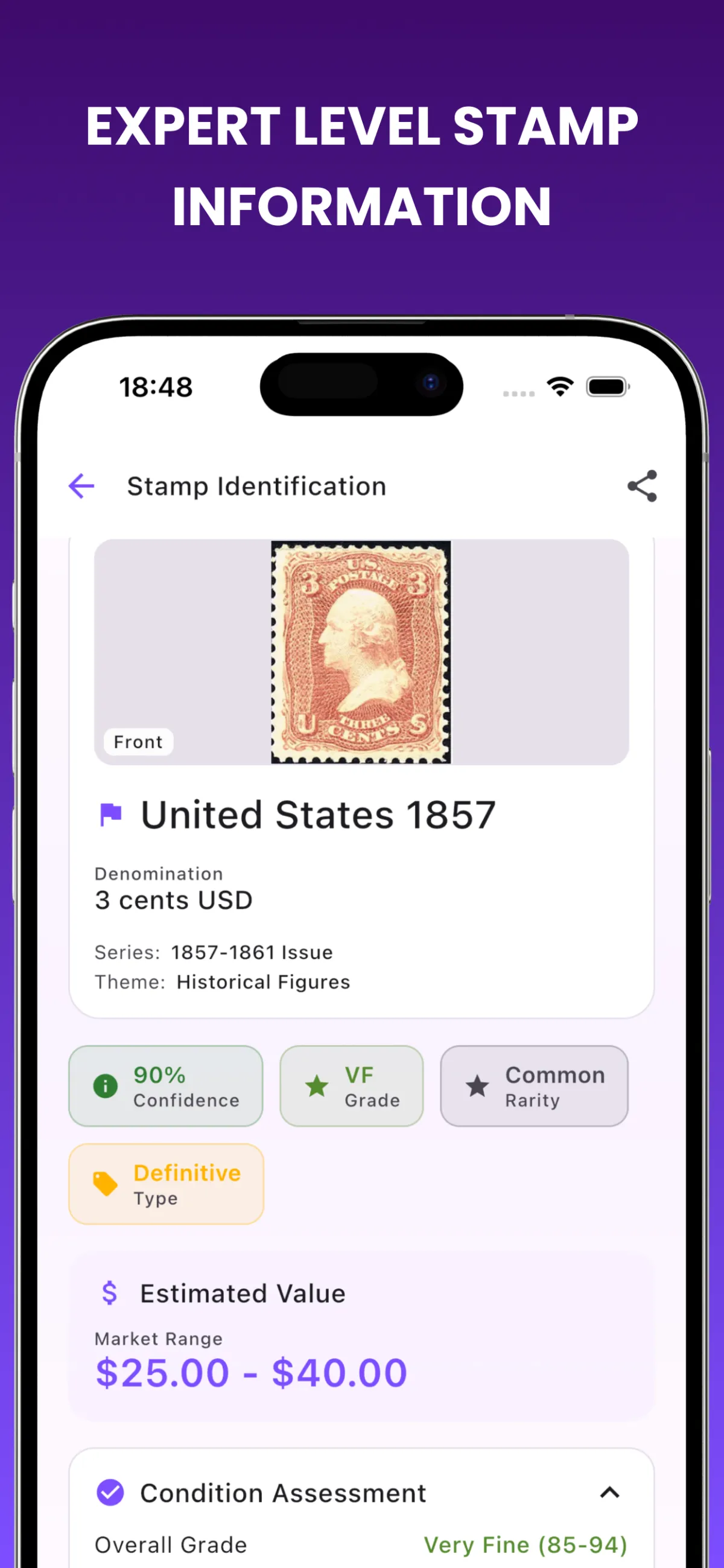
Perforations are among the most important features for identifying and valuing postage stamps. A single half-gauge difference can turn an ordinary stamp into a rarity worth thousands of dollars. This guide covers how to use a perforation gauge step by step (grab the free printable gauge PDF below), the perf types you'll encounter (line, comb, harrow, compound), and a catalogue-based shortcut using a stamp identifier app that often resolves the question without measurement at all.
Free download · PDF
Free Printable Perforation Gauge (PDF)
Download our free perforation gauge, print it at 100% / "Actual size" (not "fit to page"), and measure any stamp in seconds. It covers every common gauge from 7 to 16 and includes a 100 mm calibration bar so you can confirm your printout is to scale.
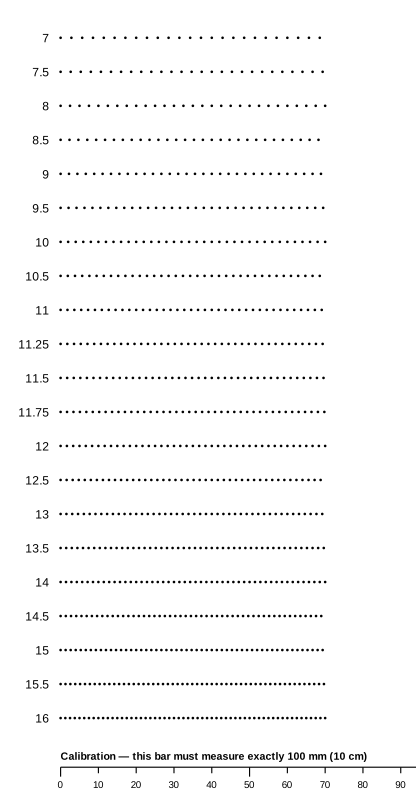
No signup. Verify the 100 mm bar with a ruler before measuring.
The Shortcut: Identify the Stamp First
If you can identify the stamp's catalogue listing first, you usually don't need to measure at all — catalogues (Stanley Gibbons, Scott, Michel, Yvert) list the expected perf gauge for each variant, so a known match already implies the perforation. Measurement then becomes confirmation rather than discovery.
StampID identifies stamps from a photo of the front and returns the catalogue context, including the perforation that variant is known to have. Faster than setting up the gauge for most identification jobs.
Free · iOS & Android
Skip the catalogue: photograph the stamp
StampID reads country, era, catalogue listing and a value range from one photo of the front. Scan first, then use this guide to verify the details.
What Are Stamp Perforations?
Perforations are the small holes punched between stamps on a printed sheet, allowing individual stamps to be torn apart cleanly. They are described by a number representing the count of perforation holes (including the two end holes) that fit within a span of two centimetres. A stamp described as "Perf 12" has 12 holes per 2 cm along each side.
Perforations matter for two critical reasons. First, they help identify exactly which printing or issue a stamp belongs to, since postal authorities frequently changed perforation gauges between printings. Second, perforation varieties can dramatically affect a stamp's market value. The same design perforated 11 versus perforated 12 may differ in price by a factor of ten or more.
A Brief History of Stamp Perforations
The world's first postage stamps, including the Penny Black of 1840, were issued without perforations. Postal clerks had to cut stamps apart with scissors, a slow and imprecise process. In 1848, Irish inventor Henry Archer patented a perforating machine that punched rows of holes between stamps. After extensive trials, Great Britain adopted official perforations in January 1854, becoming the first country to issue perforated stamps for regular use.
Other nations quickly followed: the United States introduced perforated stamps in 1857, and by the 1860s most major postal administrations had adopted the technology. Early perforating machines were inconsistent, producing gauges that varied from sheet to sheet, which is why perforation measurement is so important for identifying classic-era stamps.
How to Use a Perforation Gauge (Step by Step)
Accurate measurement requires a perforation gauge, a ruler-like tool printed with rows of dots at different spacings — like the free printable one above. To use one:
- Place the stamp on the gauge so that one row of perforations (or perforation holes along one edge) sits along the printed dots.
- Slide the stamp along the gauge until the teeth or holes align perfectly with a printed row.
- Read the number printed beside that row. This is the perforation gauge.
- Repeat for all four sides. If the horizontal and vertical gauges differ, you have a compound perforation.
Standard notation lists the top/bottom gauge first, then the side gauge. A stamp that is Perf 11 x 12 has 11 holes per 2 cm across the top and bottom, and 12 along the sides.
Types of Perforation
There are three main methods of perforating stamps — line, comb, and harrow — distinguished by how many sides are punched in a single stroke and how cleanly the corners align.
Line Perforation
The simplest and earliest method. A single row of pins punches one line of holes at a time, either horizontally or vertically. Because horizontal and vertical lines are punched in separate operations, the holes at the corners of stamps rarely align perfectly. Line perforations are identified by their slightly ragged or uneven corners. Most 19th-century stamps use line perforation.
Comb Perforation
A comb-shaped device punches three sides of a stamp row simultaneously: the top (or bottom) and both vertical sides. This produces neat, consistent corners because horizontal and vertical holes are punched in the same stroke. Comb perforation became standard in the early 20th century and remains common today.
Harrow Perforation
An entire sheet is perforated in a single strike, with pins arranged in a grid matching the full sheet layout. Harrow perforation produces the cleanest results, with perfectly aligned corners on every stamp. It requires precision-engineered equipment and is used mainly by advanced printing bureaus.
Common Perforation Gauges by Country
Most stamps fall within a narrow band of gauges — roughly Perf 10 to 16 — but each country favoured specific values during specific eras. The table below summarises the gauges you are most likely to encounter, by country and period.
| Country | Common Gauges | Period | Notes |
|---|---|---|---|
| United States | 10, 11, 12 | 1857 onwards | Perf 10 most common on early issues; Perf 11 common 20th century |
| Great Britain | 14, 15, 16 | 1854 onwards | Perf 14 standard for Victorian era; Perf 16 used 1854-1856 |
| France | 13½, 14 | 1862 onwards | Perf 14 x 13½ common on early Empire issues |
| Germany | 13½, 14, 14¼ | 1872 onwards | Imperial Eagle issues vary between 13½ and 14 |
| Canada | 11½, 12 | 1859 onwards | Perf 12 standard for Pence and Cents issues |
| Australia | 11, 12, 13½, 14 | 1913 onwards | Kangaroo series shows multiple gauge changes |
| Japan | 11½, 12, 13 | 1872 onwards | Cherry Blossom issues perforated 9½ to 13 |
Compound Perforations
A compound perforation is one where a stamp has different gauges on its horizontal and vertical sides, written as two numbers separated by "x" with the horizontal gauge first — for example, Perf 14 x 15 means 14 across the top and bottom and 15 on the sides. This occurs most often with comb perforation machines, where the horizontal and vertical pin rows are set at different spacings.
Compound perforations are particularly important for identifying Australian Kangaroo and King George V issues, Canadian Admirals, and many British Commonwealth stamps of the 1910s-1930s. Some compound combinations are scarce and command significant premiums.
Imperforate vs. Perforated Varieties
An imperforate stamp has no perforations at all and must be separated by cutting, whereas a perforated stamp has punched holes for clean tearing — and many designs exist in both forms. Early issues were released imperforate before perforating machines were available. Later, some stamps were intentionally released imperforate for collectors or for use in coil-dispensing machines. Accidental imperforates, where the perforating step was missed during production, are among the most valuable errors in philately.
A stamp described as "imperforate between" means a pair or strip of stamps is missing perforations between the individual stamps while retaining perforations on the outer edges. These errors occur when a sheet passes through the perforating machine misaligned. Such errors must be collected in pairs or larger multiples to prove the missing perforations, since a single stamp trimmed with scissors could mimic an imperforate.
Rouletting vs. Perforation
Rouletting is a separation method that cuts or scores the paper between stamps without removing any paper. Unlike perforations, which punch out small discs of paper, roulettes leave the paper intact but weakened along a line of cuts. Rouletted stamps have intact edges with small slits rather than the distinctive teeth of perforated stamps.
Common roulette types include: line roulette (straight cuts), arc roulette (curved cuts), serpentine roulette (wavy cuts), and pin roulette (tiny pinholes that do not remove paper). Finland and some South American countries used rouletting extensively in the 19th century.
Perforation Errors and Varieties
Perforation errors are highly sought after by collectors. The most important types include:
- Blind perforations: Holes that are only partially punched, leaving the paper indented but not fully pierced. Common on worn perforating equipment.
- Shifted perforations: The entire perforation pattern is displaced relative to the stamp design, causing the design to appear off-centre or showing parts of the neighbouring stamp.
- Missing perforations: One or more sides completely lack perforations. "Imperforate between" errors on pairs are particularly valuable.
- Double perforations: Two rows of perforations where only one should exist, caused by a sheet passing through the machine twice.
- Misaligned perforations: Vertical and horizontal perforations do not meet at the corners, common with line perforation.
When Perforations Change Value Dramatically
Perforation gauge differences can create enormous value disparities. Here are real-world examples:
| Stamp | Common Perf | Scarce Perf | Value Difference |
|---|---|---|---|
| US 1908 1c Franklin (Scott 331/348) | Perf 12 (~$5) | Perf 10 coil waste (~$500+) | Up to 100x |
| GB 1855 1d Red (SG 17/C6) | Perf 14 (~$20) | Perf 16 (~$800) | 40x |
| Australia 1913 1d Kangaroo | Perf 12 (~AU$15) | Perf 11 (~AU$300) | 20x |
| Canada 1912 1c Admiral | Perf 12 (~CA$3) | Perf 8 coil (~CA$150) | 50x |
Imperforate errors are even more dramatic. A common US stamp worth $1 in its normal perforated form can be worth $500 or more as an imperforate error pair, provided it can be authenticated.
Tools for Measuring Perforations
You can measure perforations four ways: a traditional printed or metal gauge, a printable PDF gauge, on-screen digital measurement of a high-resolution scan, or a catalogue match from a stamp identifier app. Each is described below.
Traditional perforation gauges: Printed cards or metal rulers with graduated dot patterns. The Instanta gauge and the Stanley Gibbons Collecta gauge are two well-known commercial options. Most cost between $5 and $15.
Printable gauges: Download our free printable perforation gauge (PDF), print it at 100% / "Actual size", and confirm the 100 mm calibration bar with a ruler before relying on it — printer scaling can otherwise introduce errors.
Digital measurement: High-resolution scans (600 dpi or higher) can be measured on screen using image software. Measure the distance between the centres of the first and last holes in a row, count the holes, and calculate the gauge.
Catalogue match via a stamp identifier app: Not strictly a measurement method — but often the fastest path to the answer. A stamp identifier app like StampID identifies the stamp from a photo of the front and returns the catalogue listing, which tells you the expected perforation. See the shortcut section above for when it works and when measurement is still required.
Tips for Measuring Perforations Accurately
The most reliable readings come from measuring an undamaged side under good light, confirming borderline results against the other three sides, and always cross-checking the catalogue listing. The full checklist follows.
- Use good lighting and a magnifying glass if your eyesight is not sharp.
- Measure along a side with complete, undamaged teeth whenever possible.
- If the reading falls between two gauge numbers, try the other sides of the stamp to confirm.
- For used stamps, soaking and flattening before measuring gives a more accurate result.
- Be aware that paper stretching from humidity can very slightly alter apparent gauge readings on old stamps.
- Always cross-reference your measurement with the catalogue listing for the stamp's design, colour, and date of issue.
Free · iOS & Android
Identify the stamp first — the catalogue tells you the perf gauge
StampID identifies stamps from a photo of the front — country, era, catalogue listing, value. From the catalogue match you can read off the expected perforation, often skipping the gauge entirely.
Rated 4.6 on Google Play · 4.4 on App Store
Frequently Asked Questions
What is a stamp perforation gauge?
A perforation gauge is a ruler-like tool printed with rows of dots at different spacings, used to measure the number of perforation holes (teeth) per 2 centimetres along the edge of a stamp. A stamp described as "Perf 12" has 12 holes per 2 cm. Common commercial gauges include the Instanta and the Stanley Gibbons Collecta.
How do I measure a stamp's perforation gauge?
Place the stamp on the gauge so a row of perforations sits along the printed dots. Slide the stamp until the teeth or holes align perfectly with a printed row — the number next to that row is your perforation gauge. Always measure more than one side; many stamps have compound perforations (different gauges on different sides).
What are the most common perforation gauges?
Perf 11, 11½, 12, 12½, 13, and 14 are by far the most commonly encountered gauges on classic and modern stamps. Great Britain extensively used Perf 14 and Perf 15×14. The United States used Perf 12 and Perf 10. Compound perfs (e.g., Perf 11×10½) are common on US issues from 1908 onward.
Why does perforation affect stamp value?
Postal authorities often changed perforation gauges between printings of the same design. The same stamp printed with two different gauges can be worth dramatically different amounts — sometimes 10× or more. For example, the US 1908 Washington-Franklin issues are worth substantially different sums depending on whether they are Perf 12 or Perf 10.
Can I measure stamp perforations without a gauge?
You can use our free printable PDF perforation gauge — verify accuracy against a stamp of known perforation first, since printer scaling can introduce errors. You can also measure on a high-resolution scan in image software, or use the catalogue-shortcut approach: identify the stamp's catalogue listing first and read the expected perforation from the catalogue.