The Most Valuable Stamps in the World, by Record Price
These five stamps have broken auction records, captivated collectors for over a century, and changed the course of philatelic history. From a one-cent provisional printed in a British colony to the world's very first postage stamp, here are their stories — plus a table of the most valuable stamp from every major collecting country.
Fastest Method
Try this in the app now.
Scan any stamp with StampID to instantly identify it, check its rarity, and estimate its market value.
AI-powered identification, fast scan, free to install.
Record-Breaking Rarities
Five stamps. Centuries of history. Millions at auction.
From printing errors to colonial provisionals, these stamps represent the pinnacle of philatelic value.
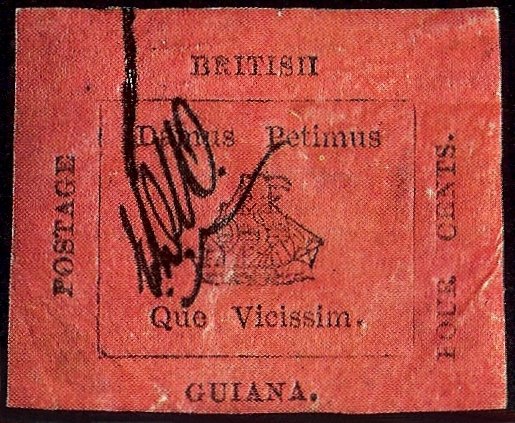
British Guiana 1c Magenta, 1856. Image by Ecphora. Public domain, via Wikimedia Commons.
The 5 most valuable stamps at a glance
| Stamp | Country | Year | Estimated value | Known copies |
|---|---|---|---|---|
| British Guiana 1c Magenta | British Guiana | 1856 | $8.3 million | 1 |
| Inverted Jenny (C3a) | United States | 1918 | $1.6–4.9 million | ~100 |
| Treskilling Yellow | Sweden | 1855 | ~$2.3 million | 1 |
| Mauritius “Post Office” | Mauritius | 1847 | $1–4 million | ~27 |
| Penny Black | Great Britain | 1840 | $6,000–$600,000+ | Many thousands |
Free · iOS & Android
Skip the catalogue: photograph the stamp
StampID reads country, era, catalogue listing and a value range from one photo of the front. Scan first, then use this guide to verify the details.
1. British Guiana 1c Magenta (1856) — $8.3 Million
British Guiana 1c Magenta, 1856. Image by Ecphora. Public domain, via Wikimedia Commons.
The British Guiana 1c Magenta is the undisputed king of stamps. Only one copy is known to exist, making it the rarest stamp in the world.
The story
In 1856, a shipment of stamps from England failed to arrive in British Guiana (modern-day Guyana). The colony's postmaster, E.T.E. Dalton, commissioned the local newspaper, the Royal Gazette, to print provisional stamps. They produced crude, small stamps on magenta paper, featuring a ship and the colony's Latin motto: “Damus Petimus Que Vicissim” (“We give and expect in return”).
The stamp was forgotten until 1873, when 12-year-old L. Vernon Vaughan discovered it among family papers. He sold it to a local collector for six shillings. From there, it passed through the hands of several prominent philatelists.
Ownership history
The stamp's provenance reads like a who's who of philately. Vaughan sold it to N.R. McKinnon, who sold it to a Liverpool dealer. It eventually reached the legendary collector Philippe la Renotiere von Ferrary, whose collection was seized by France as war reparations after World War I. American textile magnate Arthur Hind purchased it at auction in 1922 for $32,500. After further sales it passed to John du Pont, and then shoe designer Stuart Weitzman, who consigned it to Sotheby's in 2014, where it sold for $9.48 million (including buyer's premium). Stanley Gibbons acquired it shortly after.
2. Inverted Jenny (1918) — Up to $4.9 Million
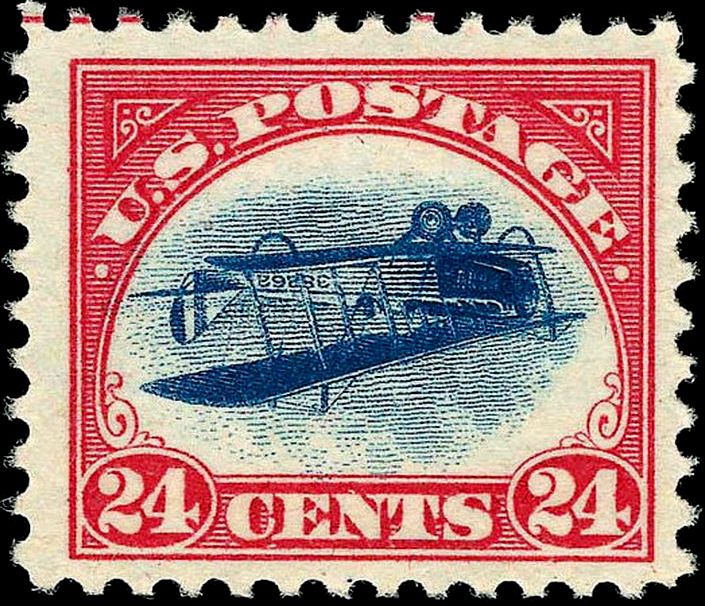
Inverted Jenny, 24c, 1918. Bureau of Engraving and Printing. Public domain, via Wikimedia Commons.
The Inverted Jenny is America's most famous stamp error and one of the most recognizable stamps in the world. It shows a Curtiss JN-4 biplane — printed upside down.
The story
On May 14, 1918, stamp collector William T. Robey walked into the New York Avenue post office in Washington, D.C. to buy the new 24-cent airmail stamps. He noticed that the blue airplane vignette on one full sheet of 100 stamps was inverted. He bought the entire sheet for $24. The next day, he sold it to dealer Eugene Klein for $15,000, who promptly sold it to Colonel Edward H.R. Green for $20,000.
Colonel Green broke the sheet apart into singles and blocks, scattering the stamps across the collecting world. Today approximately 100 copies survive. A plate block of four sold for $4.9 million in 2005. Individual stamps regularly sell for over $1 million.
The printing error
The 24-cent airmail stamp required two printing passes: one for the red frame, another for the blue airplane. When the sheet was fed through the press a second time, it was turned the wrong way, resulting in the inverted center. This type of error was possible only with the older flat-plate printing method.
- Genuine copies are on the correct unwatermarked paper used in 1918.
- Perforation gauge is 11.
- The blue vignette is clearly inverted relative to the red frame.
- Known forgeries exist — expert certification (PSE or PF) is essential for any claimed example.
- Each of the 100 stamps has a recorded position number from the original sheet.
3. Treskilling Yellow (1855) — ~$2.3 Million
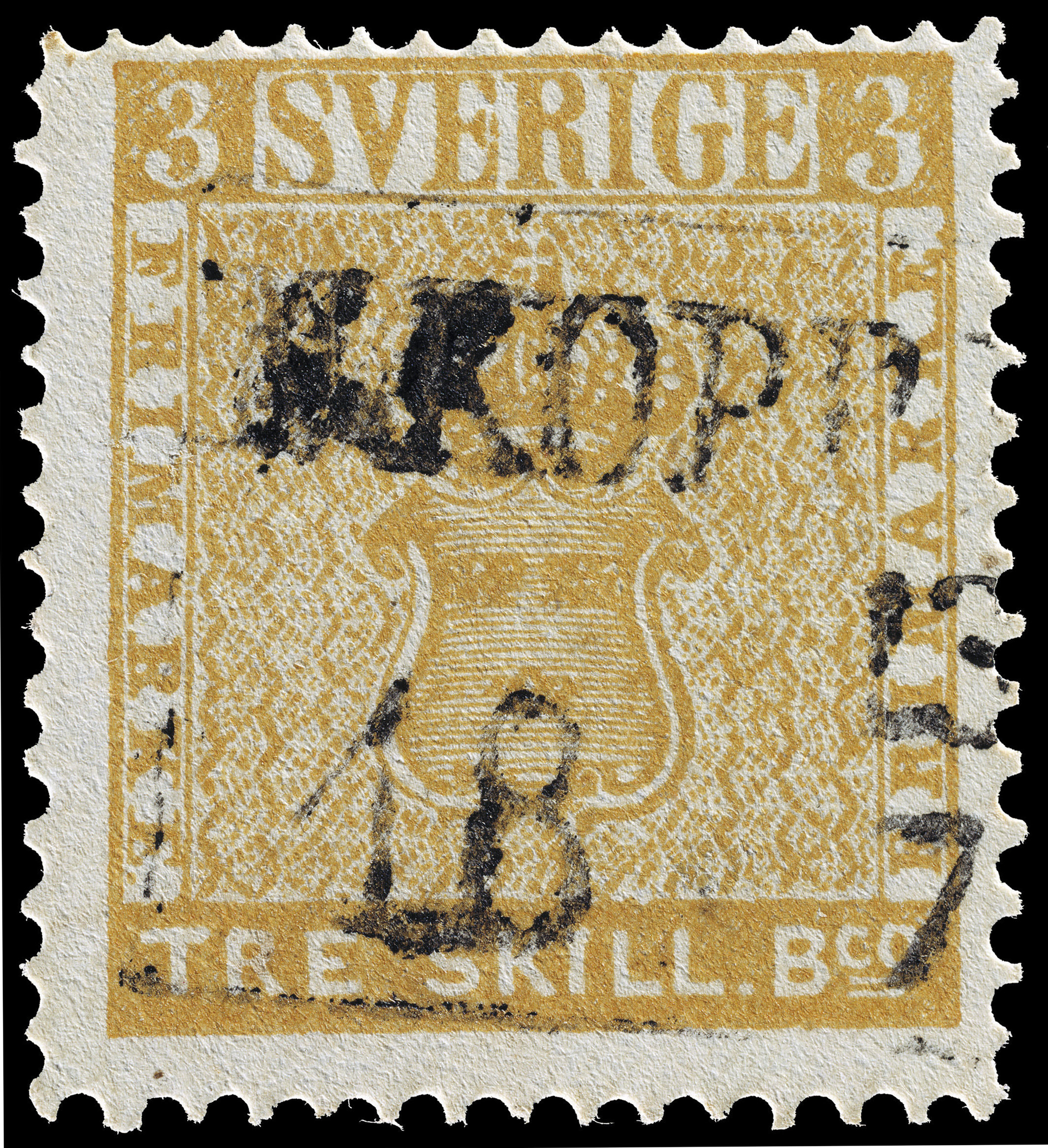
Treskilling Yellow, 1855. Image by P.A. Sparre. Public domain, via Wikimedia Commons.
The Treskilling Yellow is Sweden's most famous stamp and one of the greatest mysteries in philately. It should have been printed in blue-green, but this single copy was printed in yellow instead.
The story
Sweden's first postage stamps were issued in 1855. The 3-skilling banco denomination was printed in blue-green. But somehow, one copy was printed in yellow — the color assigned to the 8-skilling banco value. How this happened remains debated to this day.
The error stamp was discovered in 1886 by a schoolboy named Georg Wilhelm Backman, who found it on a letter in his grandmother's attic. He sold it to a local dealer for seven kronor. Over the following decades, it passed through several prominent collections.
The mystery
Philatelic experts have debated whether the Treskilling Yellow was printed from the wrong plate, or whether a sheet of yellow paper intended for the 8-skilling value was accidentally used for the 3-skilling printing. The stamp has been authenticated multiple times, though a small minority of experts have questioned its genuineness. It was last sold privately around 1996 for an estimated $2.3 million.
4. Mauritius “Post Office” Stamps (1847) — $1–4 Million
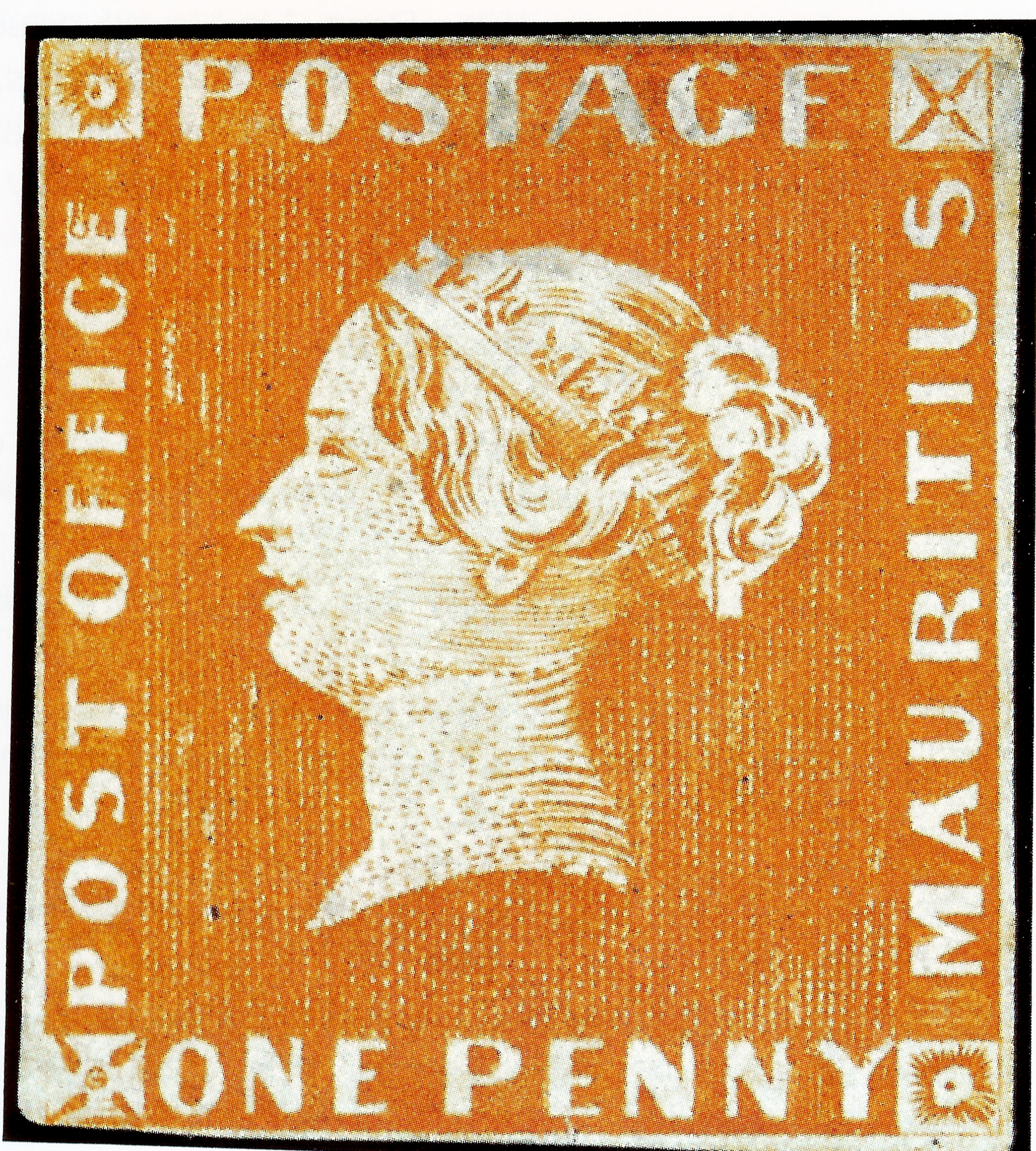
Mauritius “Post Office” 1d orange, 1847. Engraved by J.O. Barnard. David Feldman SA catalog. Public domain, via Wikimedia Commons.
The Mauritius “Post Office” stamps are among the earliest stamps issued outside of Great Britain and rank among the most sought-after stamps in philately.
The story
In September 1847, the governor of Mauritius, Sir William Gomm, needed stamps for an upcoming ball invitation. He commissioned Joseph Osmond Barnard, a local watchmaker and part-time engraver, to create the colony's first postage stamps. Barnard engraved two copper plates: a 1d orange and a 2d blue, both featuring a profile of Queen Victoria.
The key feature is the inscription on the left side. The first prints read “Post Office” rather than the intended “Post Paid.” Whether this was an error or deliberate remains debated. Around 500 of each value were printed with the “Post Office” inscription before the plates were corrected.
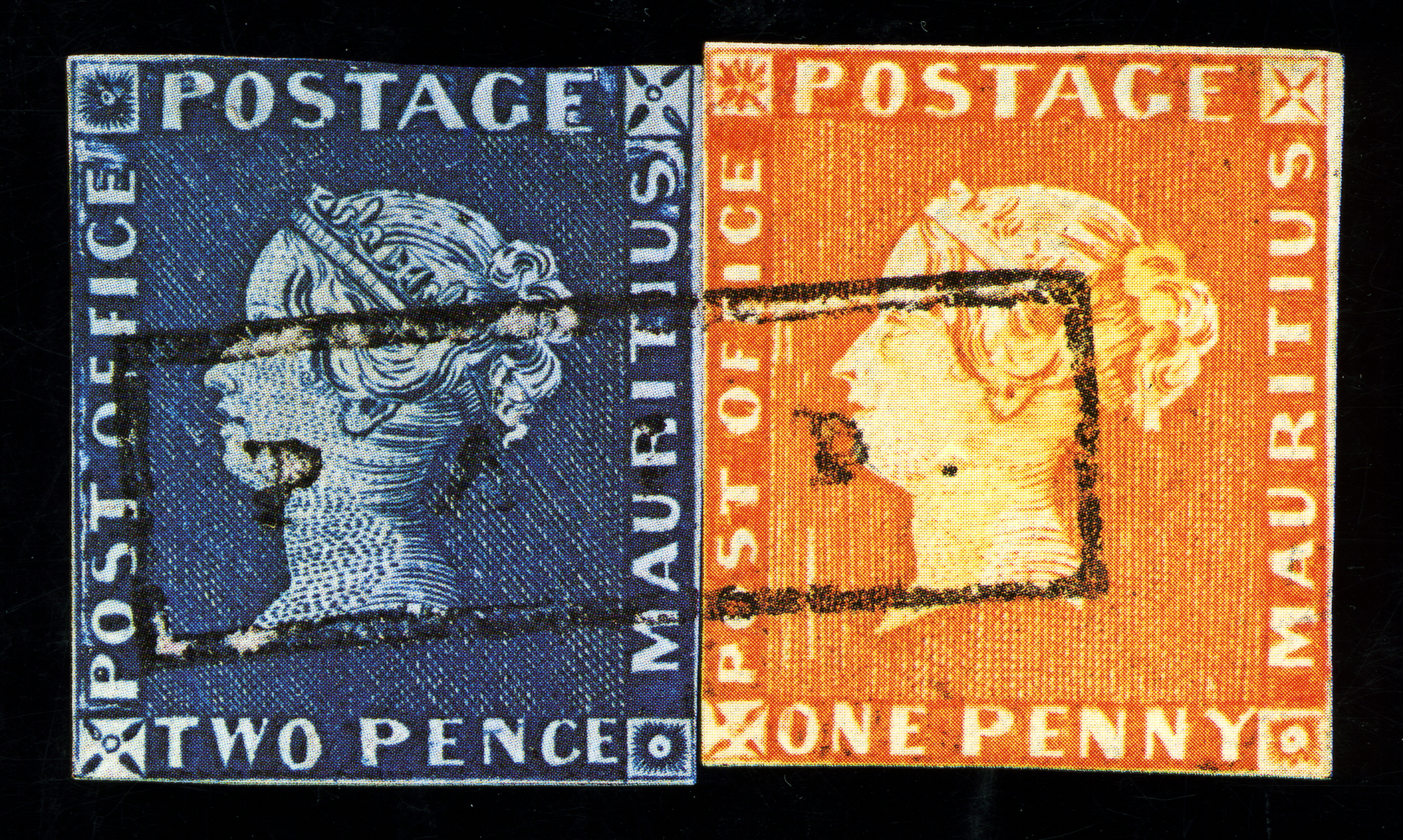
Mauritius “Post Office” 2d blue and 1d orange, 1847. J.O. Barnard. Jakubek 1985 auction catalog. Public domain, via Wikimedia Commons.
Surviving copies and famous items
Approximately 27 copies of the “Post Office” stamps survive today (both values combined). The most famous philatelic item featuring these stamps is the “Bordeaux Cover” — an envelope bearing both the 1d orange and 2d blue “Post Office” stamps. It is considered one of the most valuable philatelic items in existence.
- The critical distinction is “Post Office” (rare, 1847) vs “Post Paid” (later, much more common).
- Check the left-side inscription carefully — this is what determines value.
- The stamps are imperforate (no perforations) and engraved on yellowish paper.
- Many “Post Paid” Mauritius stamps exist and are far less valuable — do not confuse the two.
5. Penny Black (1840) — $6,000 to $600,000+
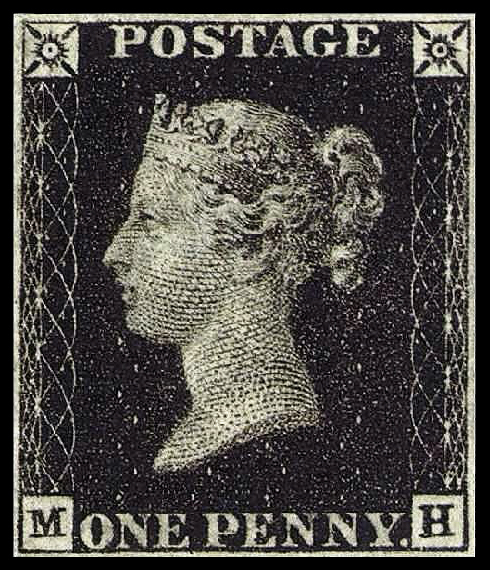
Penny Black, 1840. General Post Office of the United Kingdom. Public domain, via Wikimedia Commons.
The Penny Black is the world's first adhesive postage stamp, and quite possibly the most famous stamp ever issued. While not the most expensive per copy, its historical significance is unmatched.
The story
On May 6, 1840, the Penny Black went on sale in Great Britain. It was the brainchild of Sir Rowland Hill, who proposed a uniform penny postage rate to reform the expensive and confusing British postal system. The stamp features a profile of the young Queen Victoria, engraved from a medal by William Wyon.
The design was revolutionary: it prepaid postage, it was adhesive, and it was affordable. Within the first year, over 68 million Penny Blacks were printed from 11 different plates. However, the black ink made it difficult to see cancellation marks, leading to the quick replacement by the Penny Red in 1841.
Why values vary so widely
Because millions were printed, many Penny Blacks survive today. A heavily used copy with poor margins might sell for a few thousand dollars. But value climbs dramatically based on:
- Plate number: Plate 11 was used very briefly and is extremely rare — examples can exceed $500,000.
- Margins: Four full margins (the stamp has no perforations) command premium prices.
- Cancellation: A red Maltese cross cancellation is more desirable than the more common black one.
- Condition: Mint unused copies are exceptionally rare and can sell for six figures.
- Check the corner letters — small letters in each corner identify the stamp's position on the sheet.
- The plate number can be identified by subtle differences in the design. Specialized catalogs (SG, Scott) list plate characteristics.
- Plate 11 is the rarest — if you suspect one, seek expert certification immediately.
- The Penny Black is imperforate. If yours has perforations, it is likely a Penny Red or a later issue.
- Collectors can realistically own a Penny Black — decent examples start around $300–$500.
The most valuable stamps by country
Record-setting rarities are not limited to the five icons above. Nearly every classic stamp-issuing country has one legendary issue that dominates its national philately. The table below lists the most valuable stamp of each major collecting country — click through for the full story, identification points and surviving-copy counts of each.
| Country | Most valuable stamp | Year | Auction benchmark |
|---|---|---|---|
| United States | Inverted Jenny · 1c Z-Grill | 1918 / 1868 | Up to $4.9M · ~$3M |
| Great Britain | Penny Black · Two Penny Blue | 1840 | Up to $600,000+ |
| Guyana (British Guiana) | 1c Magenta | 1856 | $8.3 million |
| Sweden | Treskilling Yellow | 1855 | ~$2.3 million |
| Mauritius | “Post Office” issue | 1847 | $1–4 million |
| France | Cérès 1849 (1fr vermilion) | 1849 | Six figures |
| Germany (Saxony) | Saxony 3 Pfennige red | 1850 | Five figures |
| Germany (Bavaria) | Bavaria 1 Kreuzer black | 1849 | Five figures |
| Switzerland | Zurich 4 & 6 · Basel Dove | 1843 / 1845 | Five to six figures |
| Spain | 6 Cuartos 1850 | 1850 | Five figures (finest) |
| Brazil | Bull's Eye | 1843 | Five to six figures |
| Hawaii (USA) | Hawaiian Missionaries | 1851 | Six figures; famous cover over $2M |
| Canada | 12d Black | 1851 | Six figures |
| South Africa (Cape) | Cape Triangular errors | 1853 | Six figures |
| Austria | Red Mercury | 1856 | Five figures |
Benchmarks refer to the finest known examples or famous multiples; ordinary used copies of the commoner issues on this list sell for far less. See each stamp's page for realistic value ranges by condition.
Identifying which national rarity you might be holding starts with pinning down the country and era: see our guides to US stamps, British stamps, French stamps and German stamps, or browse the full famous stamps encyclopedia.
What makes these stamps so valuable?
Extreme scarcity, deep historical significance, documented provenance, condition, and intense collector demand are the five factors that drive these stamps to record prices. Each appears again and again across all five examples:
- Scarcity: Three of these stamps have only one known copy. Even the Inverted Jenny, with ~100 copies, is vanishingly rare.
- Historical significance: The Penny Black changed postal history. The Mauritius stamps represent the earliest days of colonial postage. The Inverted Jenny captures a moment in early aviation.
- Provenance: Documented ownership histories with famous collectors, auction houses, and dramatic discovery stories all add to value.
- Condition: Even among these rarities, condition matters. The Penny Black's value varies 100x based on plate number, margins, and cancellation.
- Collector demand: These stamps are philatelic icons. They attract not just stamp collectors, but investors and museums, driving prices to record levels.
Curious whether your own stamps might hold hidden value? Most valuable stamps are discovered by accident — in attics, inherited albums, and old correspondence. The stories of the British Guiana and Treskilling Yellow both began with children finding stamps in family papers.
Check your own stamps
Use StampID to scan any stamp from your collection. The app identifies the stamp, grades its condition, and estimates market value — in seconds.
Free install. AI-powered identification and valuation.
Further reading
- Rare Stamps Worth Money — What Creates Value
- Stamp Value Checker — Build Realistic Prices
- How to Identify Old Stamps — Dating Guide
- How Much Is My Stamp Worth?
- Stamp Catalog Basics — Scott, SG & Michel
Editorial note: Stamp values cited are based on publicly reported auction results and expert estimates. Market prices fluctuate. For high-value stamps, always seek professional authentication and current market comparables before buying or selling.
Frequently Asked Questions
What is the most valuable stamp in the world?
The British Guiana 1c Magenta of 1856 is the most valuable stamp in the world. Only a single copy is known to exist, and it sold for $9.48 million (including buyer's premium) at Sotheby's in 2014, making it the most expensive stamp ever sold by weight or size. It is currently owned by Stanley Gibbons.
How much is the British Guiana 1c Magenta worth?
The British Guiana 1c Magenta is valued at roughly $8.3 million, based on its last auction sale of $9.48 million (including buyer's premium) at Sotheby's in 2014. As the only known copy, it has set the record price for a single stamp four separate times since 1922.
Why is the Inverted Jenny so valuable?
The Inverted Jenny is valuable because the blue Curtiss JN-4 airplane was accidentally printed upside down on a single sheet of 100 stamps in 1918, and that one sheet is the only source of every genuine example. With only about 100 copies in existence, individual stamps regularly sell for over $1 million, and a plate block of four sold for $4.9 million in 2005.
Could I own a valuable stamp without knowing it?
Yes — many of the world's most valuable stamps were discovered by accident in attics, inherited albums, and old letters. A 12-year-old found the British Guiana 1c Magenta among family papers, and a schoolboy found the Treskilling Yellow in his grandmother's attic. Scanning inherited stamps with an app like StampID or seeking expert authentication is the fastest way to find out if you hold something rare.
Can I realistically afford to own a famous valuable stamp?
The Penny Black is the one famous icon that ordinary collectors can realistically own — decent used examples start around $300–$500 because over 68 million were printed in 1840. The four other stamps on this list (British Guiana, Inverted Jenny, Treskilling Yellow, and Mauritius "Post Office") sell for $1 million or more and are out of reach for most collectors.
Sources
- Sotheby's — The British Guiana One-Cent Black on Magenta, June 2021 auction results
- Smithsonian National Postal Museum — 1918: The Inverted Jenny
- David Feldman SA — The Sweden "Treskilling Yellow" world-record sales
- The Postal Museum, London — The first ever stamp: the Penny Black
- Blue Penny Museum, Mauritius — home of the 1847 "Post Office" stamps