Red Mercury (1856) — Austria's Rarest Newspaper Stamp
The Red Mercury (German: Rote Merkur or Zinnoberroter Merkur) is a vermilion Austrian newspaper stamp issued in 1856 to prepay bundles of ten newspapers. Because it was stuck to wrappers that were torn off and discarded, only a small number survive, making it one of the great rarities of classic European philately.
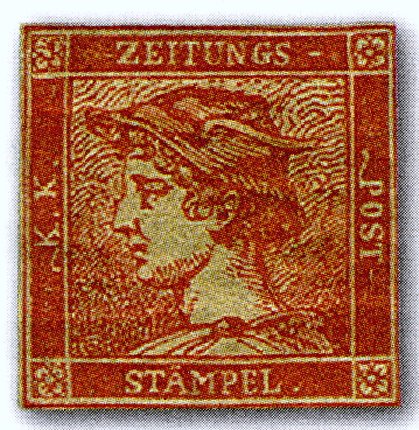
Red Mercury, 1856. Josef Axmann. Public domain, via Wikimedia Commons.

Free · iOS & Android
Think you have a Red Mercury?
Photograph it with StampID to check the type, condition and current value range in seconds — then use this page to verify the details.
How to identify a Red Mercury
All Mercury newspaper stamps share one design: the left-facing head of Mercury, the Roman messenger god, wearing a winged helmet inside a square frame inscribed K.K. ZEITUNGS POST STÄMPEL (Imperial-Royal newspaper post stamp), with small rosettes in the corners. The design was engraved by Josef Axmann and the stamps were typographed at the Imperial-Royal State Printing Works in Vienna, imperforate, so genuine copies were cut from the sheet with scissors.
Crucially, no face value is printed anywhere on the stamp — the colour alone indicated the rate. Blue paid for a single newspaper, yellow (from 1851) and later vermilion red (from 1856) paid the 6 kreuzer rate for a bundle of ten newspapers, and rose paid for larger bundles. The Red Mercury is therefore identified purely by its vivid vermilion shade combined with the standard Mercury design.
Almost every Mercury stamp a collector encounters is the common blue one. Genuine red examples are so rare and valuable that the market is full of forgeries and of blue Mercuries chemically altered to look red or rose. Colour alone is never enough: paper, printing characteristics and provenance must all be examined, and any serious candidate needs a certificate from a recognised expert in classic Austria.
History
Austria introduced the Mercury stamps on 1 January 1851 as the world's first newspaper stamps, allowing publishers to prepay the postage on newspapers sent to subscribers. The blue 0.6 kreuzer Mercury franked a single newspaper and was printed in vast quantities; the higher values served addressed bundles dispatched to agents and large subscribers.
The 6 kreuzer value for bundles of ten was first issued in yellow in 1851. The yellow ink proved impractical — the pale colour was hard to distinguish and cancellations barely showed — so in 1856 the value was reissued in a strong vermilion red. This is the stamp collectors call the Red Mercury, in use only briefly before the Mercury newspaper series was replaced by a new design in 1858.
The high-value Mercuries were attached to the wrapper or address band of the bundle, not to the newspapers themselves. Once the bundle reached the news agent the wrapper was ripped off and thrown away, which is why the blue Mercury survives in millions while the yellow and red Mercuries vanished almost completely.
Rarity and varieties
Only a few dozen genuine Red Mercuries are believed to survive, most of them used, and a number of those are repaired or with faults. Unused examples are of the utmost rarity, and pieces on the original wrapper rank among the trophies of Austrian philately. The companion Yellow Mercury of 1851 is rarer still, and the two are usually mentioned together as the keys to classic Austria.
Specialists distinguish printings on hand-made and machine-made paper as well as shade nuances from rose-red to deep vermilion. These distinctions matter for expertising, because colour-changed blue stamps and outright forgeries — some of them well over a century old themselves — make up the majority of 'red' Mercuries offered without certificates.
Anyone who believes they have found a Red Mercury should resist cleaning or pressing it and submit it, as found, to a recognised expertising authority for classic Austrian stamps. Provenance from an old collection helps considerably, since the genuine population is small and substantially documented.
Estimated value
As a broad, hedged estimate only: genuine used Red Mercuries have traded from roughly the low tens of thousands of USD for faulty or repaired examples up to well over 100,000 USD for fine certified copies, with exceptional pieces and items on the original wrapper beyond that. These are rough auction-based guides, not catalogue values. Remember the base rate: nearly all Mercury stamps found in collections are the common blue ones, often worth tens of dollars, and most red-looking Mercuries turn out to be forgeries or altered colours — only an expert certificate turns a candidate into a five- or six-figure rarity.
Free · iOS & Android
Identify your own stamps in seconds
Frequently Asked Questions
How much is a Red Mercury worth?
As a broad estimate, certified genuine examples have realised from the tens of thousands of USD up to well over 100,000 USD at auction, depending on condition, margins and provenance. Pieces on the original wrapper can bring even more. Uncertified red Mercuries trade at a heavy discount because so many are forgeries or colour-changed blue stamps.
How do I know if my Mercury stamp is the rare red one?
First check the colour: the common Mercury is blue, and only the vermilion red (1856) and yellow (1851) versions are major rarities. If your stamp genuinely appears vermilion, be cautious — chemically recoloured blue stamps and forgeries are far more common than originals. Authentication by a recognised expert in classic Austria is essential before assuming any value.
Why is there no denomination on the stamp?
The Mercury newspaper stamps carried no printed face value. The colour told postal clerks the rate: blue for a single newspaper at 0.6 kreuzer, yellow and later vermilion for the 6 kreuzer bundle rate of ten newspapers, and rose for larger bundles. This colour-coding is exactly why the rare shades are so sought after today.
What were newspaper stamps used for?
They prepaid the reduced postal rate for sending newspapers. Austria introduced them in 1851 as the first of their kind in the world. Single papers received a blue Mercury, while bundles sent to news agents and large subscribers were franked with the higher-value yellow, red or rose Mercuries attached to the wrapper.
How many Red Mercuries still exist?
Estimates vary, but only a few dozen genuine examples are generally believed to survive, most of them used and many with faults or repairs. The stamps were stuck to newspaper-bundle wrappers that were almost always destroyed on arrival, which is why so few escaped the wastebasket.