Sachsendreier (1850) — Saxony's First Stamp, 3 Pfennige Red
The Saxony 3 Pfennige red, known to collectors as the Sachsendreier, was the Kingdom of Saxony's first postage stamp, issued on 1 July 1850. Although half a million were printed, most perished on discarded newspaper wrappers, turning it into one of Germany's most celebrated classic rarities.
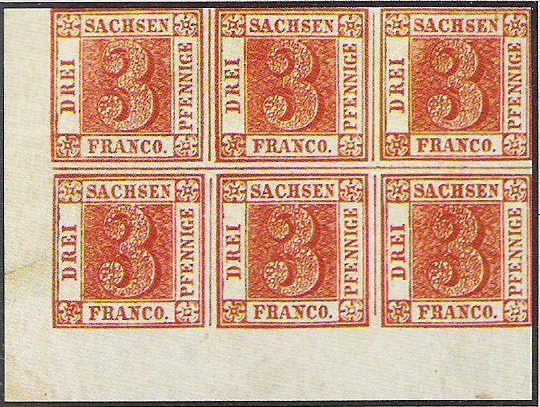
Saxony 3 Pfennige Red (Sachsendreier), 1850. Royal Saxon Post. Public domain, via Wikimedia Commons.

Free · iOS & Android
Think you have a Saxony 3 Pfennige Red (Sachsendreier)?
Photograph it with StampID to check the type, condition and current value range in seconds — then use this page to verify the details.
How to identify a Sachsendreier
A genuine Sachsendreier shows a large numeral 3 on a finely patterned ground inside a square frame, with SACHSEN across the top, FRANCO. across the bottom, DREI up the left side and PFENNIGE down the right. It was printed in red, with several distinct shades across the printings, and it is always imperforate.
The stamp was designed and printed by the J. B. Hirschfeld printing house in Leipzig using letterpress (typography), not engraving — under magnification the ink sits flat or slightly pressed into the paper rather than standing in raised lines. Sheets held only 20 stamps (five by four) assembled from individual printing blocks, so specialists distinguish numerous types, and the size of the design itself varies by up to 1.5 millimetres.
Most surviving copies are cancelled with a pen stroke, the originally prescribed method, or with town cancels; only about ten percent of survivors are unused. Do not confuse the Sachsendreier with its successor, the green 3 Pfennige coat-of-arms stamp of 1851 — the rarity is always red and always shows the big numeral.
History
Saxony introduced stamps so that it could apply the rules of the German-Austrian Postal Union, which came into force on 1 July 1850 — the very day the 3 Pfennige went on sale. That made Saxony the second German postal territory to issue stamps, after Bavaria with its Schwarzer Einser of 1849. The stamp was treated as a provisional from the outset, which explains its plain typeset look.
The 3 Pfennige paid the rate for printed matter sent under a wrapper, above all newspapers. Senders habitually stuck the stamp half on the wrapper and half on the newspaper itself — officially forbidden, but it kept the paper from sliding out. When recipients tore the wrapper off, the stamp was usually destroyed, which is the key to the stamp's rarity today. From 1 August 1851 it could also be used on letters, shortly before the green arms issue replaced it.
In total 500,000 copies were printed in eight printings on 25,000 sheets, of which 463,118 were sold; the unsold remainder was burned in Leipzig on 10 December 1851. An estimated 3,000 to 4,000 examples survive worldwide.
Rarity and varieties
With only a few thousand survivors from half a million printed, the Sachsendreier is a genuine classic rarity. Unusually, unused and used copies trade at broadly similar levels, because so few of either survive in sound condition — undamaged examples are the exception, given how the stamp was used on wrappers.
Specialists collect the stamp by printing and shade — the red varies from brick-red toward vermilion tones — and by the plate types created by the six different formes of individual blocks. The most famous piece is a complete sheet of 20 that was reportedly peeled off a wall: it passed to the legendary collector Philipp von Ferrary in 1875 and realised 620,000 Deutsche Mark at auction in 1966.
Forgeries are a serious problem: Jean de Sperati and François Fournier both produced dangerous imitations, and the Schröder collotype reproductions also circulate widely. Any Sachsendreier offered without a recent certificate from a recognised expertising body, such as the German BPP, should be treated with caution.
Estimated value
As a broad, approximate guide, sound used Sachsendreier examples typically trade somewhere in the 2,000 to 6,000 USD range, and unused copies — unusually — bring similar money. Damaged or repaired stamps, which are common given how the stamp was used, may fetch only a few hundred dollars, while premium shades, multiples and complete newspaper wrappers or covers can climb well into five figures. Catalogue listings run much higher than typical market prices, so treat these as general estimates; condition, shade and certification drive what a specific stamp actually brings.
Free · iOS & Android
Identify your own stamps in seconds
Frequently Asked Questions
Is the Sachsendreier rare?
Yes. Although 500,000 were printed, only an estimated 3,000 to 4,000 survive, because the stamp was mostly used on newspaper wrappers that were torn open and thrown away. Sound, undamaged examples are scarce, and only about ten percent of survivors are unused.
How much is a Saxony 3 Pfennige red worth?
As a broad estimate, sound used or unused examples often bring roughly 2,000 to 6,000 USD, while damaged or repaired copies may sell for a few hundred. Fine shades, multiples and stamps on complete wrappers or covers can reach five figures. These are approximate market ranges, not catalogue values, and a certificate strongly affects the price.
Why is the Sachsendreier so rare when 500,000 were printed?
Because of how it was used. The stamp paid the printed-matter rate and was typically stuck half on the newspaper wrapper and half on the newspaper, so it was destroyed when the wrapper was torn off. The unsold remainder of the printing was also burned in Leipzig in December 1851, leaving only a few thousand survivors.
How can I tell a genuine Sachsendreier from a forgery?
Genuine stamps are letterpress-printed in red with the correct plate types, and most are cancelled by pen stroke or a Saxon town cancel. Dangerous forgeries by Sperati and Fournier and the Schröder collotype reproductions exist in quantity, so comparison with reference material is rarely enough — for any serious purchase insist on a certificate from a recognised expert, such as a BPP member.
Was the Sachsendreier Germany's first stamp?
No. Bavaria issued Germany's first stamp, the Schwarzer Einser, on 1 November 1849. The Sachsendreier of 1 July 1850 made Saxony the second German state to issue stamps, and it remains the first and most famous stamp of the Kingdom of Saxony.