Penny Black (1840) — World's First Postage Stamp
The Penny Black is the world's first adhesive postage stamp, issued in Great Britain on 6 May 1840. It featured a portrait of the young Queen Victoria and launched the modern prepaid postal system that the entire world copied.
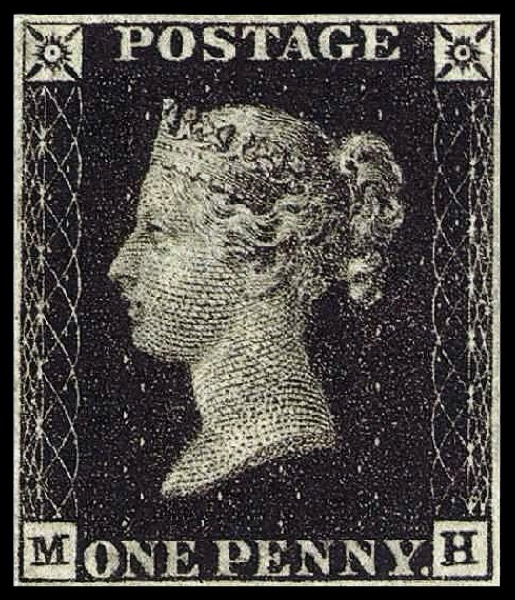
Penny Black, 1840. General Post Office of the United Kingdom. Public domain, via Wikimedia Commons.

Free · iOS & Android
Think you have a Penny Black?
Photograph it with StampID to check the type, condition and current value range in seconds — then use this page to verify the details.
How to identify a Penny Black
A genuine Penny Black shows the left-facing profile of a young Queen Victoria printed in white against a solid black background. The portrait was engraved by Charles and Frederick Heath after William Wyon's City Medal, working from a drawing by Henry Corbould, and it fills the central oval of the design.
Look at the four corners: the two upper corners contain small star-like ornaments, while the two lower corners carry letters indicating the stamp's position in the printing sheet. The frame reads POSTAGE across the top and ONE PENNY across the bottom. There is no country name, because Britain invented the stamp and to this day omits its name as the inventor's privilege.
The Penny Black is imperforate — it was cut from the sheet with scissors, so genuine copies have no perforation teeth and ideally show four clear margins around the design. It was printed by Perkins Bacon using the line-engraved (recess) method, giving the design a slightly raised, sharp feel under magnification.
History
The Penny Black grew out of Rowland Hill's 1837 postal reform, which proposed a uniform penny rate prepaid by the sender rather than charged to the recipient by distance. The stamp went on sale on 1 May 1840 and became valid for postage from 6 May 1840, making it the first adhesive stamp ever used.
About 68 million Penny Blacks were printed in the first year from eleven plates, which is why so many survive today. Each plate has minor differences prized by specialists, and corner letters help collectors reconstruct sheet positions.
The black ink had one fatal flaw: the red cancellations used to mark stamps as used were hard to see and easy to clean off, inviting reuse. To fix this, the Post Office switched to the Penny Red in 1841, which showed black cancellations clearly. The Penny Black was therefore produced for barely a year, sealing its place as a one-of-a-kind milestone in postal history.
Estimated value
As a broad, approximate estimate, used Penny Blacks with average margins typically trade in roughly the 30 to 150 USD range, making them surprisingly affordable for such a famous stamp. Cleaner used examples with four full margins can reach several hundred dollars, while mint (unused) copies, scarce plate varieties and pristine four-margin pieces can run into the thousands. These are general guides only, not catalogue values, and actual prices depend heavily on condition, margins, plate and cancellation.
Free · iOS & Android
Identify your own stamps in seconds
Frequently Asked Questions
Is the Penny Black rare?
Not as rare as its fame suggests. Around 68 million were printed in 1840, so used examples are relatively common and affordable. Rarity and high value come from specific factors such as mint condition, four full margins, scarce plates and red cancellations rather than from the stamp itself.
How do I tell a Penny Black from a Penny Red?
The most obvious difference is colour: the Penny Black is printed in black, the Penny Red in red-brown. They share the same Queen Victoria design, so check the ink first. The Penny Red replaced the Penny Black in 1841, and later Penny Reds are also perforated, while the Penny Black is always imperforate.
What do the corner letters mean?
The letters in the two lower corners mark the stamp's exact position within the printed sheet of 240 stamps. The first letter is the row (A to T) and the second is the column (A to L). The upper corners are left blank apart from star ornaments. Collectors use these letters to identify the plate and reconstruct sheet positions.
How much is a Penny Black worth?
As a broad estimate, a used Penny Black with average margins is often worth somewhere around 30 to 150 USD, while a four-margin used copy can reach several hundred. Mint examples and rare plates climb into the thousands. Condition, margins, plate and cancellation drive the price, so these are approximate ranges rather than fixed figures.
How can I tell if my Penny Black is genuine?
Check that it is imperforate with no perforation teeth, printed by recess so the design is crisp under magnification, and that the corner letters and frame inscriptions are correct. Reprints, forgeries and cleaned reused copies exist, so for anything of significant value have it examined by a reputable dealer or obtain an expert certificate.