Penny Red (1841) — Identification & Value Guide
The Penny Red is the red-brown British one-penny stamp that replaced the Penny Black in 1841. It uses the same Queen Victoria portrait but was printed in red-brown so black cancellations would show up clearly and could not be cleaned off for reuse. It is one of the most common antique stamps in the world, so most examples are inexpensive — but certain plates and varieties, above all the legendary Plate 77, are extremely valuable.
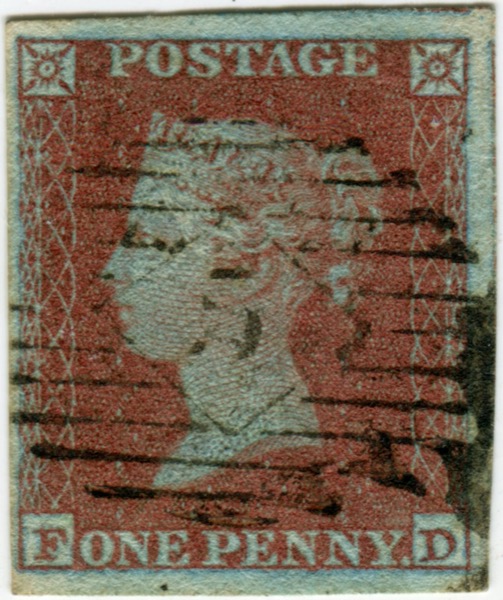
Penny Red, 1841. Perkins Bacon (engravers). Public domain, via Wikimedia Commons.

Free · iOS & Android
Think you have a Penny Red?
Photograph it with StampID to check the type, condition and current value range in seconds — then use this page to verify the details.
How to identify a Penny Red (and read plate numbers)
Start with the basics: a Penny Red shows the same left-facing profile of a young Queen Victoria as the Penny Black, but it is printed in red-brown rather than black. The word POSTAGE runs across the top, ONE PENNY across the bottom, and there are letters in the lower corners. If your one-penny Victoria stamp is red or brownish red rather than black, it is a Penny Red.
Corner letters help you place the stamp on its printing sheet. Early Penny Reds (1841–1854) have letters only in the two lower corners; from 1858 the very common 'plated' issue added letters in all four corners. Around the corner stars or check letters you may also see a small plate number engraved into the design on each side — this is how collectors tell one printing plate from another.
To find the plate number, look closely at the left and right edges of the stamp frame, level with the Queen's portrait, often inside the decorative side panels. On the four-corner-letter perforated issue (1858–1879) a tiny numeral is engraved there; a magnifier helps. The earlier imperforate stamps (no perforation holes, trimmed with scissors) are scarcer and more desirable than the later perforated ones.
Note the edges too: imperforate Penny Reds (1841 onward) have plain cut edges, while perforated issues from 1854 have the familiar rows of holes. Imperforate examples, four-margin copies, sound color, and a light readable cancel all add to the value, while plate number and corner letters tell you exactly which printing you have.
History
The Penny Black of 1840 was the world's first adhesive postage stamp, but its black color made it hard to see cancellations — and easy to clean off a stamp so it could be used again. To stop this fraud, the Post Office switched the ink in 1841: the same portrait die was now printed in red-brown, and the cancelling ink was changed to black so the postmark stood out clearly and permanently.
Printed by Perkins Bacon, the Penny Red became Britain's everyday workhorse stamp for roughly 38 years. It began as an imperforate issue, then from 1854 was sold perforated for easy separation. Over the decades the design was refined with corner stars, then check letters in all four corners, and finally engraved plate numbers, creating the rich 'plated' series that collectors study today.
Because so many billions were printed, ordinary Penny Reds are abundant and cheap — making them a perfect entry point for new collectors. The exception is Plate 77: that printing plate was rejected for poor quality and was meant to be destroyed, but a handful of stamps from it reached the public. Genuine Plate 77 examples are among the most famous and valuable of all British stamps.
Estimated value
Values vary enormously: most Penny Reds are very common and inexpensive (often pennies to a few dollars used), but specific plates — above all the legendary Plate 77 — early imperforate issues, and clean four-margin examples in fine condition can be worth thousands or far more.
Free · iOS & Android
Identify your own stamps in seconds
Frequently Asked Questions
Are Penny Red stamps valuable?
Usually not — billions were printed, so most used Penny Reds are common and worth only a small amount. Value comes from specific printing plates, scarce imperforate issues, fine condition, full margins, and clean cancels. The famous Plate 77 is an extreme exception worth a fortune.
How do I find the plate number on a Penny Red?
Use a magnifier and look at the left and right edges of the frame, level with the Queen's portrait, inside the decorative side panels. On the four-corner-letter perforated issue (1858–1879) a tiny engraved numeral appears there, telling you which plate printed the stamp.
What is the Penny Red Plate 77?
Plate 77 was a printing plate that was rejected as faulty and supposed to be destroyed, but a few stamps from it escaped into circulation. Genuine Plate 77 Penny Reds are extraordinarily rare and among the most valuable British stamps in existence.
How do I tell a Penny Red from a Penny Black?
The portrait of Queen Victoria is the same, so look at the color: the Penny Black is printed in black, the Penny Red in red-brown. The Penny Red replaced the Penny Black in 1841 so that black cancellations would show clearly against the colored stamp.
How much is a Penny Red worth?
Most common used Penny Reds sell for anywhere from a few pennies to a few dollars. Rarer plates, imperforate issues, and superb condition can push values into the hundreds or thousands, while a genuine Plate 77 can be worth a very large sum.