Ceres 1849 — France's First Postage Stamp
The Ceres issue of 1849 was France's very first postage stamp. Designed and engraved by Jacques-Jean Barre, it shows the profile of Ceres, the Roman goddess of agriculture and the harvest. The stamps are imperforate and line-engraved, and the rare 1 franc vermilion is among the most prized stamps in French philately.
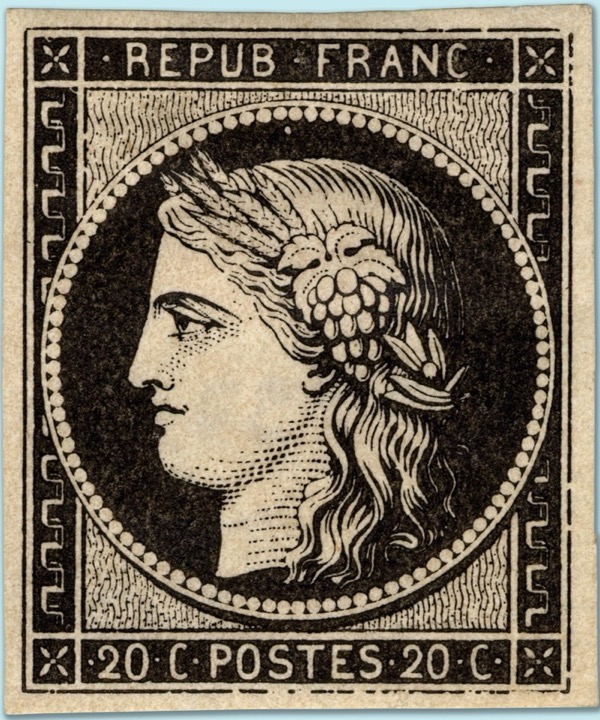
Ceres (1849), 1849. Jacques-Jean Barre (design). Public domain, via Wikimedia Commons.

Free · iOS & Android
Think you have a Ceres (1849)?
Photograph it with StampID to check the type, condition and current value range in seconds — then use this page to verify the details.
How to identify a Ceres stamp
Look for a left-facing profile head of a woman crowned with a wreath of grapes, wheat ears, and other agricultural produce, surrounded by an oval frame inscribed REPUB. FRANC. with the value at the foot. This is Ceres, the Roman goddess of agriculture, and the portrait gives the issue its name.
The 1849 originals are imperforate, meaning they have plain straight-cut edges rather than the toothed perforations of later stamps. They are line-engraved (intaglio), giving the design crisp, raised printed lines. The first values issued were the 20-centime black and the famous 1-franc vermilion (vermillon); other values followed in the early 1850s. Because the Ceres design was revived in the 1870s and again in the 1930s, careful attention to the printing method, color, and edges is needed to confirm an original 1849 example.
History
France adopted the adhesive postage stamp in 1849, nine years after Britain's Penny Black, as part of a postal reform that introduced uniform prepaid rates. The new stamps were placed on sale on 1 January 1849, making the Ceres issue the foundation of French philately.
The design was the work of Jacques-Jean Barre, engraver-general of the Paris Mint, who chose the classical figure of Ceres as a symbol of the young French Republic. The 1-franc vermilion was withdrawn quickly because its red-orange color was too close to that of the lower-value stamps, leaving few examples in circulation. The Ceres motif proved enduring and was reused in later French definitive series in the 1870s and the 1930s.
Estimated value
broad: common later printings are modest; the 1849 1 franc vermilion (esp. tête-bêche) is a major rarity reaching very high sums
Free · iOS & Android
Identify your own stamps in seconds
Frequently Asked Questions
What was France's first stamp?
France's first postage stamps were the Ceres issue of 1849, beginning with the 20-centime black and the 1-franc vermilion. They were placed on sale on 1 January 1849 as part of a national postal reform.
Who is the woman on the Ceres stamp?
She is Ceres, the Roman goddess of agriculture and the harvest. She is shown in left-facing profile, crowned with a wreath of grapes and wheat, a classical symbol chosen for the French Republic.
How do I know if my Ceres stamp is the rare 1849 issue?
Check that it is imperforate (straight-cut edges with no perforation teeth) and line-engraved, and compare the color and value carefully. The Ceres design was reused in the 1870s and 1930s, so original 1849 stamps must be distinguished from these later revivals, ideally with expert authentication for valuable examples.
What is the 1 franc vermilion?
The 1-franc vermilion (vermillon) is a red-orange Ceres stamp from 1849, withdrawn quickly because its color resembled lower values. It is one of the great rarities of French philately, especially in tête-bêche pairs where two stamps are printed head-to-foot.
How much is a Ceres stamp worth?
Values vary enormously. Common later Ceres printings are modest, but the 1849 1-franc vermilion is a major rarity, and tête-bêche pairs can reach very high sums at auction. Condition, color, margins, and authentication strongly affect value.