Inverted Jenny (1918) — Famous US Airmail Error
The Inverted Jenny is a 1918 United States 24-cent airmail stamp on which the blue Curtiss JN-4 "Jenny" biplane was accidentally printed upside down. Only one pane of 100 error stamps ever reached the public, making it one of the most valuable and famous stamps in the world.
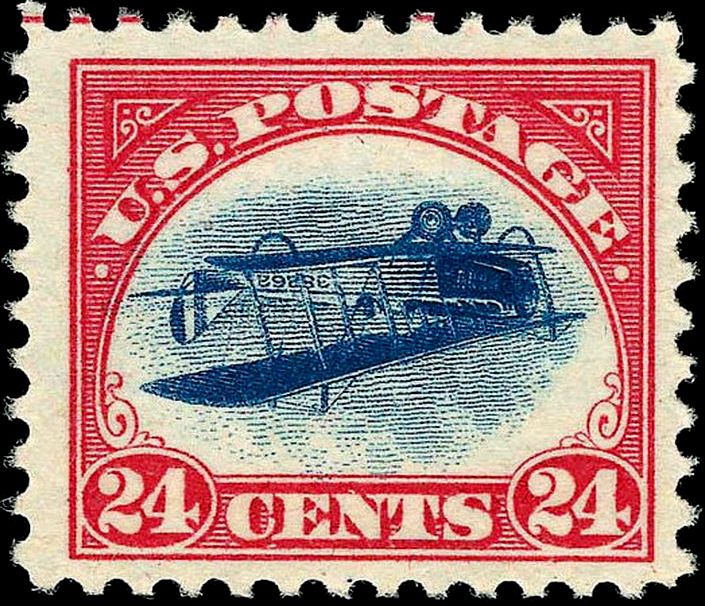
Inverted Jenny, 1918. Bureau of Engraving and Printing. Public domain, via Wikimedia Commons.

Free · iOS & Android
Think you have a Inverted Jenny?
Photograph it with StampID to check the type, condition and current value range in seconds — then use this page to verify the details.
How to identify an Inverted Jenny
A genuine Inverted Jenny is a single stamp design printed in two colors: a carmine-rose frame and a blue central vignette of a Curtiss JN-4 biplane. On the error, the airplane appears flying upside down within an otherwise correctly oriented frame, with the wheels uppermost and the tail tilted. The denomination reads "24 CENTS" and the stamp carries "U.S. POSTAGE" lettering, with a perforation gauge of 11 around all four sides.
Because the famous error came from a single discovered pane of 100, every authentic example has a known position and provenance that experts can trace. The simplest first check is the orientation of the plane against the frame; the harder and essential checks are the engraving detail, paper, gum, and perforations, which together separate a real stamp from a reproduction. Any stamp claimed to be an Inverted Jenny should be examined by a recognized philatelic authentication service before it is bought, sold, or insured.
History of the error
The stamp was issued in May 1918 to pay the new airmail rate, and its bicolor design required two separate passes through the press at the Bureau of Engraving and Printing. On at least one sheet, the paper was fed in the wrong orientation between the frame printing and the vignette printing, so the airplane came out inverted. Quality controls caught and destroyed most of the inverts, but one pane of 100 slipped through.
Collector William T. Robey bought that pane at a Washington, D.C. post office and quickly recognized what he had. The pane was eventually broken up and the individual stamps and multiples dispersed among collectors over the following decades. Today single examples sell for high six- and seven-figure sums, and a celebrated block has changed hands for millions, cementing the Inverted Jenny as the most iconic error in United States philately.
Estimated value
As a broad, approximate estimate, genuine individual Inverted Jenny stamps trade in roughly the high hundreds of thousands to several million US dollars depending on centering, condition, and provenance, with exceptional multiples reaching higher. This is our own general estimate, not a catalogue value. Fakes, photographic copies, and altered reproductions are extremely common, so professional authentication is essential before relying on any figure.
Free · iOS & Android
Identify your own stamps in seconds
Frequently Asked Questions
How much is an Inverted Jenny worth?
Genuine examples are extremely valuable. As a broad approximate estimate, single stamps trade in roughly the high hundreds of thousands to several million US dollars, with fine multiples reaching higher. The exact figure depends heavily on condition, centering, and documented history, and this is a general estimate rather than a catalogue value.
How many Inverted Jenny stamps exist?
Only one pane of 100 error stamps is known to have reached the public, bought by collector William T. Robey. That pane was later divided, so the surviving population is a small, well-documented group of singles, blocks, and other multiples, with a handful lost or damaged over the years.
How can I tell a real Inverted Jenny from a fake?
Reproductions are very common, so orientation alone proves nothing. A genuine stamp must show the correct engraved detail, paper, gum, and perforation gauge of 11, and it should match a known position and provenance from the single famous pane. Only a recognized philatelic authentication service can confirm authenticity.
Why is the airplane upside down?
The stamp was printed in two colors using two separate passes through the press. Between the frame and the vignette printing, a sheet was fed in the wrong orientation, so the blue Curtiss JN-4 biplane ended up inverted within a correctly printed frame.
I think I found one in an old album — what should I do?
Handle it carefully, avoid removing it from any backing, and do not clean or trim it. The overwhelming majority of such finds are reproductions or facsimiles, but if there is any chance it is genuine, photograph it and contact a reputable philatelic authentication service or dealer for an expert opinion before assuming a value.