US 1847 Franklin 5¢ — First United States Stamp
The 1847 5¢ red-brown Benjamin Franklin (Scott 1) and the 10¢ black George Washington (Scott 2) were the first general-issue postage stamps of the United States. They were engraved and imperforate, printed by Rawdon, Wright, Hatch & Edson of New York, and released on July 1, 1847.
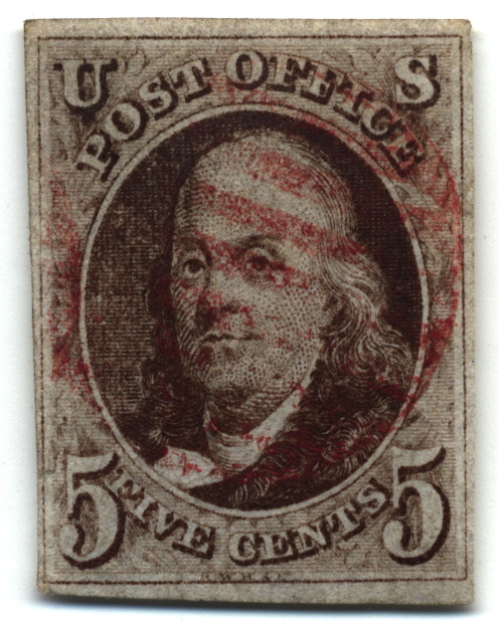
US 1847 Franklin 5¢, 1847. Rawdon, Wright, Hatch & Edson (printer). Public domain, via Wikimedia Commons.

Free · iOS & Android
Think you have a US 1847 Franklin 5¢?
Photograph it with StampID to check the type, condition and current value range in seconds — then use this page to verify the details.
How to identify the 1847 issue
There are only two stamps in the 1847 issue: a 5-cent red-brown showing a left-facing portrait of Benjamin Franklin (Scott 1) and a 10-cent black showing George Washington (Scott 2). Both are engraved on unwatermarked paper and have no perforations — they were issued imperforate and were meant to be separated with scissors, so genuine copies have plain cut edges rather than the toothed perforation tips of later stamps.
Confirm the design details: the Franklin is captioned “POST OFFICE” at top and “FIVE CENTS” at the bottom, while the Washington reads “TEN CENTS.” The most important check is distinguishing a genuine 1847 from the official 1875 reproductions made for the Centennial. The reproductions differ in small design points: on the reproduced 5¢ the upper-left bust outline and the hairlines around Franklin’s eye and forehead are altered, and on the 10¢ reproduction the white shirt frill and the lines of the coat differ from the original. The 1875 reproductions were printed without gum and were never valid for postage, so a genuinely postally used copy with a period cancellation is a strong sign of authenticity. Because values are high, any expensive example should carry a certificate from a recognized expertizing body.
History
Before 1847, US postage was paid in cash and rates depended on distance, with the recipient often footing the bill. The Act of March 3, 1847 authorized adhesive stamps, and the Post Office Department contracted the New York engraving firm Rawdon, Wright, Hatch & Edson to produce them. The 5-cent rate covered a single-sheet letter carried up to 300 miles, and the 10-cent rate covered longer distances.
The stamps went on sale on July 1, 1847 and remained valid until they were demonetized in mid-1851 when a new perforated-era design program began. In 1875 the Post Office issued official reproductions of both values for display at the Centennial Exhibition; these copies are themselves collectible but are worth far less than the genuine 1847 originals. Today the 1847 issue is celebrated as the foundation of United States philately.
Estimated value
Values span a wide range: genuine used 5¢ Franklin examples are attainable but valuable, typically running into the hundreds of dollars and far more with four good margins or a sound mint example; the 10¢ Washington and pristine mint copies command much higher prices. Condition, margins, color, and a clear cancellation drive value, and any costly example should be certified. Beware the cheaper 1875 reproductions, which are often mistaken for the originals.
Free · iOS & Android
Identify your own stamps in seconds
Frequently Asked Questions
What was the first US postage stamp?
The first general-issue US postage stamps were the 1847 issue: the 5-cent red-brown Benjamin Franklin (Scott 1) and the 10-cent black George Washington (Scott 2), both released on July 1, 1847.
How can I tell a genuine 1847 from the 1875 reproduction?
The 1875 reproductions differ in small design details — altered hairlines and bust outline on the Franklin, and a changed shirt frill and coat lines on the Washington — and were printed without gum and never valid for postage. A period postal cancellation suggests an original, but any valuable copy should be checked by an expert and certified.
How much is an 1847 Franklin stamp worth?
A genuine used 5¢ Franklin commonly sells in the hundreds of dollars, with well-margined, mint, or specially cancelled examples worth much more. Condition, margins, and certification heavily affect the price, and the 1875 reproductions are worth substantially less.
What is Scott #1?
Scott #1 is the catalog number for the 1847 5-cent red-brown Benjamin Franklin stamp — the very first listing in the Scott catalog of United States stamps. Its companion, Scott #2, is the 1847 10-cent black George Washington.
Are these stamps rare?
They are scarce and historically important. Genuine 1847s exist in collectible numbers, especially the used 5¢ Franklin, but sound copies with full margins, the 10¢ value, and mint examples are genuinely rare and highly prized.