Basel Dove (1845) — World's First Tricolour Stamp
The Basel Dove (Basler Taube) is the only stamp ever issued by the Swiss canton of Basel, released on 1 July 1845. Printed in black, crimson and blue with an embossed white dove, it was the world's first tricolour stamp and remains one of the most admired classics in philately.
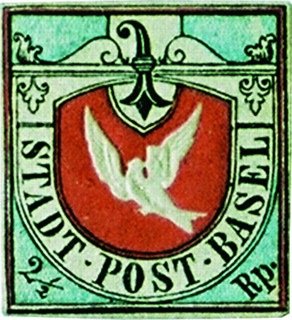
Basel Dove, 1845. Melchior Berri. Public domain, via Wikimedia Commons.

Free · iOS & Android
Think you have a Basel Dove?
Photograph it with StampID to check the type, condition and current value range in seconds — then use this page to verify the details.
How to identify a Basel Dove
A genuine Basel Dove shows a white embossed dove carrying a letter in its beak, set on a crimson shield inside a frame printed in blue to greenish blue and black. The inscription STADT POST BASEL runs around three sides of the design, the value 2½ Rp. sits in the lower corners, and the bishop's crosier from the Basel coat of arms appears at top centre.
The defining feature is the relief: the dove was embossed, so on a genuine stamp it stands physically proud of the paper. Run a fingertip over it or view it in raking light — a completely flat dove is a strong warning sign. The frame was printed by letterpress (typography) on thickish yellowish-white wove paper.
The stamp is imperforate and was printed in sheets of 40 (sold to the public in half sheets of 20), so genuine copies were cut out with scissors and should show margins rather than perforation teeth. Anything perforated, or printed in flat single-pass colour, is not an original.
History
Before Switzerland created a federal post on 1 January 1849, each canton ran its own mail service, and only three issued stamps: Zurich, Geneva and Basel. The Basel city post issued its single stamp on 1 July 1845 to prepay local letters up to one Lot (about 15 grams) within the city — hence the 2½ rappen value.
The design came from Melchior Berri, the prominent Basel architect who also designed the city's post office and letter boxes. His dove with a letter in its beak was both the world's first stamp in three colours and one of the first to combine printing with embossing — a technical showpiece for 1845. The stamps were produced by the Krebs printing works in Frankfurt am Main.
There were two printings — 522 sheets in 1845 and 515 sheets in 1847 — for a total of just 41,480 stamps. The Basel Dove remained valid until 30 September 1854, when the new federal Swiss issues fully took over, and the little cantonal stamp passed into legend alongside the Zurich 4 and 6 and the Double Geneva.
Rarity and varieties
With a print run barely above 41,000 — against the Penny Black's 68 million — the Basel Dove is rare in absolute terms, and only a fraction of the printing survives. Specialists distinguish the 1845 and 1847 printings mainly by the shade of the frame, from blue to distinctly greenish blue.
The most famous variety is the "Haube auf der Taube" (hood on the dove) plate flaw, in which a mark above the dove's head looks like a small bonnet. Multiples, sheet-margin copies and above all stamps on complete covers are great rarities; outstanding covers have achieved six-figure results at auction.
Because the stamp is valuable and visually distinctive, it has been forged extensively since the 19th century, including well-known imitations made for the packet trade. Missing or weak embossing, wrong shades, coarse lettering and incorrect paper give most forgeries away, but for any purchase of consequence a certificate from a recognised expert is essential.
Estimated value
As a broad, approximate estimate, used Basel Doves with faults or cut-in margins often trade somewhere around 500 to 1,500 USD, while sound used examples with clear margins commonly bring several thousand dollars — roughly 2,000 to 8,000 USD is a realistic span for attractive copies. Unused examples and stamps on original covers are rarities that can climb into the tens of thousands. These are general guides only, not catalogue values; condition, margins, freshness of the embossing, printing and certification heavily influence actual prices.
Free · iOS & Android
Identify your own stamps in seconds
Frequently Asked Questions
Is the Basel Dove rare?
Yes, genuinely rare. Only 41,480 stamps were printed across two printings in 1845 and 1847, and far fewer survive. Unlike the Penny Black, which is famous but common, the Basel Dove is scarce in any condition, and covers or multiples are major rarities.
How much is a Basel Dove worth?
As a broad estimate, a used Basel Dove with faults may bring roughly 500 to 1,500 USD, a sound used copy with good margins commonly several thousand, and unused examples or covers considerably more, sometimes into the tens of thousands. These are approximate ranges, not catalogue values — and because forgeries abound, only certified examples achieve full prices.
Why is the Basel Dove famous?
It was the world's first stamp printed in three colours (black, crimson and blue), one of the first to use embossing, and among the first to depict a bird. It is also the only stamp the canton of Basel ever issued, designed by the noted architect Melchior Berri — a combination of firsts that made it a celebrity of classic philately.
How do I spot a Basel Dove forgery?
Check the embossing first: on a genuine stamp the white dove is raised in relief above the paper. Flat doves, wrong frame shades, clumsy lettering in STADT POST BASEL and thin or wrong paper betray most forgeries. The stamp has been imitated since the 19th century, so an expert certificate is strongly recommended before buying.
What was the Basel Dove used for?
It prepaid local letters up to one Lot (about 15 grams) within the city of Basel at the 2½ rappen city rate. At the time each Swiss canton ran its own post; Basel, Zurich and Geneva were the only ones to issue stamps before the federal post took over in 1849.