Zurich 4 and 6 (1843) — First Stamps of Continental Europe
The Zurich 4 and 6 rappen, issued by the Swiss Canton of Zurich on 1 March 1843, were the first postage stamps of continental Europe. Only Great Britain preceded them, which makes these modest black numerals two of the most coveted classics in philately.
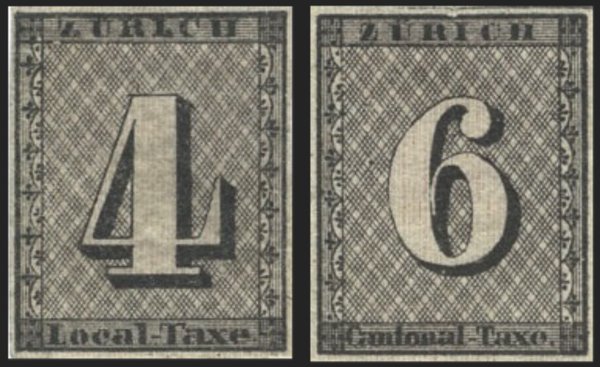
Zurich 4 and 6, 1843. Postal administration of the Canton of Zurich. Public domain, via Wikimedia Commons.

Free · iOS & Android
Think you have a Zurich 4 and 6?
Photograph it with StampID to check the type, condition and current value range in seconds — then use this page to verify the details.
How to identify a Zurich 4 or 6
Both stamps show a large numeral, 4 or 6, printed in black on a background of fine diagonal crosshatching, with the word ZÜRICH in a panel at the top. The bottom panel states the rate: Local-Taxe on the 4 rappen, for delivery within the town, and Cantonal-Taxe on the 6 rappen, for letters anywhere in the canton.
As a security measure the paper carries an underprint of fine red lines beneath the black design. On the earliest printings these red lines run vertically; on later printings they run horizontally. The presence and direction of this red underprint is one of the first things an expert checks.
The stamps were lithographed by Orell, Füssli & Co. in Zurich and are imperforate. Each horizontal row of five on the printing stone was drawn separately, so there are five distinct types of each value, identifiable by small differences in the ornaments and numerals — a detail specialists use both for plating and for detecting forgeries.
History
On 1 March 1843 the cantonal postal administration of Zurich became the third stamp-issuing authority in the world, after Great Britain in 1840 — and the first on the European continent, several months ahead of Brazil's Bull's Eyes. Switzerland was not yet a unified postal territory, so the stamps were a purely cantonal experiment.
The two values mirrored the local tariff: 4 rappen prepaid a letter within the city of Zurich, 6 rappen a letter to any destination in the canton. Other cantons soon followed with their own classics — Geneva's Double Geneva in 1843 and the Basel Dove in 1845.
The federal constitution of 1848 transferred the posts to the new Swiss confederation, which took over in 1849 and issued the first federal stamps in 1850. The cantonal issues were withdrawn shortly afterwards, ending the brief era that produced some of Europe's greatest rarities.
Rarity and varieties
Both stamps are rare in any condition, but the 4 rappen is significantly rarer than the 6 rappen: the local rate was used far less than the cantonal rate, so far fewer were printed and survive. Unused examples of either value are great rarities, and multiples such as strips showing several of the five types rank among the trophies of Swiss philately.
Collectors distinguish the printings by the red underprint — vertical red lines for the first printing, horizontal for the later ones — and by the five lithographic types of each value. Full reconstructions of the five types, and the rare horizontal strips of five, carry large premiums.
Because of their value the Zurich 4 and 6 have been forged extensively, including well-known products of the Fournier workshop. Genuine stamps show the correct type characteristics, the red underprint and contemporary Zurich cancellations. A certificate from a recognised expert body is effectively mandatory for any purchase.
Estimated value
As a broad, approximate estimate, a sound used Zurich 6 rappen often trades somewhere in the 1,000 to 5,000 USD range, while a used Zurich 4 rappen typically runs from roughly 5,000 to 25,000 USD and beyond for fine examples. Unused stamps, scarce underprint varieties, strips and covers can reach well into five and six figures. These are general guides only, not catalogue values; actual prices depend heavily on margins, underprint, type, cancellation and certification.
Free · iOS & Android
Identify your own stamps in seconds
Frequently Asked Questions
Is the Zurich 4 and 6 rare?
Yes — genuinely rare, unlike many famous classics. Both values survive only in small numbers, and the 4 rappen is much scarcer than the 6 rappen because the local rate saw far less use. Unused examples and multiples are among the great rarities of Swiss philately.
How much is a Zurich 4 rappen worth?
As a broad estimate, a sound used 4 rappen typically sells somewhere in the 5,000 to 25,000 USD range, with superb four-margin examples and scarce varieties going higher. The 6 rappen is more affordable, often roughly 1,000 to 5,000 USD used. Condition, underprint, type and certificates drive the price, so these are approximate ranges only.
What do Local-Taxe and Cantonal-Taxe mean?
They state what the stamp paid for. Local-Taxe on the 4 rappen covered a letter delivered within the town of Zurich; Cantonal-Taxe on the 6 rappen covered a letter to any destination in the canton. The inscriptions are the quickest way to tell the two values apart at a glance.
What are the red lines on the paper?
A security underprint of fine red lines printed beneath the black design to deter forgery. The first printing has vertical red lines, later printings horizontal ones — a key variety distinction that affects value. A missing or wrong underprint is a strong sign of a forgery.
How can I tell a genuine Zurich 4 or 6 from a forgery?
Check the red underprint, the lithographic type characteristics (there are five types of each value), the quality of the crosshatched background and the cancellation. Forgeries, including Fournier products, are common. Given the sums involved, only buy with a certificate from a recognised expertising authority.