Two Penny Blue (1840) — World's Second Postage Stamp
The Two Penny Blue is the world's second postage stamp, issued in Great Britain in May 1840 alongside the famous Penny Black. It shares the same Queen Victoria design but was printed in blue, paid the two-penny rate for heavier letters, and is considerably scarcer than its black sibling.
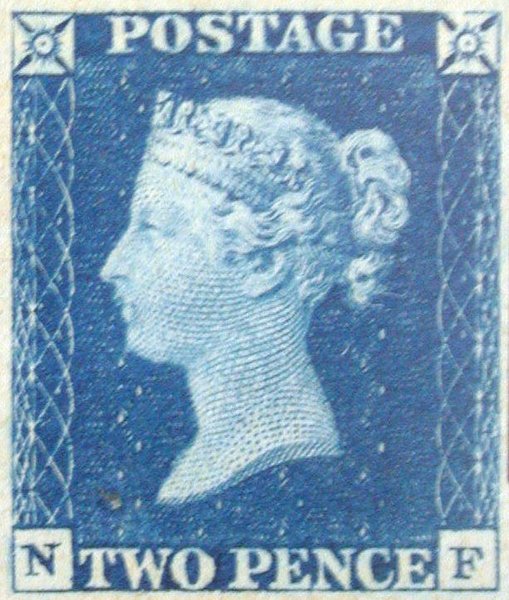
Two Penny Blue, 1840. William Wyon. CC0, via Wikimedia Commons.
.jpg)
Free · iOS & Android
Think you have a Two Penny Blue?
Photograph it with StampID to check the type, condition and current value range in seconds — then use this page to verify the details.
How to identify a Two Penny Blue
A genuine Two Penny Blue shows the left-facing profile of the young Queen Victoria in white against a deep blue background. The design was struck from the same die as the Penny Black — William Wyon's portrait drawn by Henry Corbould and engraved by Charles and Frederick Heath — so apart from the colour and the value tablet, the two stamps look identical. The frame reads POSTAGE at the top and TWO PENCE at the bottom, with star ornaments in the upper corners and position letters in the lower corners. There is no country name.
The single most important check is the space directly below POSTAGE and above TWO PENCE. The original 1840 printing has no white lines there. In 1841 the design was modified with a thin white line added under the top inscription and above the bottom one, and those later "white lines" printings are far more common and much cheaper. If your blue stamp shows white lines, it is not the 1840 original.
Like the Penny Black, the 1840 Two Penny Blue is imperforate — it was cut from the sheet with scissors, so a genuine copy has no perforation teeth and ideally shows four clear margins. It was printed by Perkins Bacon in line-engraved (recess) printing, which leaves a crisp, slightly raised impression under magnification. Perforated two penny blues are later issues from the 1850s onwards.
History
The Two Penny Blue was part of the same revolution as the Penny Black: Rowland Hill's uniform penny postage, prepaid by the sender. One penny carried a letter up to half an ounce; the blue stamp paid the two-penny rate for letters up to a full ounce. Both values became valid for postage on 6 May 1840, although supplies of the 2d reached most post offices a couple of days later.
Only about 6.46 million Two Penny Blues were printed in 1840, from plates 1 and 2, before printing stopped at the end of August — roughly a tenth of the 68 million Penny Blacks. The original plates were destroyed in 1843. That smaller printing is why the 1840 2d is significantly scarcer and more expensive today than the Penny Black, despite being far less famous.
When the Post Office abandoned black ink in 1841 because red cancellations were too easy to remove, the one-penny stamp turned red — but the two-penny stamp stayed blue, simply gaining the white lines as a mark of the new printing. Blue remained the colour of Britain's two-penny stamps for decades, and the corner-letter system carried on exactly as on the Penny Black, recording each stamp's position in the sheet of 240.
Rarity and varieties
Specialists separate the 1840 printing into plate 1 and plate 2, identified by subtle differences in the corner letters and minor plate flaws. Shades matter too: the stamps range from a pale blue to a deep, full blue, with the richer shades generally more sought after. Most used examples carry the red Maltese cross cancellation of 1840, later replaced by black.
Condition drives value more than anything else. Because the stamps were cut apart by hand, margins vary wildly: a copy cut into the design is worth a small fraction of one with four even margins. Unused 1840 Two Penny Blues are genuinely rare — most went onto letters — and command strong five-figure prices at auction.
Beware of the usual pitfalls: 1841 white-lines stamps offered as 1840 originals, later perforated 2d blues with the perforations trimmed off, and outright forgeries. The white-lines check, the corner letters and the quality of the engraving expose most of them, but for any expensive purchase an expert certificate is worth the cost.
Estimated value
As a broad, approximate estimate, used 1840 Two Penny Blues with average margins typically trade somewhere in the rough 150 to 600 USD range — noticeably more than a comparable Penny Black, because far fewer were printed. Attractive four-margin used examples often bring several hundred to a couple of thousand dollars, and unused copies can run well into five figures. The 1841 white-lines printings are much more affordable, often under 100 USD used. These are general guides only, not catalogue values; condition, margins, plate, shade and cancellation drive actual prices.
Free · iOS & Android
Identify your own stamps in seconds
Frequently Asked Questions
Is the Two Penny Blue rare?
The 1840 original is genuinely scarce: only about 6.46 million were printed, roughly a tenth of the Penny Black's print run, so it is significantly rarer and more expensive. The 1841 and later "white lines" two penny blues were printed in vast quantities and are common. Always check for the white lines first.
How much is a Two Penny Blue worth?
As a broad estimate, a used 1840 Two Penny Blue with average margins is often worth somewhere around 150 to 600 USD, a fine four-margin example several hundred to a couple of thousand, and unused copies far more. The later white-lines printings are usually much cheaper, often under 100 USD. These are approximate ranges, not catalogue values — condition and margins dominate.
How do I tell the 1840 Two Penny Blue from the 1841 issue?
Look directly under the word POSTAGE and above TWO PENCE. The 1840 original has no white lines there; the 1841 reissue has a thin white line in each position. The 1841 and later printings are far more common, so a blue stamp without white lines deserves a careful second look.
Was the Two Penny Blue issued with the Penny Black?
Yes. Both stamps became valid for postage on 6 May 1840 as part of Rowland Hill's uniform postage reform, making the Two Penny Blue the world's second postage stamp. In practice the 2d reached most post offices about two days after the Penny Black, so the earliest known uses are slightly later.
How can I tell if my Two Penny Blue is genuine?
Check that it is imperforate, line-engraved with a crisp impression under magnification, has star ornaments in the upper corners and letters in the lower corners, and shows no white lines if sold as an 1840 original. Forgeries, trimmed perforated stamps and misdescribed 1841 printings all circulate, so obtain an expert certificate for any valuable example.