Mauritius "Post Office" (1847) — Blue & Red Mauritius
The Mauritius "Post Office" stamps are an 1847 pair, the 1d orange-red and 2d deep blue, that rank among the most valuable stamps in the world. They were among the first postage stamps issued anywhere in the British Empire outside Great Britain, and only about 27 examples survive across both values. Their fame comes from a single detail: the early printing reads "POST OFFICE" along the left margin instead of the "POST PAID" used on later issues.
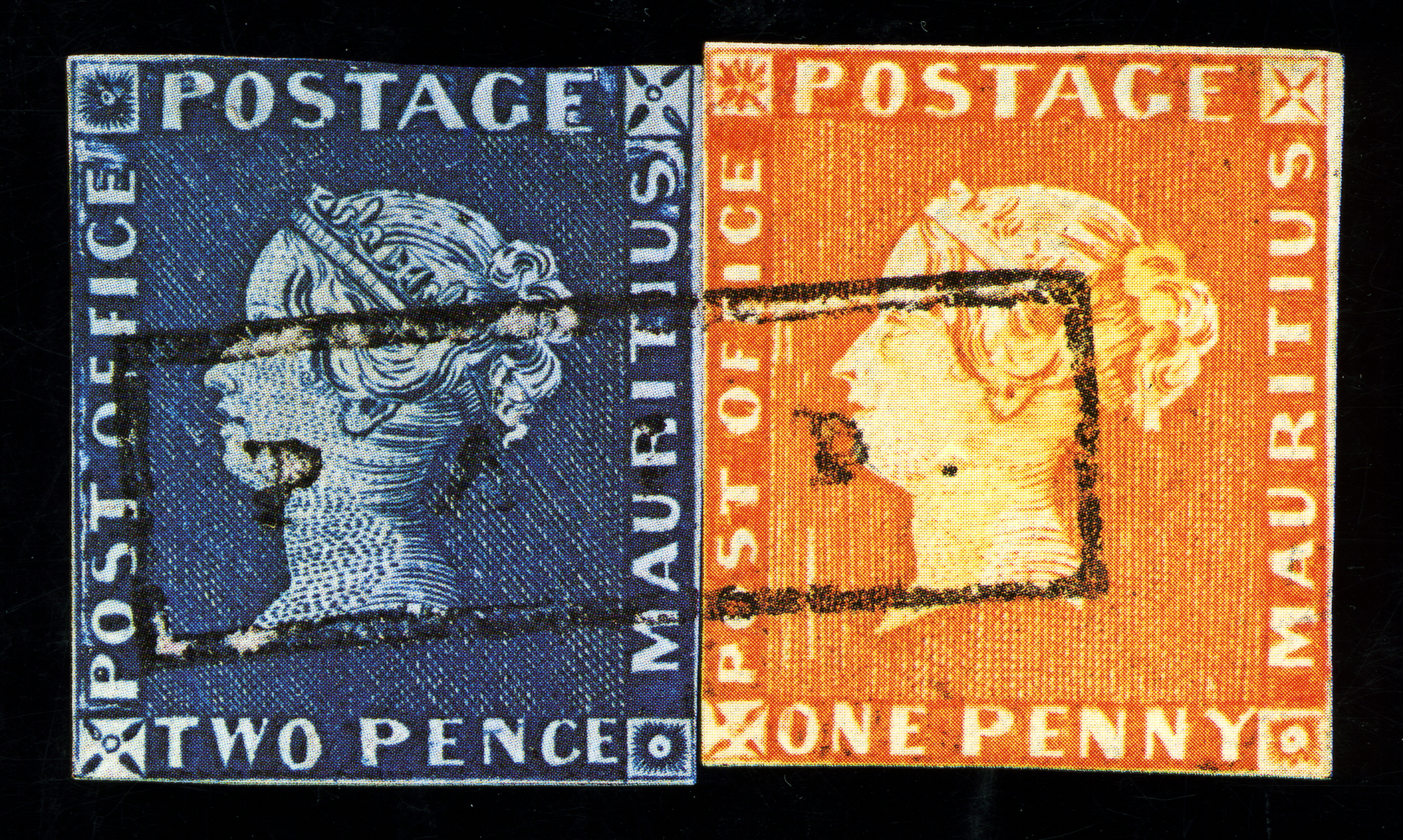
Mauritius "Post Office", 1847. J.O. Barnard. Public domain, via Wikimedia Commons.

Free · iOS & Android
Think you have a Mauritius "Post Office"?
Photograph it with StampID to check the type, condition and current value range in seconds — then use this page to verify the details.
Post Office vs Post Paid
Both stamps were engraved by hand on a single copper plate by Joseph Osmond Barnard, a local engraver and miniature painter. The earliest 1847 printing carries the words "POST OFFICE" in the left-hand panel, while a later, far more common issue replaces this with "POST PAID". It is the "POST OFFICE" wording that makes a stamp one of the legendary rarities.
A persistent legend claims Barnard engraved "POST OFFICE" by mistake and that it was meant to read "POST PAID". Most modern scholars reject this, treating the wording as a deliberate, if quickly superseded, choice rather than a true error. Either way, the scarcity is real: the "POST OFFICE" printing was tiny, while the "POST PAID" version that followed is the one usually seen in albums.
History
Mauritius, then a British colony, ordered the stamps for local mail in 1847. Barnard produced 500 of each value. The 2d deep blue became known as the "Blue Mauritius" and the 1d orange-red as the "Red Mauritius", names that have entered popular culture far beyond stamp collecting.
The most celebrated survivor is the "Bordeaux cover", an envelope sent to a wine merchant in Bordeaux, France, bearing both the 1d and the 2d "POST OFFICE" stamps together. It is regarded as one of the single greatest items in all of philately. With only around two dozen examples known across both denominations, surviving stamps and covers are held mostly in royal, national, and major private collections.
Estimated value
broad: among the world's most valuable stamps; the rare 'POST OFFICE' examples reach seven figures at auction
Free · iOS & Android
Identify your own stamps in seconds
Frequently Asked Questions
What is the difference between Post Office and Post Paid Mauritius stamps?
Both were engraved by J.O. Barnard in 1847, but the earliest printing reads "POST OFFICE" in the left panel while a later, far more common issue reads "POST PAID". The "POST OFFICE" wording marks the legendary rarities; "POST PAID" stamps, though still scarce, are much more frequently seen.
How many Mauritius Post Office stamps exist?
Only about 27 examples are known across both values combined, the 1d orange-red and the 2d deep blue. Most are in royal, national museum, or major private collections, which is a key reason for their extraordinary value.
What is the Blue Mauritius?
The "Blue Mauritius" is the nickname for the 2d deep blue "Post Office" stamp of 1847. The matching 1d orange-red is called the "Red Mauritius". Together they are among the most famous stamps ever produced.
How much is a Mauritius Post Office stamp worth?
Genuine "POST OFFICE" examples are among the most valuable stamps in the world and have reached seven-figure sums at auction. Exact prices depend on condition, the denomination, and whether the stamp is on a cover such as the celebrated Bordeaux cover.
Could I have a genuine one?
It is extremely unlikely. With only around 27 genuine examples known and nearly all accounted for in famous collections, almost anything resembling a Mauritius "Post Office" stamp is a reproduction, facsimile, or fake. Any suspected original would require authentication by a recognized philatelic expert.