Brazil Bull's Eye (1843) — First Stamps of the Americas
The Bull's Eye (Olho-de-boi) is the first postage stamp of the Americas, issued by the Empire of Brazil on 1 August 1843. Its large numerals in ornate black ovals made Brazil the second country in the world, after Great Britain, to introduce national adhesive stamps.
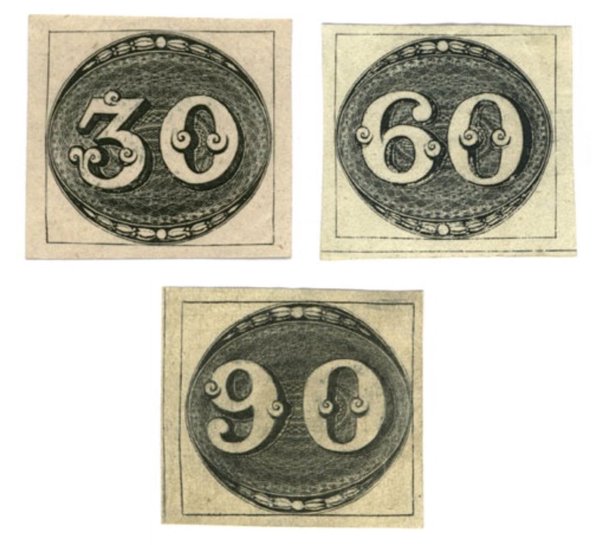
Bull's Eye, 1843. Correios do Brasil. Public domain, via Wikimedia Commons.

Free · iOS & Android
Think you have a Bull's Eye?
Photograph it with StampID to check the type, condition and current value range in seconds — then use this page to verify the details.
How to identify a Bull's Eye
A genuine Bull's Eye shows a large numeral — 30, 60 or 90 — set inside an ornate oval filled with fine engine-turned (guilloche) lattice work, printed in black on yellowish to greyish wove paper. The dense, swirling background pattern is similar in spirit to the lathework of the Penny Black and was intended to defeat forgers.
There is no country name, no portrait and no inscription apart from the numeral of value in réis. The design is enclosed by a thin rectangular frame line, and the stamps are imperforate, so genuine copies were cut from the sheet with scissors and ideally show four clear margins.
The stamps were printed by intaglio (line-engraving) at the Casa da Moeda, the imperial mint in Rio de Janeiro. Under magnification the black lines feel crisp and slightly raised. Flat, greyish or fuzzy impressions are a warning sign of lithographed forgeries.
History
Brazil adopted prepaid postage remarkably early. A decree of Emperor Pedro II dated 29 November 1842 ordered adhesive stamps on the British model, and the three values went on sale on 1 August 1843 — only three years after the Penny Black and months after the Canton of Zurich. That made Brazil the second country in the world and the first in the Americas to issue national postage stamps.
Unusually, the design deliberately avoided the emperor's portrait: it was considered disrespectful for Pedro II's face to be defaced by postmarks. The mint chose pure numerals instead, and the bold figures in their wide ovals soon earned the nickname Olho-de-boi, the eye of the ox.
The 30 réis paid printed matter and local letters, the 60 réis the standard single letter rate, and the 90 réis heavier mail. Surviving records indicate roughly 856,000 of the 30 réis, 1.34 million of the 60 réis and only about 341,000 of the 90 réis were sold. In 1844 the large design was replaced by the smaller, lighter Inclinados, known to collectors as the goat's eyes.
Rarity and varieties
The 60 réis is the most frequently seen value today, the 30 réis somewhat scarcer, and the 90 réis is clearly the rarest of the set thanks to its small printing. Condition matters enormously: most survivors were cut close, so copies with four full margins command strong premiums.
One plate was composite, carrying 30 réis and 60 réis impressions on the same sheet. Se-tenant pairs of the two values from this plate are among the great rarities of classic philately — the famous Pack strip combining both denominations realised a record price for Brazilian philately. Early dated covers, especially first-month usages from August 1843, are also keenly fought over.
Specialists distinguish printings by paper and impression: early printings on greyish paper with sharp, fine impressions, later ones on yellowish paper with worn, blurred backgrounds. Forgeries and later reprints exist, so material offered as unused or in multiples should always come with an expert certificate.
Estimated value
As a broad, approximate estimate, used 30 and 60 réis Bull's Eyes with average margins often trade somewhere in the 100 to 500 USD range, while the scarcer 90 réis typically runs from several hundred up to roughly 1,500 USD or more. Four-margin examples, unused copies, se-tenant pairs and covers climb into the thousands and well beyond. These are general guides only, not catalogue values; actual prices depend heavily on margins, impression, paper and certification.
Free · iOS & Android
Identify your own stamps in seconds
Frequently Asked Questions
Why is it called the Bull's Eye?
The nickname comes from the design: a large numeral inside a wide ornamental oval that reminded people of the eye of an ox — Olho-de-boi in Portuguese. The smaller Brazilian issues that followed were nicknamed goat's eyes (1844) and cat's eyes (1850) in the same spirit.
How much is a Bull's Eye stamp worth?
As a broad estimate, used 30 and 60 réis examples with average margins are often worth around 100 to 500 USD, and the rarer 90 réis from several hundred to roughly 1,500 USD or more. Unused copies, four-margin pieces, pairs and covers can reach thousands. Margins, impression quality and certificates drive the price, so treat these as approximate ranges.
Is the Bull's Eye rare?
Moderately so. Over two million were sold in total, so single used copies of the 30 and 60 réis appear regularly at auction. Real rarity starts with the 90 réis, fine four-margin examples, unused stamps, the se-tenant pairs of 30 and 60 réis, and early covers — those are genuinely hard to find.
Why is there no portrait of Emperor Pedro II on the stamp?
It was considered disrespectful for the emperor's face to be struck and obliterated by cancellation marks. Brazil therefore chose a neutral numeral design, which is why the first stamps of the Americas show only large figures of value in an ornate oval.
How can I tell a genuine Bull's Eye from a forgery?
Genuine stamps are recess-printed, so the engine-turned background is sharp and slightly raised under magnification, on yellowish to greyish wove paper. Lithographed forgeries look flat and muddy in the lattice work. For unused examples, multiples or anything expensive, obtain a certificate from a recognised expertising body.