Hawaiian Missionaries (1851) — Hawaii's Legendary First Stamps
The Hawaiian Missionaries are the first postage stamps of the Kingdom of Hawaii, placed on sale on 1 October 1851 and printed on extremely fragile pelure paper in Honolulu. With only about 200 examples known to survive, they rank among the rarest and most storied stamps in the world.
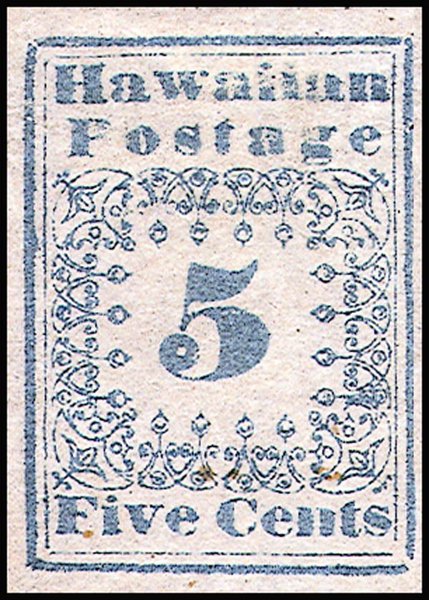
Hawaiian Missionaries, 1851. Hawaiian Post Office. Public domain, via Wikimedia Commons.

Free · iOS & Android
Think you have a Hawaiian Missionaries?
Photograph it with StampID to check the type, condition and current value range in seconds — then use this page to verify the details.
How to identify a Hawaiian Missionary
The Missionaries are not engraved miniatures like most classic stamps — they are plain typeset (letterpress) designs assembled from printer's type and stock ornaments. The centre shows a large numeral of value (2, 5 or 13) surrounded by a rectangular frame of ornamental printer's flourishes, with the denomination repeated in words across the bottom: Two Cents, Five Cents or Thirteen Cents.
The inscription at the top is a key identification point. The 2-cent and 5-cent values read "Hawaiian Postage", while the 13-cent value reads "H.I. & U.S. Postage", because it prepaid both Hawaiian and United States postage on a single letter. A thin inner line and thicker outer line frame the whole design, and the stamps are imperforate — cut apart by hand.
All values were printed in the same shade of blue on pelure paper, a tissue-thin, brittle paper that tears very easily. This fragility is why roughly 90 percent of surviving Missionaries are damaged in some way; a crisp, perfect-looking example on ordinary paper is a strong warning sign of a reproduction.
History
Until mid-century, mail to and from Hawaii travelled informally with ship captains. The California Gold Rush multiplied traffic with San Francisco, and in December 1850 the Hawaiian government opened a post office in Honolulu. Henry Martyn Whitney, the first postmaster, was authorized in June 1851 to print stamps, which he did on the press of The Polynesian, a weekly government newspaper.
The stamps went on sale on 1 October 1851 in three denominations matching the published rates: 2 cents for newspapers to the United States, 5 cents for letters to the US, and 13 cents for letters to the US East Coast — 5 cents of Hawaiian postage, a 2-cent ship fee and 6 cents of US transcontinental postage combined on one stamp.
The issue remained in use until about 1856. The nickname came later: most surviving examples were found on the correspondence of American missionaries working in the Hawaiian Islands, so collectors began calling them the "Missionaries".
Rarity and varieties
Roughly 200 Missionaries survive across all four stamps of the series (a widely cited census lists 197), of which only 28 are unused and 32 are on cover. The 2-cent is the rarest, with about 15 recorded copies and a single unused example — a stamp so coveted that, by philatelic lore, an early owner was murdered for it in 1892.
The most valuable Missionary item is the Dawson cover, the only cover bearing the 2-cent value, rescued decades after being stuffed into a factory furnace that failed to burn. It sold for 2.09 million USD in 1995 and 2.24 million USD in 2013, placing it among the highest-priced philatelic items ever traded.
Forgeries dominate the market in practice. The most famous are the Grinnell Missionaries, a hoard of 43 stamps that surfaced in 1920 and was declared forged in a 1922 court case, though debate has flared up periodically since. Countless cruder reproductions and souvenir reprints also exist, so any unpapered "find" must be treated as a forgery until certified.
Estimated value
As a very broad estimate only: genuine Hawaiian Missionaries are museum- and auction-grade rarities. Even damaged used examples have traded for roughly 10,000 to 100,000 USD, sound copies typically command six figures, and the greatest pieces — the unique unused 2-cent and the Dawson cover — have realized over 2 million USD. These are rough historical guides, not catalogue values. Crucially, virtually every "Missionary" found in an ordinary album is a reproduction or forgery; the genuine stamps are essentially all documented in census lists, so expert certification is mandatory.
Free · iOS & Android
Identify your own stamps in seconds
Frequently Asked Questions
How much is a Hawaiian Missionary stamp worth?
A genuine example is worth from tens of thousands of dollars even when damaged, with sound copies reaching six figures and the unique 2-cent items selling for over 2 million USD. These are broad auction-based estimates, not catalogue values. An uncertified stamp found in a collection is almost certainly a reproduction or forgery worth little.
Is the Hawaiian Missionary rare?
Yes — among the rarest stamps in the world. Only about 200 examples survive across the whole 1851–52 series, with just 28 unused and 32 on cover. The 2-cent value is the rarest, with roughly 15 recorded copies, only one of them unused.
Why are they called Missionaries?
Because most surviving examples were found on the correspondence of American missionaries working in the Hawaiian Islands in the 1850s. The name is a collector's nickname, not an official designation — the stamps themselves are simply the Kingdom of Hawaii's first postage issue.
How can I tell if my Hawaiian Missionary is genuine?
Genuine stamps are typeset in blue on extremely thin, brittle pelure paper, imperforate, with the correct inscriptions: "Hawaiian Postage" on the 2c and 5c, "H.I. & U.S. Postage" on the 13c. About 90 percent of genuine survivors are damaged, so a fresh-looking copy on normal paper is suspect. Since nearly all genuine examples are documented in census records, anything new must be authenticated by a major expertizing body before it has any value.
What is the Dawson cover?
It is the only known cover bearing the 2-cent Missionary, addressed to New York and also franked with a 5-cent Missionary and two US 3-cent stamps. It survived being stuffed into a factory furnace around 1870 and was rediscovered some 35 years later. It sold for 2.09 million USD in 1995 and 2.24 million USD in 2013.