Canada Twelve Penny Black (1851) — The Black Empress
The Twelve Penny Black, nicknamed the "Black Empress of Canada", is the great rarity of Canadian philately: an imperforate black stamp of the Province of Canada issued on 14 June 1851 showing Queen Victoria after Alfred Edward Chalon's portrait. Of 51,000 printed, only 1,450 were ever sold, and roughly 130 examples are believed to survive.
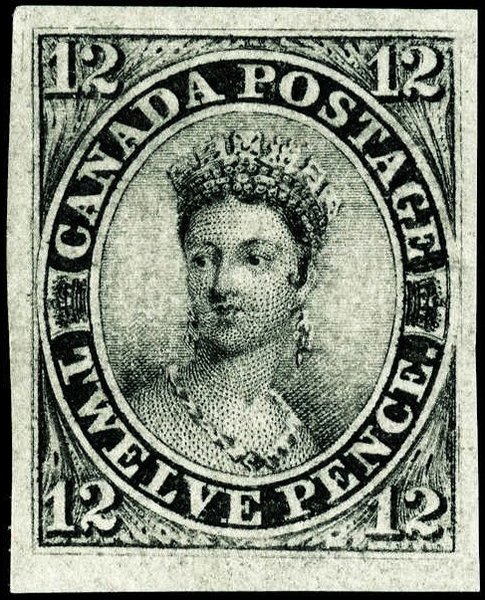
Twelve Penny Black, 1851. Dominion of Canada Post Office. Public domain, via Wikimedia Commons.

Free · iOS & Android
Think you have a Twelve Penny Black?
Photograph it with StampID to check the type, condition and current value range in seconds — then use this page to verify the details.
How to identify a Twelve Penny Black
The stamp shows the full-face Chalon portrait of a young Queen Victoria wearing a diadem — not the profile head familiar from British stamps. The portrait sits in a central oval, with the surrounding band inscribed CANADA POSTAGE above and TWELVE PENCE below, and the numeral 12 in all four corners.
It was printed in black by the line-engraved (recess) method by Rawdon, Wright, Hatch & Edson of New York, the same firm behind the first United States stamps. Genuine examples are imperforate — separated with scissors — and printed on thin laid paper, which shows faint parallel lines when held to the light.
Beware of look-alikes: plate proofs in black on india or card, later trial impressions and outright forgeries circulate far more widely than the issued stamp. Proofs typically show no gum, different paper and razor-sharp impressions; a genuine issued 12d is so rare that every candidate needs a certificate.
History
In 1851 the Province of Canada took over its postal service from Britain and issued its first stamps: the 3-pence Beaver — the world's first pictorial animal stamp — the 6-pence Prince Albert, and the 12-pence Queen Victoria. Sandford Fleming, later famous as the engineer who proposed worldwide standard time, prepared the designs.
The odd denomination has a practical explanation. The stamp was deliberately inscribed twelve pence rather than one shilling, because in colonial North America "one shilling" meant different amounts in different local currencies — about 10 pence in New England reckoning and about 7½ pence in New York reckoning. "Twelve pence" was unambiguous.
The 12d rate served little practical purpose under the rate structure of the day, so the stamp barely sold: of 51,000 printed, only 1,450 were sold during roughly three and a half years on sale. The remainders were withdrawn and destroyed in 1857, instantly creating one of philately's great rarities.
Rarity and varieties
About 130 examples are believed to exist today, split between unused and used copies. Multiples are exceptional: only five unused pairs and two used pairs are recorded. Collectors call the stamp the "Black Empress of Canada", and no serious collection of Canadian classics is considered complete without one.
Prices reflect that status. A used example sold for 292,500 CAD in 2023, and a mint pair brought 625,000 CAD in 2024. Condition matters enormously — examples with four clear margins, fresh paper and light cancels command large premiums over creased or repaired copies.
Because the issued stamp is so valuable, the market is full of plate proofs, reprints and forgeries that mimic it. Proofs in black on india paper are genuine printings from the original plate and are collectible in their own right, but they are worth a small fraction of an issued stamp. Authentication by a recognized expert committee is essential for any 12d candidate.
Estimated value
As a broad, hedged estimate only: genuine issued Twelve Penny Blacks are auction-grade rarities that typically trade from several tens of thousands of US dollars for sound used examples up to several hundred thousand for choice copies — a used single brought 292,500 CAD in 2023 and a mint pair 625,000 CAD in 2024. These are rough auction-based guides, not catalogue values. Be aware that nearly every "12d black" found in a collection is a plate proof, reprint or forgery; proofs are collectible but worth only a small fraction of the issued stamp, and anything else requires expert certification before it has significant value.
Free · iOS & Android
Identify your own stamps in seconds
Frequently Asked Questions
How much is a Canada Twelve Penny Black worth?
Genuine issued examples are auction-grade rarities: roughly tens of thousands of US dollars for sound used copies, rising to hundreds of thousands for fine examples — a used single sold for 292,500 CAD in 2023 and a mint pair for 625,000 CAD in 2024. These are broad estimates, not catalogue values. Uncertified copies found in albums are almost always proofs or forgeries worth far less.
Is the Twelve Penny Black rare?
Yes — it is Canada's most famous stamp rarity. Of 51,000 printed in 1851, only 1,450 were sold before the rest were destroyed in 1857, and about 130 examples are believed to survive today, including just five unused pairs and two used pairs.
Why does it say twelve pence instead of one shilling?
Because "one shilling" was ambiguous in colonial North America: in New England reckoning it equalled about 10 pence and in New York reckoning about 7½ pence. Inscribing the stamp "twelve pence" removed any doubt about its face value.
How can I tell if my Twelve Penny Black is genuine?
A genuine issued stamp is line-engraved in black on thin laid paper, imperforate, with the Chalon portrait of Victoria, CANADA POSTAGE and TWELVE PENCE in the oval band and 12 in each corner. Most copies encountered are plate proofs on india paper, reprints or forgeries, so any candidate should be submitted to a recognized expert committee — the genuine stamps are largely accounted for.
What is the Black Empress of Canada?
It is the collectors' nickname for the Twelve Penny Black, combining its black colour with the portrait of Queen Victoria, who later became Empress of India. The nickname underlines its status as the crown jewel of Canadian philately.