Cape of Good Hope Triangular (1853) — First Triangular Stamp
The Cape of Good Hope Triangular, issued on 1 September 1853, was the world's first triangular postage stamp and the first stamp of the British Cape Colony in southern Africa. Its three-cornered shape and seated figure of Hope made it one of the most recognisable classics in philately.
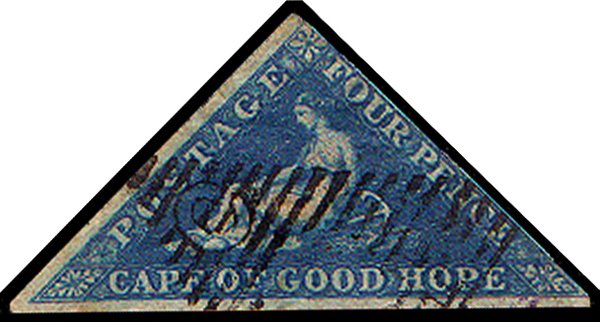
Cape of Good Hope Triangular, 1853. Cape of Good Hope Post Office. Public domain, via Wikimedia Commons.

Free · iOS & Android
Think you have a Cape of Good Hope Triangular?
Photograph it with StampID to check the type, condition and current value range in seconds — then use this page to verify the details.
How to identify a Cape Triangular
A genuine Cape Triangular is a triangular stamp showing the seated allegorical figure of Hope leaning on an anchor, the symbol of the colony. The design is credited to Charles Davidson Bell, Surveyor-General of the Cape, and the die was engraved by William Humphrys at Perkins Bacon. The two upper sides read POSTAGE and the value, while CAPE OF GOOD HOPE runs along the base.
The first issue of 1 September 1853 comprised two values: the 1 penny in brick-red and the 4 pence in deep blue. Both were printed by Perkins Bacon in London — the same firm that printed the Penny Black — using the line-engraved (recess) method on handmade paper that was deeply blued in this first printing. All triangulars are imperforate and carry an anchor watermark, so each stamp had to be cut from the sheet of 240 with scissors, which makes margins critical to value.
Dating a copy starts with the paper: blued paper points to 1853, while the 1855–1863 printings are on whiter paper with cleaner colours. A 6 pence and a 1 shilling were added in 1858, and the final triangular printings were made by De La Rue in 1863–64 in noticeably different shades on hard white paper.
History
The Cape of Good Hope introduced its stamps on 1 September 1853 to prepay a uniform postal tariff: 4 pence carried a half-ounce letter within the colony and 1 penny paid the newspaper rate. They were the first stamps of southern Africa, following the Mauritius issues of 1847 as the earliest stamps of the wider African region.
The famous shape was probably inspired by the large triangular obliterator that the Cape Revenue Department had used since 1839. Collector tradition adds a practical motive: the unmistakable outline let postal sorters separate Cape mail from incoming overseas mail at a glance, regardless of whether they could read the inscriptions.
In February 1861, when supplies from London ran out, the local firm Saul Solomon & Co. produced the crude provisional triangulars nicknamed the woodblocks — actually printed from steel clichés engraved by C. J. Roberts and mounted on wooden blocks. Two clichés were placed in the wrong formes, creating one error of colour per sheet of 64: a blue penny and a red four pence, both world-famous rarities. The triangulars were replaced by a rectangular Hope design in 1864 and finally demonetised on 1 October 1900.
Rarity and varieties
Cape triangulars were printed for over a decade in substantial numbers, so the design as such is not rare: ordinary used copies of the 4 pence from the white-paper printings are the most affordable way to own one. The 1853 first printings on deeply blued paper are considerably scarcer, especially with four clear margins.
The 1861 woodblocks are rare in any condition, and the two errors of colour rank among the great rarities of the British Empire — only a handful survive of each. Multiples, stamps on cover and fine unused examples of any printing also command strong premiums.
Because three sides had to be cut by hand, many surviving copies are touched or cut into the design, which sharply reduces value. Forgeries and later souvenir reproductions are extremely common; genuine stamps are recess-printed with an anchor watermark, and anything valuable should be confirmed with an expert certificate.
Estimated value
As a broad, approximate guide, used Cape triangulars from the commoner 1855–1863 white-paper printings often trade in roughly the 80 to 400 USD range depending on margins and cancellation, while the 1853 first printings on deeply blued paper typically run from several hundred dollars into the low thousands. The 1861 woodblock provisionals start around a few thousand dollars, and the errors of colour have realised six-figure sums at auction. These are general estimates only, not catalogue values; condition, margins, paper and shade drive actual prices.
Free · iOS & Android
Identify your own stamps in seconds
Frequently Asked Questions
Is the Cape of Good Hope Triangular rare?
The design itself is not rare: triangulars were printed in large quantities between 1853 and 1864, and used copies of the common printings are readily available. Genuine rarity lies in the 1853 blued-paper printings in fine condition, the 1861 woodblock provisionals and above all the woodblock errors of colour, of which only a handful exist.
How much is a Cape Triangular worth?
As a broad estimate, ordinary used copies from the later printings bring roughly 80 to 400 USD, 1853 blued-paper examples several hundred to a few thousand, and woodblocks from a few thousand upwards. The blue penny and red four pence errors of colour reach six figures. Margins and condition dominate the price, so treat these as approximate ranges.
Why is the stamp triangular?
The shape was probably suggested by the triangular obliterator used by the Cape Revenue Department since 1839. Tradition adds that the distinctive outline helped postal sorters instantly distinguish Cape mail from overseas mail. Whatever the exact motive, it made the Cape issues the first triangular stamps in the world.
How do I tell the 1853 issue from later printings?
Check the paper first: the 1853 printings are on deeply blued paper, visible especially from the back, while 1855–1863 printings are on white paper. The De La Rue printings of 1863–64 use hard white paper and different shades, such as a steelier blue for the 4 pence. All genuine triangulars are imperforate with an anchor watermark.
Are there many forgeries of Cape triangulars?
Yes. The triangulars have been forged and reproduced for over a century, from crude souvenirs to dangerous lithographed fakes. Genuine stamps are recess-printed, so the design feels sharp under magnification, and the paper shows an anchor watermark. For the 1853 printings, the woodblocks or anything unusual, obtain a certificate from a recognised expertising body.