1c Benjamin Franklin Z Grill (1868) — The Rarest US Stamp
The 1-cent Benjamin Franklin Z Grill of 1868 is generally regarded as the rarest of all United States stamps, with only two examples known to exist. It is an ordinary-looking 1861-design 1c blue Franklin distinguished solely by a tiny embossed waffle pattern on the back — the so-called Z grill.
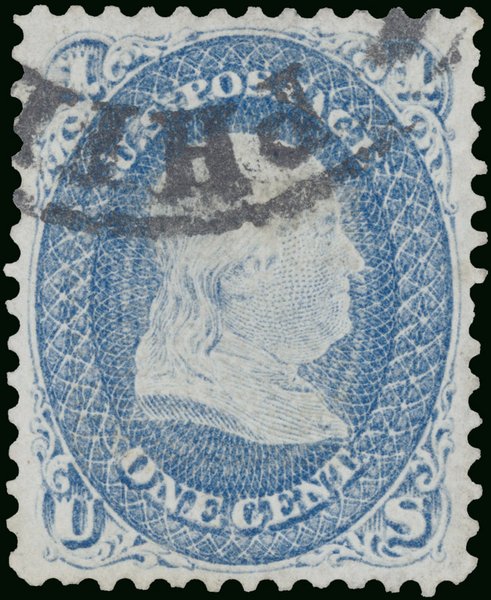
1c Benjamin Franklin Z Grill, 1868. National Bank Note Company. Public domain, via Wikimedia Commons.

Free · iOS & Android
Think you have a 1c Benjamin Franklin Z Grill?
Photograph it with StampID to check the type, condition and current value range in seconds — then use this page to verify the details.
How to identify a 1c Z Grill
The stamp itself is the familiar 1c blue Benjamin Franklin of the 1861 series: Franklin's right-facing profile, modelled on a bust by Jean-Jacques Caffieri, sits in an ornate oval with U.S. POSTAGE above and ONE CENT below. It is line-engraved by the National Bank Note Company and perforated 12. Millions of stamps share this exact front — nothing on the face reveals the rarity.
What matters is the back. A grill is a small embossed pattern of pyramid-shaped points pressed into the stamp to break the paper fibres, so that cancellation ink soaked in and could not be washed off for reuse. Grill types are classified by letters according to their size and the orientation of the ridges on the points. The Z grill shows horizontal ridges across the tips of its points, whereas the common E and F grills show vertical ridges. The Z grill area measures roughly 11 by 14 millimetres.
Be realistic before getting excited: the overwhelming majority of grilled 1c Franklins are E or F grills, and many 1c Franklins have no grill at all. Both of those are collectable but inexpensive. A genuine 1c Z Grill claim would need to survive expert examination — the two known copies are fully documented, so a third discovery would be a sensation requiring certification by a recognised expertising body such as the Philatelic Foundation or PSE.
History
In the late 1860s the US Post Office was losing money to people who washed cancellations off used stamps and reused them. Charles F. Steel patented the grilling process as a countermeasure, and from 1867 to 1871 most US stamps were grilled. The presses and grill rollers were modified repeatedly, producing the alphabet of grill types — A, B, C, D, E, F and Z — that collectors study today.
The Z grill was used only briefly, in early 1868, before being superseded by other grill sizes. On most denominations it went unnoticed for decades: the Z pattern on the 1c was only properly recognised in the early twentieth century, when specialists led by William L. Stevenson classified the grill types and assigned the letters.
One of the two known 1c Z Grills belongs to the New York Public Library as part of the Benjamin K. Miller collection, donated in 1925, and can never be sold. The other copy is the only one a private collector can own. It sold for 935,000 USD at auction in 1998, was famously traded in 2005 for a plate block of Inverted Jennys in a swap valued at about 3 million USD, and brought over 4 million USD when the William H. Gross collection was sold in 2024 — a record for a US stamp.
Rarity and varieties
With just two recorded examples, the 1c Z Grill shares the title of rarest US stamp with the 15c Lincoln Z Grill, of which two copies are also known. The 10c Z Grill is a major rarity as well, with only a handful recorded, while the 12c Z Grill is rare but obtainable. The 1c retains its special status because only one example can ever appear on the market.
The lookalikes are where collectors must be careful. The ungrilled 1861 1c blue is a common stamp, and the 1c with E grill or F grill is a routine catalogue item worth modest sums. Grills can also be faked by embossing a genuine ungrilled stamp, which is why provenance and expert certificates decide everything at this level.
If you have a grilled 1c Franklin, photograph the back in raking light, measure the grill, and examine the ridge direction on the points under magnification. Horizontal ridges would justify submitting the stamp for expert certification — but be aware that every previous 'third Z Grill' claim has failed examination.
Estimated value
As a broad, hedged estimate only: a genuine 1c Z Grill is a multi-million-dollar stamp — the privately owned copy sold for over 4 million USD in 2024. But this applies to exactly one stamp in private hands. The 1c Franklins people actually find in albums are almost never Z Grills: an ungrilled 1861 1c blue is often worth roughly 10 to 60 USD used, and E or F grill examples typically trade in the tens to low hundreds of dollars depending on condition. These are rough guides, not catalogue values, and condition, faults and certification dominate real prices.
Free · iOS & Android
Identify your own stamps in seconds
Frequently Asked Questions
How many 1c Z Grill stamps exist?
Only two examples are known. One is permanently held by the New York Public Library in the Benjamin K. Miller collection; the other is the sole copy in private hands and has set price records every time it has changed owners.
How much is a 1c Z Grill worth?
The privately owned example sold for 935,000 USD in 1998, was valued at about 3 million USD in a 2005 trade for an Inverted Jenny plate block, and realised over 4 million USD at the Gross collection sale in 2024. Those figures apply only to the certified rarity itself — an ordinary 1c Franklin is typically worth tens of dollars, not millions.
How do I know if my 1c Franklin is a Z Grill?
Turn the stamp over and look for a grill — an embossed waffle-like pattern of small points. If there is one, examine the tips of the points under magnification: the Z grill shows horizontal ridges, while the common E and F grills show vertical ridges. Since only two Z Grills are recorded, any candidate must be submitted to a recognised expertising service before believing it.
What is a grill on a US stamp?
A grill is a pattern of tiny pyramid points embossed into stamps from 1867 to 1871 to break the paper fibres so cancellation ink soaked in deeply. This made it nearly impossible to wash a stamp clean and reuse it. Grill types are lettered A through F plus Z, based on the grill's size and the ridge orientation on the points.
Why is it called the Z Grill?
When specialist William L. Stevenson classified the US grills in the early 1900s, he assigned letters to each type. The pattern with horizontal ridges on the points did not fit the established A-to-F sequence, so it received the letter Z. The name refers purely to this classification, not to anything visible in the design.