How to Identify Spanish Stamps: From Isabel II (1850) to the Euro
Spain has issued stamps since 1 January 1850, and the country's turbulent nineteenth and twentieth centuries left their marks on every one of them: three currencies, two republics, a Carlist rival government, a civil war fought partly with overprints, and a dictatorship followed by a restored monarchy. The good news for identification is that Spanish stamps almost always tell you who was in charge. This guide takes each era in turn, explains the Edifil catalog that Spanish collectors use, and shows you the inscriptions, currencies, cancels and watermarks that date a Spanish stamp.
Isabel II (1850-1868)
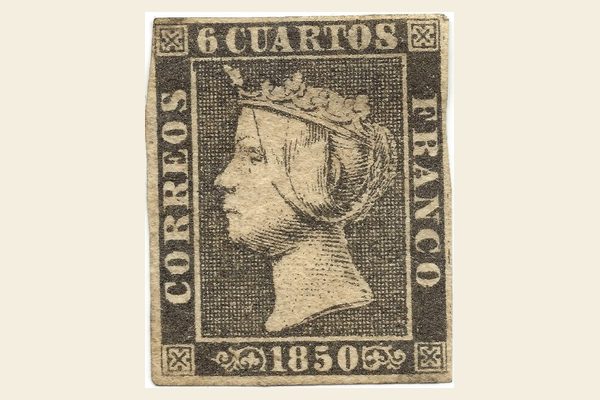
Spain's first stamp is the 6 cuartos black of 1850 (Edifil 1), a lithographed, imperforate profile of Queen Isabel II inscribed "CORREOS" and "FRANCO" with the value "6 CUARTOS" above and the year "1850" below. It was issued together with a 12 cuartos and three values in reales. The 6 cuartos is common used and is a good stamp to learn on; the reales values are scarce.
What makes the 1850s difficult is that Spain changed the design every year from 1850 to 1855 to prevent re-use of stamps whose cancels had been cleaned. Each year has its own frame and its own portrait, so the printed year on the earliest issues and the design details on the later ones are the first thing to check. Other points:
- Watermarks: the 1855 issue is on paper watermarked with loops (lazos) and the 1856 issue with crossed lines (líneas cruzadas). Most other Spanish stamps of the period, and almost all later ones, are unwatermarked.
- Cancels: Spanish classic cancels are a dating tool in themselves. The araña (spider) was used in 1850-1851, the parrilla (grid) in the 1850s, and the rueda de carreta (cartwheel) with a town number from 1858 to the mid-1860s.
- Perforation: Spanish stamps were imperforate until 1865, when the first perforated issue appeared. An imperforate Isabel II stamp is normal; a perforated one is 1865 or later.
- Currency: cuartos and reales until 1866, then escudos and milésimas (1866-1871), then pesetas and céntimos from 1872 until the euro.
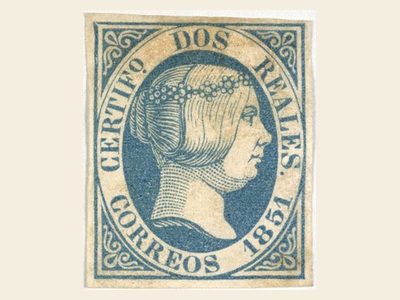
The period also contains Spain's most famous rarities. The 1851 2 reales colour error, printed in blue instead of red because a cliché of the 2 reales was accidentally placed in the plate of the 6 reales blue, is one of the great world rarities with only a handful of copies known. The 1853 Madrid local 3 cuartos (correo interior) and the 1865 issues with inverted frames (marco invertido) are the other key items collectors hunt for and forgers imitate.
Free · iOS & Android
Skip the catalogue: photograph the stamp
StampID reads country, era, catalogue listing and a value range from one photo of the front. Scan first, then use this guide to verify the details.
Revolution, Amadeo and the First Republic (1868-1874)
The Glorious Revolution of September 1868 deposed Isabel II, and the new government immediately overprinted the existing stamps with "HABILITADO POR LA NACION" (authorised by the nation). Those overprints, in several types and many forged, date a stamp precisely to late 1868 and 1869. They were followed by:
- 1870 Provisional Government: the allegorical figure of Spain (Alegoría de España, often called the Matrona), inscribed "COMUNICACIONES" rather than "CORREOS", an inscription that continued into the 1880s.
- 1872-1873 Amadeo I: the brief reign of the Italian-born king produced a single portrait series in pesetas and céntimos, the first Spanish stamps in the new currency.
- 1873-1874 First Republic: allegorical designs of the Republic with "COMUNICACIONES", including the 1874 "Justice" design.
- Carlist stamps (1873-1875): the rival Carlist government issued stamps with the portrait of the pretender Carlos VII for the Basque provinces, Navarre, Catalonia and Valencia. They are genuine postal issues and are listed by Edifil.
- War tax stamps (impuesto de guerra, 1874-1879): a compulsory extra stamp on all mail during the Carlist war. They are often found alongside regular postage on covers of the period and are cataloged separately.
Alfonso XII (1875-1885)
The Restoration brought Alfonso XII to the throne, and his portrait appears on the definitives of 1875-1882 in several engraved types that Edifil separates by the frame and the position of the inscription. They remain inscribed "COMUNICACIONES" and denominated in pesetas and céntimos. Most are common used; mint copies of the higher values and the scarcer shades are worth checking.
Alfonso XIII: Five Portraits (1889-1931)
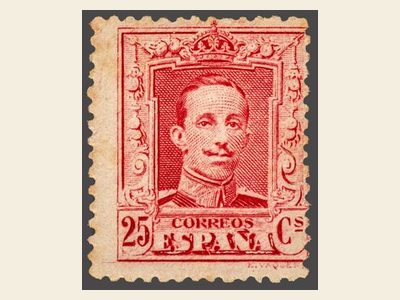
Alfonso XIII became king at birth in 1886 and reigned until 1931, so his definitives show him growing up. Spanish collectors name the five types by his appearance, and the nickname is the fastest way to date the stamp:
- "Pelón" (1889-1901): the baby king, nicknamed "baldy". Inscribed "CORREOS Y TELEGS." with the value in céntimos or pesetas.
- "Cadete" (1901-1905): the boy in cadet uniform. The first stamps inscribed "ESPAÑA" appear in this period.
- "Medallón" (1909-1922): the young king's profile in a medallion, a long-running series with many shades.
- "Vaquer" (1922-1930): the adult portrait engraved by Enrique Vaquer, shown here, printed in enormous quantities.
- "Vaquer de perfil" (1930-1931): the final profile type, used only briefly before the monarchy fell.
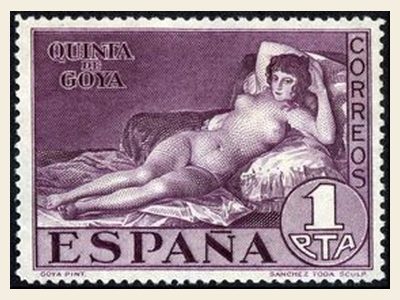
Spain issued its first commemorative in 1905 for the tercentenary of Don Quixote, and from the 1920s produced a long run of large sets: the 1920 UPU Congress in Madrid, the 1926 Red Cross, the 1928 Toledo and Santiago catacombs sets, the 1929 Seville and Barcelona exposition sets, and in 1930 the Goya centenary set with its Naked Maja, the first nude on a postage stamp, alongside the Columbus and Ibero-American Exposition sets. Many of these were printed in quantities aimed at the collector trade, so they are cheaper mint than their size suggests; genuine postally used copies are often the scarcer form.
Second Republic and Civil War (1931-1939)
The Republic proclaimed in April 1931 first overprinted Vaquer stamps "REPÚBLICA ESPAÑOLA" and then issued its own "Personajes" definitives, portraits of republican and liberal figures such as Pablo Iglesias, Blasco Ibáñez and Pi y Margall, together with a series showing Spanish monuments. All are inscribed "REPÚBLICA ESPAÑOLA".
The Civil War (1936-1939) split the postal system in two:
- Republican zone: continued the Republic's issues and added war-themed stamps, including sets for the defence of Madrid and the International Brigades.
- Nationalist zone: issued its own definitives, first the "Isabel la Católica" and "El Cid" designs of 1937-1938 inscribed "ESPAÑA" and "CORREOS", then the Burgos-era commemoratives. In the war's first months, towns under Nationalist control overprinted existing stamps with patriotic slogans ("Viva España", "Arriba España", "Saludo a Franco"). These local overprints number in the hundreds of types and are the most forged area of Spanish philately.
- Charity and local labels: both sides produced beneficencia (charity) stamps and thousands of local "pro" labels. Most are not postage stamps and are worth little unless genuinely used on cover.
The Franco Era (1939-1975)
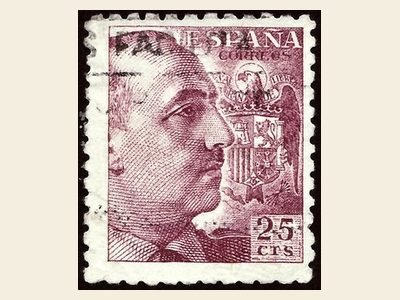
Definitives of the dictatorship carry Franco's portrait in three main types: the 1939-1940 series by Sánchez Toda (shown here), the 1948-1954 profile series, and the small-format 1955-1956 series that stayed in use for two decades. All are inscribed "ESPAÑA" and "CORREOS" in pesetas and céntimos. Around them Spain issued a steady stream of thematic sets that dominate every Spanish accumulation: the annual painters' series from 1958 (Goya, Velázquez, Murillo, El Greco and others), the coats of arms of the provinces (1962-1966), the regional costumes (1967-1971), monasteries, castles and tourism sets. They are attractive, complete sets are easy to assemble, and they are worth very little individually because print runs were in the millions.
The same period saw parallel issues for the Spanish colonies and territories: Ifni, Spanish Sahara, Spanish Guinea, Fernando Poo and Río Muni, plus Cape Juby and Spanish Morocco earlier. They are inscribed with the territory's name and are cataloged in Edifil's colonial section.
Juan Carlos I, Felipe VI and the Euro (1975-Present)
After 1975 the definitives switched to King Juan Carlos I in successive portraits (1976 onward, including the long-running 1985-1990s numeral-style series), and to Felipe VI after 2014. The euro arrived in 2002, so 2001 stamps show dual peseta and euro values and everything from 2002 is in euros only. Since the 2000s Correos has issued self-adhesive stamps, rate-letter stamps (Tarifa A, B, C) and increasingly large commemorative programs. Almost nothing from this period is worth more than face value, though year books, errors and the engraved architecture and art series remain collected.
The Edifil Catalog
The standard reference is Edifil, whose annual Catálogo Unificado de Sellos de España assigns the numbers Spanish dealers and auctions use, quotes values in euros, and covers the mainland issues, the colonies, and specialized areas such as the Civil War local overprints and the postal forgeries. Edifil's numbering runs from Edifil 1, the 1850 6 cuartos, continuously to the present. Internationally you will also meet Yvert (widely used in France and for the colonies), Michel and Scott. Because Edifil and Yvert numbers differ for many issues, note both when cataloging anything valuable.
Identification Checklist
Read the Inscription, Then the Currency, Then the Head
- "CORREOS" and "FRANCO", cuartos or reales: Isabel II, 1850-1866.
- "HABILITADO POR LA NACION" overprint: 1868-1869.
- "COMUNICACIONES", allegory or Amadeo I / Alfonso XII portrait: 1870-1889.
- "CORREOS Y TELEGS." with a child portrait: Alfonso XIII "Pelón", 1889-1901.
- "ESPAÑA" with an Alfonso XIII portrait: 1901-1931; use the five portrait types to narrow the year.
- "REPÚBLICA ESPAÑOLA": 1931-1939.
- "ESPAÑA" / "CORREOS" with Franco: 1939-1975.
- Juan Carlos I or Felipe VI, pesetas: 1976-2001; euros: 2002 onward.
Watermarks are rarely decisive for Spain outside the 1855-1856 issues, and perforation gauge matters mainly for the 1865-1870s issues and for separating the 1930s-1950s sets from their imperforate collector varieties. Cancels, on the other hand, are central: the spider, grid and cartwheel cancels of the classic period, and the town-and-date cancels after 1870, tell you where and when a stamp was used and separate genuine postal use from later favour cancels.
What Are Spanish Stamps Worth?
| Era | Typical Items | Typical Value Range | What Drives Value |
|---|---|---|---|
| 1850-1868 | Isabel II issues | A few euros for a used 6 cuartos; hundreds to thousands for reales values and mint copies | Margins, cancel, genuineness, the rare colour errors |
| 1868-1889 | Habilitado overprints, Amadeo, Republic, Alfonso XII | A few euros to hundreds | Overprint type, high values, mint condition |
| 1889-1931 | Alfonso XIII definitives and 1920s sets | Cents for definitives; tens to hundreds for complete sets and high values | Complete sets, high values, genuine postal use |
| 1931-1939 | Republic, Civil War issues and local overprints | Cents to thousands | Certificates; genuine local overprints on cover |
| 1939-1975 | Franco definitives, thematic sets, colonies | Mostly cents; a few 1940s sets and colonial issues more | Complete sets, early Franco-era commemoratives |
| 1976-present | Juan Carlos, Felipe VI, euro issues | Face value | Year sets, varieties, errors |
Identify Any Spanish Stamp Instantly
Photograph a Spanish stamp and StampID's AI will identify the period, suggest the Edifil and Yvert numbers, and show its current market value, from the 1850 6 cuartos to the latest Correos issues.
Google Play App StoreFrequently Asked Questions
What was the first Spanish stamp?
Spain's first stamp is the 6 cuartos black of 1 January 1850 (Edifil 1), a lithographed, imperforate profile of Queen Isabel II inscribed "CORREOS" and "FRANCO" with the year 1850 at the foot. It was issued with a 12 cuartos and 5, 6 and 10 reales values. The 6 cuartos is common used; the reales values are scarce and valuable.
How much is an 1850 6 cuartos stamp worth?
A used 1850 6 cuartos with average margins is worth only a few euros because millions were printed; copies with four wide margins, clear spider cancels or the scarcer paper varieties fetch more, and mint copies with original gum sell for hundreds. The same issue's reales values, and the 1851 2 reales colour error, are in a completely different class and require expertization.
How do I date an Alfonso XIII stamp?
Look at the king's age. The "Pelón" baby portrait is 1889-1901, the "Cadete" boy in uniform is 1901-1905, the "Medallón" young profile is 1909-1922, the adult "Vaquer" portrait is 1922-1930, and the "Vaquer de perfil" is 1930-1931. Edifil lists each type with its values and shades, so once you have the type the exact number follows from the denomination and colour.
Are Spanish Civil War overprints valuable?
Genuine local patriotic overprints from the Nationalist zone of 1936-1937 can be worth from a few euros to thousands, especially on cover, but they are the most heavily forged area of Spanish philately and most loose examples offered without a certificate are forgeries or later fantasies. The charity and "pro" labels of both sides are generally not postage stamps and have little value.
Which catalog should I use for Spanish stamps?
Use Edifil, whose annual unified catalog of Spanish stamps provides the numbers used by Spanish dealers and auctions, values in euros, and specialized coverage of the colonies, the Civil War overprints and the postal forgeries. Yvert is the usual alternative in France and for the former colonies, while Michel and Scott are quoted by dealers in Germany and the United States.