How to Identify Danish Stamps: From the 1851 Rigsbank Skilling to Margrethe II
Denmark has issued stamps continuously since 1851, and Danish philately is one of the most orderly in Europe: a small number of long-lived designs, a currency change in 1875, and a national catalog, AFA, that every Danish collector and dealer quotes. That makes most Danish stamps easy to place once you know four things: the inscription, the currency, the watermark and the perforation. This guide covers each era from the Rigsbank Skilling issues to the Margrethe II definitives, explains the famous bicoloured "inverted frame" varieties and the century-old wavy-lines design, and shows what Danish stamps are actually worth.
The First Issues: Rigsbank Skilling (1851-1854)
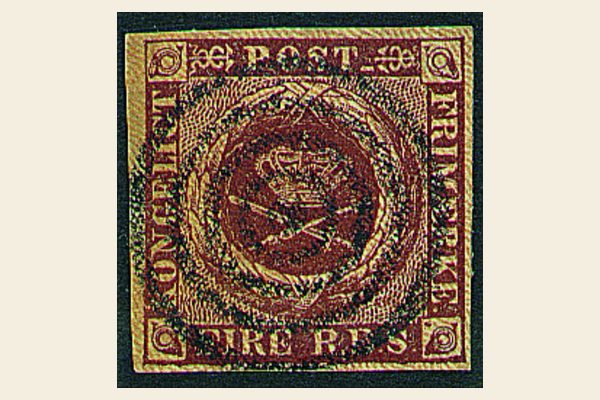
Denmark's first stamps appeared in 1851, the 2 Rigsbank Skilling (2 RBS) in April for the Copenhagen local rate and the 4 Rigsbank Skilling (4 RBS) in May for domestic letters. Both are imperforate, printed in a single colour and inscribed "KGL. POST FRM." (Kongeligt Post Frimærke, Royal Post Stamp). The design shows the royal insignia, a crown above a sceptre and sword, surrounded by an engine-turned frame, and the whole stamp is printed over a fine wavy-line background called a burelage, a security feature that is also the easiest way to spot most forgeries, which lack it or reproduce it crudely.
- 4 RBS brown (AFA 1): the workhorse stamp, printed in large quantities by two printers, first Ferslew and then Thiele. Used copies are common and affordable; value depends almost entirely on the width of the margins, since the stamps were cut apart with scissors.
- 2 RBS blue (AFA 2): the key Danish classic. The first printing by Ferslew is scarce and sells for thousands; the later Thiele printing is more available but still expensive. The two printings are told apart by the details of the burelage and the plate characteristics that AFA illustrates.
- Watermark: both stamps are on paper watermarked with a crown, one of the first watermark types AFA lists.
- Reprints: official reprints of the 1851 stamps were made later for exhibitions. They are on different, unwatermarked paper and are worth a small fraction of originals, so check the watermark before paying for a "mint 1851".
The 1854-1858 skilling issues (2, 4, 8 and 16 skilling) keep the crown-sceptre-sword design but drop "Rigsbank" from the currency, reflecting the new skilling. They were rouletted from 1863 and finally perforated in 1864, when a redesigned large oval issue inscribed "DANMARK" replaced them. That 1864 issue is the first Danish stamp to carry the country name.
Free · iOS & Android
Skip the catalogue: photograph the stamp
StampID reads country, era, catalogue listing and a value range from one photo of the front. Scan first, then use this guide to verify the details.
The Bicoloured Numeral Issue (1870-1905)
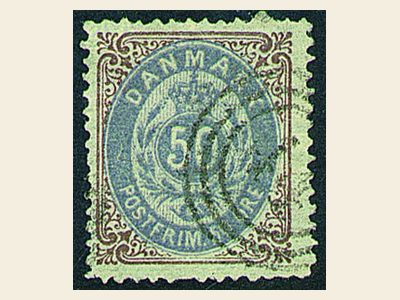
From 1870 Denmark used a single definitive design for 35 years: a large numeral in an oval, with the oval and the ornamental frame printed in two different colours in two separate passes. Collectors call it the bicoloured issue (tofarvede). Because the frame was printed separately, some sheets went through the press the wrong way round, producing inverted frames (omvendt ramme). The inverted-frame varieties are the most sought-after Danish stamps after the 1851 classics, and AFA lists them for each value and printing.
- Skilling values (1870-1874): 2, 3, 4, 8, 16 and 48 skilling. These were replaced when Denmark adopted the krone.
- Øre values (1875-1905): after the 1875 currency reform (100 øre = 1 krone), the same design reappeared with øre values from 3 øre to 100 øre. The 1875 50 øre shown here is a typical example.
- Perforation: early printings are perforated 14 x 13½; later printings are perforated 12¾. The perforation gauge is often the fastest way to separate an early printing from a late one.
- Watermark: a crown, in more than one size across the life of the issue.
- Shades and printings: the issue was printed for three decades, and AFA distinguishes dozens of printings by shade, frame type and paper. The rarer shades and inverted frames carry substantial premiums; the common ones are inexpensive.
Wavy Lines: The Longest-Lived Danish Design (1905-Present)
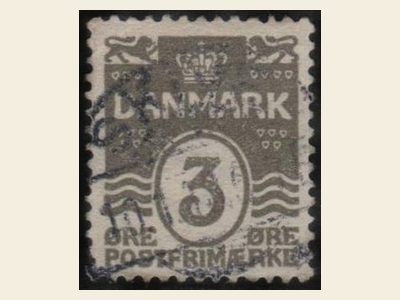
In 1905 Denmark introduced the wavy-lines numeral design (bølgelinjer): a numeral in an oval set against a field of wavy lines, with three small hearts below. It was intended for the low values and has been in use, with modifications, ever since, making it one of the longest-running stamp designs in the world. Because it has been printed for more than a century, a wavy-lines stamp is dated by its details rather than its design:
- Watermark: crown watermark on the 1905-1933 printings, multiple crosses on the 1933-1936 printings, crown again from 1937, and no watermark at all on issues from the early 1960s onward.
- Engraving: the design was re-engraved several times; AFA separates the types by the shape of the numeral, the wave pattern and the hearts.
- Paper: fluorescent paper appears from the 1960s for automatic sorting, and modern printings are on phosphor-coated paper.
- Currency: always øre, so the value alone will not date it. Very high øre values (50 øre and above in the wavy-lines design) belong to the late 20th century.
Royal Portraits and Commemoratives (1904-1972)
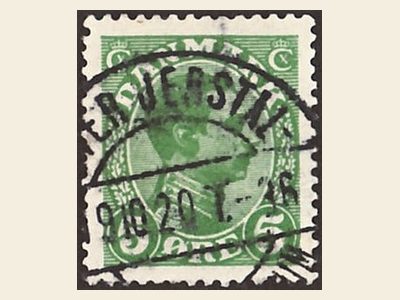
Higher values from 1904 carried the reigning monarch: Christian IX (1904-1906), Frederik VIII (1907-1912), Christian X (1913-1947, in several portrait types), and Frederik IX (1948-1972). The king's portrait dates a stamp to a reign, and the watermark and perforation then narrow it to a printing. The Christian X definitives in particular exist across three watermark types and several perforations, and the scarcer combinations are worth far more than the common ones.
Commemoratives were rare until the 1920s. The ones collectors look for:
- 1912 and 1915 5 kroner "General Post Office": the large-format high values showing the Copenhagen GPO, the most valuable Danish stamps of the 20th century.
- 1920 Reunion issue: marking the return of Northern Schleswig after the plebiscite. Related plebiscite stamps inscribed "SLESVIG" were issued for the voting zones and are collected with Danish stamps.
- 1924 postal tercentenary: a set of 16 stamps in four designs celebrating 300 years of the Danish post, sold in sheets that mixed the designs, so se-tenant blocks exist.
- 1925-1929 airmails: Denmark's first airmail set, showing an aircraft over Copenhagen. Complete mint sets are a key modern item and the high values are frequently faked with forged perforations.
- 1927-1940 Caravel definitives: a sailing ship design in two types, the earlier with a finer engraving. Watch the type when buying the higher values.
- 1930s-1940s commemoratives: Christian X's 60th birthday (1930), Hans Christian Andersen (1935), Thorvaldsen (1938) and the wartime issues, all inexpensive but widely collected.
Margrethe II and Modern Issues (1972-Present)
Queen Margrethe II's portrait definitives began in 1974 and continued, in successive portraits and printing methods, until her abdication in 2024, when Frederik X definitives followed. Modern Danish stamps are inscribed "DANMARK" with values in øre and kroner, are usually engraved or a combination of engraving and offset, and since the 2000s include self-adhesive booklets and rate-based issues. Very little from this period is worth more than face value, though complete year sets, booklets and the engraved art and architecture series remain popular.
Danish West Indies, Faroe, Greenland and Schleswig
Several related areas turn up in Danish collections and are worth separating out, because some of them are far more valuable than mainland Danish stamps:
- Danish West Indies (1855-1917): stamps in cents and later bit/francs for the Caribbean colony sold to the United States in 1917. Early issues and the 1902-1905 provisional surcharges are valuable, and the area has its own AFA section.
- Schleswig-Holstein (1850, 1864-1865): stamps for the duchies before and during the 1864 war, some inscribed in German. They are collected both as Danish and as German States material.
- Faroe Islands: Danish stamps were used until 1975, when the Faroes began their own issues. The 1919 and 1940-1941 provisionals, including a bisected 4 øre and locally surcharged stamps, are rare and heavily forged.
- Greenland: regular stamps from 1938, preceded by the 1905-1937 Pakke-Porto parcel-post stamps, which are scarce and valuable, especially used on piece.
- Iceland: stamps from 1873 under Danish rule, now a separate collecting area but often found alongside Danish material.
The AFA Catalog
The standard Danish reference is the AFA catalog (AFA Danmark Frimærkekatalog), published annually by Aarhus Frimærkehandel since the 1930s. AFA numbers are what Danish dealers, auction houses and collectors quote, values are in Danish kroner, and the catalog covers Denmark, the Danish West Indies, Faroe Islands, Greenland and Schleswig in one volume, with a specialized edition that lists printings, shades, watermark types and plate varieties. Outside Scandinavia you will also meet Facit (the Swedish catalog for all the Nordic countries), Michel and Scott, so it is worth recording both AFA and Michel numbers for anything valuable.
Identification Checklist
Four Questions That Date Any Danish Stamp
- Inscription: "KGL. POST FRM." is 1851-1863; "DANMARK" is 1864 onward.
- Currency: Rigsbank Skilling (RBS) is 1851-1853; skilling is 1854-1874; øre and kroner are 1875 onward.
- Watermark: crown types from 1851 into the 1930s, multiple crosses 1933-1936, crown again from 1937, unwatermarked from the early 1960s. Hold the stamp face down on a black tray; Danish crowns are usually visible without fluid.
- Perforation: imperforate to 1862, rouletted 1863, perforated 13 from 1864, 14 x 13½ and 12¾ on the bicoloured issue, and mostly 13 or 12¾ on 20th-century issues.
Cancellations matter too. From 1852 to the 1880s Danish post offices used numeral cancels (nummerstempler), a number inside concentric rings, with each number assigned to a town. Scarce numbers add a premium to otherwise common stamps, and a clear numeral cancel on a bicoloured stamp is worth checking against the AFA numeral list.
What Are Danish Stamps Worth?
| Era | Typical Items | Typical Value Range | What Drives Value |
|---|---|---|---|
| 1851-1854 | 2 RBS, 4 RBS, skilling issues | Tens of euros for a 4 RBS with margins; thousands for a Ferslew 2 RBS | Margins, printing, genuine burelage and watermark |
| 1864-1869 | Large oval issue | Tens to a few hundred euros | Centering, perforation condition |
| 1870-1905 | Bicoloured numerals | Under a euro for common shades; hundreds to thousands for inverted frames | Inverted frame, printing, shade, perforation |
| 1904-1947 | Royal portraits, GPO high values, 1925 airmails | Cents to hundreds of euros | Watermark type, mint condition, complete sets |
| 1948-present | Frederik IX, Margrethe II, modern commemoratives | Mostly face value | Year sets, booklets, varieties |
| Related areas | Danish West Indies, Greenland Pakke-Porto, Faroe provisionals | Tens to thousands of euros | Genuineness, certificates |
Identify Any Danish Stamp Instantly
Photograph a Danish stamp and StampID's AI will identify the issue, suggest the AFA and Michel numbers, and show its current market value, from the 1851 Rigsbank Skilling to modern Post Danmark issues.
Google Play App StoreFrequently Asked Questions
What was the first Danish stamp?
Denmark's first stamps were the 2 Rigsbank Skilling blue, issued in April 1851 for Copenhagen local mail, and the 4 Rigsbank Skilling brown, issued in May 1851 for domestic letters. Both are imperforate, inscribed "KGL. POST FRM." and show a crown, sceptre and sword over a wavy-line security background. The 4 RBS is common; the 2 RBS, especially the first Ferslew printing, is the key Danish rarity.
How much is a Denmark 4 RBS stamp worth?
A used 4 Rigsbank Skilling of 1851 is worth from tens of euros up to a few hundred, depending almost entirely on its margins, since the stamps were cut apart by hand and copies with four clear margins are the minority. Mint copies and copies with scarce numeral cancels sell for more, while later official reprints on unwatermarked paper are worth only a small fraction of an original.
What is an "inverted frame" on a Danish stamp?
The bicoloured Danish definitives of 1870-1905 were printed in two passes, the oval with the numeral in one colour and the ornamental frame in another. When a sheet went through the second pass rotated, the frame ended up upside down relative to the oval. These inverted frames (omvendt ramme) are genuine printing varieties, are listed by AFA for each value and printing, and are among the most valuable Danish stamps.
How do I date a Danish wavy-lines stamp?
The wavy-lines numeral design has been used since 1905, so you date it by the watermark (crown to 1933, crosses 1933-1936, crown from 1937, none from the early 1960s), the engraving type, the perforation, and whether the paper is fluorescent, which points to the 1960s or later. The AFA catalog illustrates each type.
Which catalog should I use for Danish stamps?
Use AFA (AFA Danmark Frimærkekatalog), the standard Danish catalog whose numbers are quoted by every Danish dealer and auction, with values in kroner and coverage of Denmark, the Danish West Indies, Faroe Islands, Greenland and Schleswig. Facit covers all the Nordic countries and is widely used in Scandinavia, while Michel and Scott are what dealers elsewhere in Europe and in the United States quote.