How to Identify Polish Stamps: From Poland No. 1 (1860) to Today
Polish stamps are unusually easy to date once you know the story behind them, because the country's postal history follows its political history so closely. Poland issued exactly one stamp before 1918, spent 123 years partitioned between Russia, Prussia and Austria, re-emerged in 1918 with a flurry of overprints in two currencies, survived the Second World War through occupation and exile issues, and then produced tens of thousands of designs under the People's Republic and the modern Third Republic. This guide walks through each era, explains the Fischer catalog that every Polish collector uses, and shows you the inscriptions, currencies and overprints that pin a stamp down to its period.
Poland No. 1: The 10 Kopeck Stamp of 1860
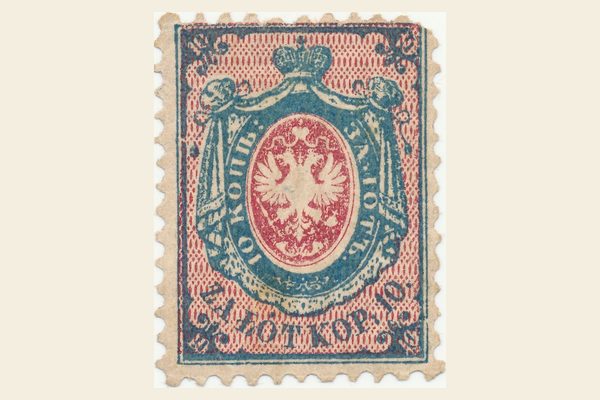
The only stamp issued for Poland before independence is the 10 kopeck of 1 January 1860, known simply as Poland No. 1 (Fischer 1). It was issued for the Kingdom of Poland, the Russian-controlled "Congress Poland", and it looks Russian for that reason: a double-headed eagle with the Polish eagle on its breast shield, a rose or carmine centre inside a blue frame, and the value written in Russian-style kopecks. The inscription reads "ZA ŁÓT KOP. 10" (10 kopecks per łut, the weight unit of the time).
Around three million copies were printed in Warsaw before the stamp was withdrawn on 1 April 1865, when Russian stamps became compulsory throughout the Kingdom. Identification points:
- Colours: blue frame with a rose, red or carmine centre. Shade varieties exist and are listed by Fischer, but the basic two-colour design is constant.
- Cancellations: most surviving copies are used, struck with a numeral inside concentric rings. "1" is Warsaw and by far the commonest; scarcer numerals for small towns can multiply the value several times, which is why Polish collectors describe a No. 1 by its cancel first.
- Mint copies are genuinely rare and sell for several times the price of a used example.
- Forgeries are abundant, including the well-known Fournier forgeries and modern reproductions. Genuine examples show fine, sharp frame lines and clean lettering; anything with soft, blurred detail or a suspiciously perfect cancel needs a certificate from a Polish Philatelic Union (PZF) expert.
Free · iOS & Android
Skip the catalogue: photograph the stamp
StampID reads country, era, catalogue listing and a value range from one photo of the front. Scan first, then use this guide to verify the details.
The Independence Overprints (1918-1919)
When Poland regained independence in November 1918 there was no time to design stamps, so the new postal authority overprinted whatever stock the occupying powers had left behind. Three overprint groups exist, and they are the most valuable and most forged area of Polish philately:
- Warsaw issue (November 1918): German "Gen.-Gouv. Warschau" Germania stamps and Warsaw city post stamps overprinted "Poczta Polska" with a Polish eagle. Values are in fenigi and marki.
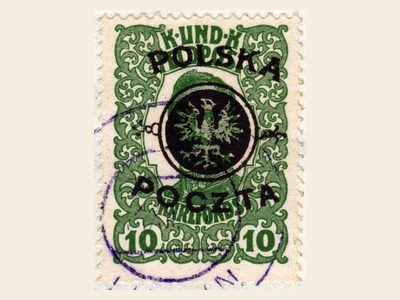
- Lublin issue (December 1918): Austro-Hungarian military post stamps (originally for Bosnia) overprinted "POCZTA POLSKA" in the former Austrian zone. Values in halerze and korony.
- Kraków issue (January 1919): Austrian definitives, newspaper and postage-due stamps overprinted "POCZTA POLSKA" in Kraków. The high values of this issue, especially the korona denominations, are among the most valuable Polish stamps of all, and the overprints have been forged in enormous quantities. Never buy a Kraków overprint without expertization.
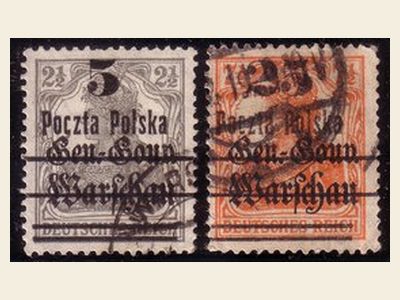
The reason for two currencies is that the former Russian and German partitions used the marka (100 fenigów) while the former Austrian partition kept the korona (100 halerzy) until the currencies were unified in 1920. A halerz or korona value therefore tells you a stamp was made for southern Poland, and a fenig or marka value points to the centre and west.
The first proper definitives followed in 1919: eagle designs for both currency zones, the Sejm (Constituent Assembly) commemoratives, and the so-called Paris issue, a set printed in France for the whole country and found both perforated and imperforate.
Second Republic (1920-1939)
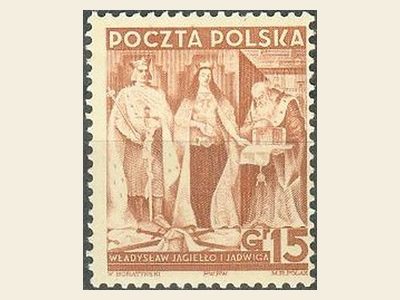
Stamps of the interwar Second Republic are inscribed "POCZTA POLSKA" and fall into two clear groups divided by the 1924 currency reform:
- Marka period (1920-1924): Poland had its own inflation, milder than Germany's but severe enough that face values climbed from a few marek into the millions by early 1924. Surcharged provisionals are common and cheap; specific surcharge errors are not.
- Złoty period (1924-1939): the złoty (100 groszy) replaced the marka at 1,800,000 marek to 1 złoty. From 1924 look for "ZŁ" and "GR" values and the eagle definitives, followed by portraits of Marshal Piłsudski and President Mościcki and a steady flow of commemoratives.
Key collecting areas of the period include the 1925 airmails, the 1928 Warsaw Philatelic Exhibition miniature sheet (Poland's first souvenir sheet), the 1936 Gordon Bennett balloon race sheet, the 1938 Stratosphere balloon sheet, and the long 1938 set for the 20th anniversary of independence, which portrays Polish rulers from Mieszko I onward. Miniature sheets (Fischer "Bl.") from these years are consistently the most valuable interwar items.
Do not confuse regular Polish stamps with the Port Gdańsk overprints (1925-1938). These are Polish stamps overprinted "PORT GDAŃSK" for the Polish post office inside the Free City of Danzig, and they are scarcer and more valuable than the unoverprinted stamps. The Free City of Danzig itself issued German-language stamps inscribed "DANZIG", which belong to German rather than Polish collecting.
Second World War (1939-1945)
Wartime Polish philately is spread across four very different issuers:
- General Government (Generalgouvernement, 1939-1945): the German occupation administration issued stamps inscribed "DEUTSCHES REICH / GENERALGOUVERNEMENT", at first by overprinting Polish and German stamps ("Deutsche Post Osten") and later with its own designs, including Hitler heads. They are cataloged by Michel as a German area but are found in almost every Polish collection.
- Government-in-Exile (London, 1941-1945): stamps showing destroyed Warsaw, Polish forces and Polish ships, valid on Polish naval and merchant vessels and among Polish units abroad. Genuine postally used covers are worth far more than the mint stamps.
- Prisoner-of-war camp posts (poczta obozowa): officers' camps at Woldenberg, Gross-Born, Murnau and Neubrandenburg ran internal posts with their own stamps. Genuine examples are rare and are the subject of persistent forgery.
- Lublin and the 1944-1945 liberation issues: the PKWN administration in Lublin issued the imperforate "Leaders" set (Traugutt, Kościuszko, Dąbrowski) in 1944, followed in 1945 by "Poczta Polska" overprints on leftover General Government stamps, including the Kraków overprints of early 1945.
People's Republic (1945-1989)
Between 1945 and 1989 Poland issued thousands of stamps, most of them inscribed simply "POLSKA" with "Poczta Polska" in the design, and most of them worth very little because printings ran into the millions. The exceptions are worth knowing:
- The 1950 "GROSZY" overprints: after the October 1950 currency reform, post offices across the country hand-stamped existing stock with the word "groszy". Thousands of overprint types exist, distinguished by office, typeface and colour, and it is a complete specialist field in its own right. Common types are cheap; rare offices are valuable and heavily forged.
- Imperforate versions (cięte): from the mid-1950s into the 1960s many sets were also issued imperforate in small quantities. The imperforate stamps of a set are usually worth many times the perforated (ząbkowane) ones. Check that the margins are wide enough to rule out a trimmed perforated stamp.
- Thematic sets of the 1960s-1980s: sport, space, art, animals and folk costumes, printed by the state security printer PWPW in photogravure and offset. Pleasant and collectable, but cheap unless in complete mint sets or on genuine commercial covers.
- Cancelled-to-order copies: many PRL stamps were sold pre-cancelled to the export trade. Clean, full-gum stamps with a neat corner cancel are CTO and worth less than genuinely used examples.
Third Republic (1990-Present)
Modern Polish stamps continue the "POLSKA" inscription. Two things date them quickly. The 1995 redenomination replaced 10,000 old złoty with 1 new złoty, so stamps of 1993-1994 carry values in thousands while stamps from 1995 show small złoty and groszy values again. And from the 2000s Poczta Polska moved to self-adhesive stamps and letter-denominated stamps ("A", "B", "C" for different rate classes) alongside conventional gummed issues. Pope John Paul II, Solidarity anniversaries and Polish painters are the most heavily collected modern themes.
The Fischer Catalog
The standard reference for Polish stamps is the Fischer catalog (Katalog polskich znaków pocztowych), published annually in Poland. Its numbers are written "Fi" (for example Fi 1 for Poland No. 1, Fi 312 for the 1938 stamp shown above), values are quoted in złoty, and it covers everything a Polish collector is likely to encounter: the 1918-1919 overprints, Port Gdańsk, the wartime camp posts, the groszy overprints, and the imperforate variants of PRL sets. Miniature sheets are numbered separately as "Bl." Michel (Osteuropa volume) and Scott also list Poland, and dealers outside Poland usually quote Michel numbers, so it helps to keep a concordance for the issues you own.
Identification Checklist
Read the Inscription and Currency First
- "ZA ŁÓT KOP. 10", double-headed eagle: Poland No. 1, 1860. Everything else with kopecks is a Russian stamp used in Poland.
- Overprinted "Poczta Polska" on a German or Austrian stamp: 1918-1919 independence issue, or the 1945 overprints on General Government stamps. Check the underlying stamp to tell them apart.
- Halerz / korona values: made for the former Austrian zone, 1918-1920.
- Fenig / marka values: 1918-1924, including the inflation surcharges.
- Złoty / groszy values with "POCZTA POLSKA": 1924-1939, or 1945 onward.
- "GROSZY" hand-stamped across an older value: 1950 currency-reform overprint.
- Values in thousands of złoty: 1990-1994, before redenomination.
- "A", "B" or "C" instead of a value, or self-adhesive: 2000s and later.
Watermarks play a much smaller role in Polish philately than in German or British collecting: the great majority of Polish stamps are unwatermarked. Paper, perforation gauge and printing method (typography for early issues, photogravure and offset for PRL and modern stamps) are the varieties that Fischer lists and that affect value.
What Are Polish Stamps Worth?
| Era | Typical Items | Typical Value Range | What Drives Value |
|---|---|---|---|
| 1860 | Poland No. 1 | Hundreds of euros used; thousands mint | Cancel type, margins, genuineness |
| 1918-1919 | Warsaw, Lublin and Kraków overprints | A few euros to several thousand | Denomination, expertization; Kraków high values are the keys |
| 1920-1939 | Definitives, commemoratives, miniature sheets, Port Gdańsk | Cents for singles; tens to hundreds for sheets and Port Gdańsk sets | Miniature sheets, mint condition, complete sets |
| 1939-1945 | Exile issues, camp posts, 1944 Lublin set | A few euros to thousands | Genuine postal use, certificates |
| 1945-1989 | PRL sets, groszy overprints, imperforates | Cents for most; imperforates and rare groszy types much more | Imperforate status, overprint type, genuine use |
| 1990-present | Modern commemoratives and definitives | Face value or less | Complete year sets, errors |
A useful rule: the value of a Polish collection is almost always concentrated in a handful of items from 1860, 1918-1919, the interwar miniature sheets, Port Gdańsk and the wartime issues. A box of PRL stamps, however large, is usually worth little more than its postage value unless imperforate variants are present.
Identify Any Polish Stamp Instantly
Photograph a Polish stamp and StampID's AI will identify the era, suggest the Fischer and Michel numbers, and show you the current market value, from Poland No. 1 to the latest Poczta Polska issues.
Google Play App StoreFrequently Asked Questions
What was the first Polish stamp?
The first Polish stamp is the 10 kopeck of 1 January 1860, known as Poland No. 1 (Fischer 1). It was issued for the Russian-controlled Kingdom of Poland, shows a double-headed eagle with the Polish eagle on its breast, and was withdrawn in 1865 when Russian stamps became compulsory. No other Polish stamp was issued until independence in 1918.
How much is Poland No. 1 worth?
A genuine used Poland No. 1 with the common Warsaw "1" cancel is worth several hundred euros; scarce town cancels raise the price considerably, and mint copies sell for several thousand euros. Because forgeries are so common, the price depends heavily on a certificate from a PZF expert, and uncertified copies offered cheaply are almost always forgeries.
How do I tell Polish stamps from Russian, German or Austrian stamps used in Poland?
Between 1865 and 1918 Polish territory used the stamps of the partitioning powers, so a Russian, German or Austrian stamp with a Polish town cancel is a stamp used in Poland, not a Polish stamp. Genuine Polish issues carry "POCZTA POLSKA" or "POLSKA", the 1860 stamp carries "ZA ŁÓT KOP. 10", and the 1918-1919 issues are foreign stamps with a "Poczta Polska" overprint. The overprint, not the base stamp, makes them Polish.
Are Polish stamps from the communist period valuable?
Most PRL stamps (1945-1989) are worth only a few cents each because they were printed in the millions and many were sold cancelled-to-order. The valuable exceptions are imperforate versions of 1950s-1960s sets, rare 1950 "groszy" overprint types, and complete mint sets from the late 1940s. Sort a PRL accumulation by looking for stamps with no perforations and wide margins first.
Which catalog should I use for Polish stamps?
Use the Fischer catalog (Katalog polskich znaków pocztowych), the standard Polish reference with "Fi" numbers and złoty values, which lists the overprints, Port Gdańsk, wartime and imperforate varieties that international catalogs skip. Michel (Osteuropa) and Scott also cover Poland and are what most non-Polish dealers quote, so it helps to note both numbers for valuable items.